|
|
| Initially was recorded as disturbed saucer grave, but identified as pyre by SIR.
Found by gardener washing out of scarp during the winter rains. The location is just south of an east-west road; there ... 1962 ... The location is just south of an east-west road; there were traces of houses in this general area. |
West Road and Drain. (Road, drain and closely related cuts.) Packing in line of ancient road running along the northwest shoulder of the Areopagus. Includes excavation of 1957 titled "Road Area to North", ... Late 6th c. B.C. - Roman ... West Road and Drain. ... Includes excavation of 1957 titled "Road Area to North", "North cut road area", "North cut, west of road", (not including "Roman Bath" or "area of A7" notations) ... Coins:
19 April 1939 #2
24 April 1939 #4-#9
25 May 1939 #2-#3
29 May 1939 #1-#3
30 May 1939 #16
31 May 1939 #1-#4
5 June 1939 #1
13 June 1939 #1-#2
16 June 1939 #1
17 June 1939 #1-#2
20 June 1939 #1-#3
21 June 1939 #15-#22
22 June 1939 #1-#6
23 June 1939 #1-#8
17 April 1957 #2-#3
30 April 1957 #2, #7-#8
7 May 1957 #2-#3
9 May 1957 #1-#3
10 May 1957 #1-#3
11 May 1957 #1-#7
13 May 1957 #1-#5
14 May 1957 #1-#20
15 May 1957 #8
16 May 1957 #1
20 May 1957 #6 (east of road against east face of road)
25 May 1957 #1-#4 (late drain in A9 ... around lead pipe)
29 May 1957 #2 (E-W drain next to South Wall of A2)
30 May 1957 #2 (East drain in road ca. |
Filling under North-South Road surface, apparently to raise the level of the road as thickness of fill varies depending on height of road. Fill sits on earliest, cobbled road layer. The road surface set ... Mid-6th c. B.C ... Filling under North-South Road surface, apparently to raise the level of the road as thickness of fill varies depending on height of road. Fill sits on earliest, cobbled road layer. The road surface set upon this fill consists of cobbling to the west and a hard packed surface to the east. |
Outside the market square, near the southeast corner, on the south edge of the east-west road, where it passes to the south of the Mint.
There is no doubt that the pottery from the well is "stratified" ... Early 1st to 6th c. and of 8th c. A.D ... Outside the market square, near the southeast corner, on the south edge of the east-west road, where it passes to the south of the Mint.
|
Gravel above early road some 5m wide. The bedrock was heavily scored by traffic, and the accumulation of gravel, ca. 0.30m, thick produced Middle Helladic Pottery. This early thoroughfare ran in a northwest-southeast ... Middle Helladic ... Gravel above early road some 5m wide. ... It may be noted in passing that the east to west thoroughfare which skirted the south side of the Agora has had a continuous history from the Middle Helladic period to the present. |
| Marcie Handler ... Fill within the drain from the basin on the west side of Roman Room B through Wall A.
After we removed the fill within the basin on the west side of Roman Room B (BZ XXVII p. 5325), we began excavating ... Late Roman ... Fill within the drain from the basin on the west side of Roman Room B through Wall A.
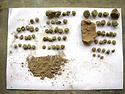
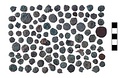
After we removed the fill within the basin on the west side of Roman Room B (BZ XXVII p. 5325), we began excavating in the cutting on the east face of a conglomerate block that is part of Wall A. ... The cutting is probably a drain that carried water from the basin through Wall A and onto the North-South Road. Seventy-eight coins were found in the fill, of varying sizes but all badly corroded. |
| Marcie Handler ... Located in the south section of Room E in the Byzantine Building east of the North-South Road. The uppermost 1.5 meters of well lining was built of well-coursed stones (some reused marble blocks) and tiles ... 12th c. A.D ... Located in the south section of Room E in the Byzantine Building east of the North-South Road. ... Under the terracotta lining, only the north and west sides of the lining were preserved, where it was constructed of rubble and tiles.
|
| Marcie Handler ... Continued from 2000 season, 10-12 July 2000; BZ XXIII p. 4472.
The hoard was originally excavated during the 2000 season (Lot BZ 1049, 5th-6th centuries AD), from a higher elevation through a gap in the ... 10-12 July 2000
21-22 July 2003 |
|
|