|
|
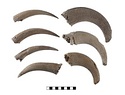
Thra (ΘΡΑ) Well (East of Stoa Room 2). Heavy dumped filling, including figured, black and plain wares, and also a quantity of animal bones, mostly skulls of oxen. On many of these the horns had been sawn ... Ca. 520-480 B.C ... Thra (ΘΡΑ) Well (East of Stoa Room 2). Heavy dumped filling, including figured, black and plain wares, and also a quantity of animal bones, mostly skulls of oxen. On many of these the horns had been sawn off sharply near the base; the freshness of the sawn surface suggested that this had been done at the time of slaughtering rather than while the animal was still alive.
|
| Marcie Handler ... Located in the south section of Room E in the Byzantine Building east of the North-South Road. The uppermost 1.5 meters of well lining was built of well-coursed stones (some reused marble blocks) and tiles ... 12th c. A.D ... Excavations | 2001 | Trenches | Handler | Byzantine Building East of the North-South Road | Room E | Well J 2:18 ... Excavations | 2003 | Trenches | Handler | Byzantine Building East of the North-South Road | Room E | Well J 2:18 |
Well East of Stoa Room 6 (well with Siana Cup); scanty dumped filling.
No water. Well never used. Estimated Grid ... 600-550 B.C. |
Geometric Well East of Stoa Room 4. Diameter 1.10m; narrows at bottom. Rough-cut, with irregular footholds north-south and east-west sides. Little water; no use fill Estimated Grid ... 725-700 B.C. |
| Marcie Handler ... Continued from 2000 season, 10-12 July 2000; BZ XXIII p. 4472.
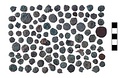
The hoard was originally excavated during the 2000 season (Lot BZ 1049, 5th-6th centuries AD), from a higher elevation through a gap in the ... 10-12 July 2000
21-22 July 2003 ... Excavations | 2003 | Trenches | Handler | Byzantine Building East of the North-South Road | Room F | Coin Hoard J 1:2 | Fill |
| Marcie Handler ... Fill within the drain from the basin on the west side of Roman Room B through Wall A.
After we removed the fill within the basin on the west side of Roman Room B (BZ XXVII p. 5325), we began excavating ... Late Roman ... Excavations | 2003 | Trenches | Handler | Roman Building East of the North-South Road | Roman Room B | Coin Hoard J 2:21 |
| David Scahill ... Below packed clay floors in Room 2 of Classical Building II; bordered on east and south sides by polygonal cross wall and back wall extension for Classical Building. Late Roman wall and drain installation ... LHIII A:1 ... Below packed clay floors in Room 2 of Classical Building II; bordered on east and south sides by polygonal cross wall and back wall extension for Classical Building. ... Upper part of tomb cut away by leveling for floors of Classical Building. Loose fill of stones and earth with large number of Geometric sherds ranging from Protogeometric to late Geometric in date, from top of cutting extending down into layer of tomb contents. |
| Mycenaean Grave F.
It seemed to be more as a collection of bones and offerings, presumably swept aside to make room for later burials; they are east of and slightly higher than children's graves A and ... Myc. IIIA |
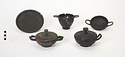
| Pyre against north face of polygonal wall, Room 2, Classical Building II. No floor preserved above, but the pyre is below floor level 51.820masl, preserved just to the east and above patchy floor with ... Ca. 275-260 B.C ... Pyre against north face of polygonal wall, Room 2, Classical Building II. No floor preserved above, but the pyre is below floor level 51.820masl, preserved just to the east and above patchy floor with plaster at ca. 51.70 ... Includes 2 chytra, small saucer and rilled rim plates. |
Early Roman pit at P/3-6/6,7
Layer 4a in Room 6 of Greek House δ, area P/2,3-6/6,8.
Pit in NW corner of Room 6 bounded by walls of Room to North and West, cut into preexisting layers to east, cutoff by ... 17 May 1971 |
| Mycenaean Chamber Tomb under north side of Temple of Ares, towards its west end.(1951).
The tomb had a hasty and unfinished appearance oddly at variance with its long history and the quality of the pottery ... 1st: Myc IIB-IIA:1-2, 2nd: Myc. IIIC:1 (1450-1200 B.C.) |
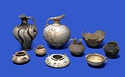
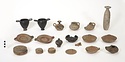
| James Artz Pirisino Daniele Kylindreas Miltiades ... Excavation in Room 3 of ΒΘ West revealed 5 ceramic vessels in a row against the eastern face of Wall 12. 3 complete vessels (ΒΘ 122, 124, and 125) were catalogued, along with the base of a plain glazed ... 9th-11th c. A.D ... Excavation in Room 3 of ΒΘ West revealed 5 ceramic vessels in a row against the eastern face of Wall 12. 3 complete vessels (ΒΘ 122, 124, and 125) were catalogued, along with the base of a plain glazed flat-bottomed basin (ΒΘ 121). ... Excavation of Room 3 progressed over the course of the 2012 season, and was only stopped due to the end of season. ... See also ΒΘ Lots 139, 239 and 240 for possible joining sherds from previous excavation seasons.
2013 Addendum:
During the 2013 field season, excavation in Room 3 of ΒΘ West revealed 3 ceramic vessels at approximately the same elevation as the pots assigned to Deposit K 3:2 during the 2012 season. |
| Disturbed pyre dispersed in fill of Room 5, House D.
Pyre pots in very fragmentary condition were noticed by Barbara Tsakirgis in later analysis of pottery that had been excavated in 1938; no mention of ... 14 June 1938 |
Ash and Carbon Dump in Corridor directly behind Room C of Brick Building.
This material comprises what appears to have been a household dump associated with the period of use of the Brick Building, but ... To mid-2nd century ... Ash and Carbon Dump in Corridor directly behind Room C of Brick Building.
This material comprises what appears to have been a household dump associated with the period of use of the Brick Building, but probably dating just prior to its abandonment, since it included a a few roof tiles, presumably from the demolition of the Brick Building. The dump is located in the corridor between the back wall of the Brick Building and the retaining wall behind the building , immediately east of the line of the dividing wall between Rooms B and C [City Grid: Q/18-11/2] |
| Pyre in House C, Room 8 (RSY=Pyre 6).
Near east corner of room 8. Artifacts, burnt bone, burnt sticks, and large cinders in a shallow pit dug into surface of layer 3, and covered by layer 2. Some cinders ... 350-325 B.C.-end of 4th c. B.C ... Near east corner of room 8. Artifacts, burnt bone, burnt sticks, and large cinders in a shallow pit dug into surface of layer 3, and covered by layer 2. Some cinders from pyre in layer 2. These strata lay above the first floor of the third phase of the house. |
Debris, Room I of Street Stoa (R/16,20-13/10,15).
The lack of any rooftiles and similar architectural debris suggests that perhaps it was brought in from an adjacent area and dumped in the room. This is ... 6-8 May 1975 ... Debris, Room I of Street Stoa (R/16,20-13/10,15).
The lack of any rooftiles and similar architectural debris suggests that perhaps it was brought in from an adjacent area and dumped in the room. ... Another possible explanation is that the room was quarried for clean bedrock fill (perhaps by the builders of the Late Roman Building to the east), with the resultant filling of the room with destruction debris from Alaric's attack on the city, perhaps taken from the same area where the bedrock fill was to be used (cf. east, in Room 1 and the south half of Room 2. |
| Well in Room 6 of Street Stoa U/2,U/3-13/15.
Associated with the building lying under the Roman Street Stoa. Its fills divided into 5 separate layers, with the bulk of finds belonging to Layer 1, the ... 14 June-21 August 1973 ... Well in Room 6 of Street Stoa U/2,U/3-13/15.
... At its bottom it was round with a diameter of 1.00m. hand-holes roughly 0.42m apart, were noted on its east and west sides.
... An additional 212 tins were thrown; these included 46 tins of lekanis fragments, 50 tins of roof tiles, 87 tins of amphora fragments, 7 tins of mortar fragments, 2 tins of lopas fragments, 4 tins of eschara fragments, 4 tins of basins and tubs in fragments, and 11 tins of assorted coarse ware fragments. |
Filling in the footing trench of the late Roman Fortification.
Includes Layer 1 and Layer 2 of Library Colonnade opposite Room 2. "Note: both these layers are fill thrown into V.W. footing trench." (nb.p ... End 3rd. c. A.D ... Filling in the footing trench of the late Roman Fortification.
Includes Layer 1 and Layer 2 of Library Colonnade opposite Room 2. ... Coins:
23 March 1933 #16-#19
24 March 1933 #4-#5(below layer of bricks 1.00m. east of
Ven. wall 24/ΙΗ)
26 April 1933 #1-#5
1 May 1933 #5-#8 (yellow fill against Venetian wall 36/ΙΑ)
27 May 1939 #6-#7
13 June 1939 #3 |
| Pyre in House T (= House D), Room 2 (5th c.) and fill east of pyre.
Earlier than the other pyres of this house.
Pottery, slivers of burnt bone, and heavy deposit of carbonized material and cinders in ... Ca. 420-410 B.C ... Pyre in House T (= House D), Room 2 (5th c.) and fill east of pyre.
Earlier than the other pyres of this house.
Pottery, slivers of burnt bone, and heavy deposit of carbonized material and cinders in pit in floor sequence, with some pottery and burning found outside pit. ... It was probably deposited in the course of the first phase of the house, when the floor was renewed. |
| Pyre in House D, Room 4 (RSY=Pyre 4) in the industrial area west of the Areopagus.
Notebook refers to House N.
Pottery belongs late in third quarter of the 4th. c. BC. Pyre burned near beginning of last ... 350-300 B.C ... Pyre in House D, Room 4 (RSY=Pyre 4) in the industrial area west of the Areopagus.
... Artifacts, burnt bone, and cinders in round pit. The east side of the pit was destroyed by a Roman pit, but the deposit appears to be largely intact. The pyre pit was dug through layer 1 and into layer 2, both of which overlay the foundation of the wall between rooms 3 and 4. |
Michael Laughy ... Debris pit, located in Room 2 of ΒΘ East. Pit measures ca. 2.30 by 1.70m., and nearly a meter deep. The pottery from the pit dates ca. 10th-12th c. A.D. The fill of the pit consisted of soft, black charcoal ... 10th-12th c. A.D ... Debris pit, located in Room 2 of ΒΘ East. ... The fill of the pit consisted of soft, black charcoal and earth, within which we recovered ca. 800 goat horns, representing over 400 unique adult goats. The tip of every well preserved horn has been cut to facilitate husbandry. |
|
|