|
|
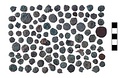
East Building, pit in footing trench. Coins:
20 April 1959 #5-#6 ... 2nd c. A.D ... Pit in Footing Trench, East Building |
Unstratified pit below east part of Odeion Cavea (Trench K).
Brann Well or Pit O. Estimated Grid ... To ca. 725 B.C ... Unstratified pit below east part of Odeion Cavea (Trench K).
|
Pyre at N/9-6/1,2, layer 11a.
No formal limits, apparent limits about 0.30-0.40m N-S; 0.50-0.60 E-W (cut into by trench at east) ... Late 575-550 B.C ... No formal limits, apparent limits about 0.30-0.40m N-S; 0.50-0.60 E-W (cut into by trench at east). |
| (Grave XXIX: EG).
Rectangular cutting with remains of charred human bones and both burned and unburned pottery fragments. Bones discarded.
Rectangular trench cut through earth into bedrock, oriented east-west ... Middle Geometric I ... Rectangular trench cut through earth into bedrock, oriented east-west and measuring 1.10m long, 0.70m wide and under 0.30m deep. ... According to the excavator, cremated skull fragments were encountered at the east end of the trench, leg bones near the west end. Burned and unburned sherds representing at least nine vessels were found throughout the trench. The inclusion of the fragmentary cooking pot or chytra led Smithson to suggest that the deceased was a woman. |
| Rodney S. Young ... Grave 7 in notebook (E.L. Smithson: Grave XXI: PG). Bones discarded. Disturbed and damaged cremation (originally trench-and-hole), the east end cut away, probably contained the burial urn.
JP
It consisted ... Late Protogeometric ... Disturbed and damaged cremation (originally trench-and-hole), the east end cut away, probably contained the burial urn.
JP
It consisted of a rectangular trench cut through hard-packed fill and slightly into bedrock to a depth of 0.48m. the trench oriented east-west, had a preserved length of 0.70m and a width of 0.60m. ... The preserved east end, built up from redeposited green schist bedrock streaked with reddened earth, may have been a barrier between the destroyed urn-hole and the pyre trench, constructed after the fire had subsided. |
Exploratory excavation trench between east front of Hellenistic Metroon and Great Drain.
Cf. Hesperia Suppl. 4 (1941), p. 106.
Cf. also Metroon Drain Cut I 9:1 and F-G 12:1 and H 12:9 ... 8th-6th c. B.C ... Exploratory excavation trench between east front of Hellenistic Metroon and Great Drain.
|
| Rodney S. Young ... Grave 2 in notebook (E.L. Smithson: Grave XV: PG). Urn cremation (trench-and-hole), adult female.
JP
It consists of a roughly rectangular pit or trench cut into bedrock to a depth of 0.35m., measuring ... Late Protogeometric ... Urn cremation (trench-and-hole), adult female.
JP
It consists of a roughly rectangular pit or trench cut into bedrock to a depth of 0.35m., measuring 1.12m long and 0.67m wide. The trench was oriented east-west, urn-hole to the east. |
Mycenaean burial, disturbed (Piers 12-13 east). Plan unclear.
Bones discarded.
It was found in the trench for the east stylobate of the Square Building. It was so badly disturbed by the Classical builders ... Myc. IIIA:2 ... Mycenaean burial, disturbed (Piers 12-13 east). Plan unclear.
... It was found in the trench for the east stylobate of the Square Building. |
Material from trenches:
a) 1.00-7.00m. from East End of Stoa.
b) 18.40-21.40m. from East End of Stoa.
c) 46.60-48-60m. from East End of Stoa.
d) 51.00-53.00m. from East End of Stoa.
e) 79.00-81.00m. from ... 2nd c. B.C ... Material from trenches:
a) 1.00-7.00m. from East End of Stoa.
b) 18.40-21.40m. from East End of Stoa.
c) 46.60-48-60m. from East End of Stoa.
d) 51.00-53.00m. from East End of Stoa.
e) 79.00-81.00m. from East End of Stoa.
Includes drain trench in front of back wall of Stoa (some disturbed, some undisturbed fill), soft fill above stone drain, fill from within stone drain, channel behind stylobate. |
Two pebble floors of Roman date, broken into at the SE and north, covered a 6x5m trench in ΕΛ, bounded by the unexcavated east trench and a wall from Byzantine Building D (Wall A). Under these pebble floors ... 220 - 150 B.C ... Two pebble floors of Roman date, broken into at the SE and north, covered a 6x5m trench in ΕΛ, bounded by the unexcavated east trench and a wall from Byzantine Building D (Wall A). |
Channel J (in ΗΗ)
Cutting that probably originally held a drain. Packed with amphoras and other coarse pottery. It tapped the poros aqueduct wall just East of our explanatory trench at the East end of ... 1st c. B.C. - early 1st. A.D ... It tapped the poros aqueduct wall just East of our explanatory trench at the East end of ΗΗ. |
Filling in the footing trench of the late Roman Fortification.
Includes Layer 1 and Layer 2 of Library Colonnade opposite Room 2. "Note: both these layers are fill thrown into V.W. footing trench." (nb.p ... End 3rd. c. A.D ... Filling in the footing trench of the late Roman Fortification.
... "Note: both these layers are fill thrown into V.W. footing trench." (nb.p. 2314) ... Coins:
23 March 1933 #16-#19
24 March 1933 #4-#5(below layer of bricks 1.00m. east of
Ven. wall 24/ΙΗ)
26 April 1933 #1-#5
1 May 1933 #5-#8 (yellow fill against Venetian wall 36/ΙΑ)
27 May 1939 #6-#7
13 June 1939 #3 |
| Pyre in Horos Terrace Trench, East end, set into Strosis 5.
In room 1 (court), near north wall. Concentration in stratum, no pit discerned; described as a "little nest of pots" within layer V (Lot ΜΣ ... 350-325 B.C ... Pyre in Horos Terrace Trench, East end, set into Strosis 5.
|
| Homer A. Thompson ... Cremation burial (trench-and-hole) under S. edge of E-W Street, southern burial. In some records as Grave XLVI.
Neat trench, rectangular as preserved, but may have originally been square, cut partly through ... Early Geometric I ... Cremation burial (trench-and-hole) under S. edge of E-W Street, southern burial. ... The north side of the trench was destroyed by the a Turkish cess pit. As preserved, the trench measured ca. 1.05x 0.60m, and was presumably oriented east-west, but as the north side was destroyed it is possible that the trench extended toward the north and may, therefore, have had a north-south orientation. |
| Grave 1 in notebook (E.L. Smithson: Grave XXV: PG). No remains. Probable trench-and-hole.
JP
Roughly circular pit measuring 0.39m in diameter cut into bedrock to a depth of 0.72m. Pyre refuse-described ... Late PG/EG I ... Probable trench-and-hole.
JP
Roughly circular pit measuring 0.39m in diameter cut into bedrock to a depth of 0.72m. Pyre refuse-described as "ashes and cinders etc"- was encountered throughout the tomb pit, below, around and above the urn. although there is no specific mention of a trench, Young's description of the tomb suggests that a rectangular trench, with a maximum length of about 0.80m and a preserved width of ca. 0.60m, was cut through earth into bedrock. consequently, the tomb appears to be a classic example of an Athenian trench-and-hole, oriented east-west,with the urn-hole at the east. |
| Dorothy Burr Thompson ... Grave 2. Urn cremation (trench-and-hole). In some records as XXIII.
Variously labeled as grid 7/Δ, 7/Γ and 7/Γ-Δ.
Rectangular pyre trench cut through earth into bedrock, with only the lowest 0.04m surviving ... Transitional Late Protogeometric/Early Geometric I ... Urn cremation (trench-and-hole). In some records as XXIII.
... The exact orientation of the trench has not noted in the field, but it appears to have been roughly oriented east to west (or east-southeast to west-northwest). ... The urn-hole was located at the east end of the pyre trench; its diameter and depth were not recorded, but judging from the cover stones the pit probably measured just under 0.50m in diameter and was about 0.35m deep. |
7th c. well below east part of Odeion Cavea Trench K). Use filling negligible; dumped filling of the second half of the 7th c. B.C.
Brann Well H. Diameter 1.10m. Cut into bedrock. During excavation seepage ... 650-600 B.C ... 7th c. well below east part of Odeion Cavea Trench K). |
Mycenaean Tomb to E of Stoa Shop 19 (ΣΑ 2).
Found while digging just east of Stoa Shop XIX, when came upon some bones, Mycenaean sherds and a pot. As the excavation was enlarged the legs of two skeletons ... Myc. III A:2 (2nd half of 14th c.) ... Found while digging just east of Stoa Shop XIX, when came upon some bones, Mycenaean sherds and a pot. As the excavation was enlarged the legs of two skeletons were exposed in a trench about one meter wide, with the whole pot and the coil of lead wire found between two sets of legs. ... No sure limit to the tomb cold be fixed in any direction, although tunneling to the east the following year was done to a maximum penetration of 1.80m east of the Stoa Foundations. |
| Rodney S. Young ... Grave 3 in notebook (E.L. Smithson: Grave XIII: PG). Urn cremation (trench-and-hole), adult female.
JP
Rectangular trench, measuring approximately 1.10x0.45m, but which may have been larger, cut through ... Late Protogeometric ... Urn cremation (trench-and-hole), adult female.
JP
Rectangular trench, measuring approximately 1.10x0.45m, but which may have been larger, cut through earth and partly into bedrock. ... The fill of the trench was excavated in three layers: 1. |
Pit in Tholos Trench V (below Layer e).
In plan it would seem to have been oval, though its east end is c/../ by the south wall of the North Archaic Home. Its N-S width is 1.25m, its E-W length is 1.40m ... 7th-early 6th c. B.C ... Pit in Tholos Trench V (below Layer e).
In plan it would seem to have been oval, though its east end is c/../ by the south wall of the North Archaic Home. |
| C.G. Thomas ... Geometric grave. Bones discarded.
Tomb located about 2m west/west-southwest of the EG1 child inhumation, beneath the restored line of a hypothetical wall connecting the western "apse' and the south wall ... Middle Geometric II ... The highest preserved side of the trench was approximately 65.15 masl. Oriented more or less to the points of the compass, the trench measured about 0.80m (east-west) by about 0.70m (north-south). ... Cremated human bone was scattered throughout the filling, with the heaviest concentration at the east end. Fragments of mudbrick, found throughout the fill, were most numerous at the east end, where the largest piece marked the southeast corner. |
| Laura Gawlinski ... Burial of a woman (young adult female ca. 18-20); precise dating difficult due to disturbance by later features, but the amount of Neolithic and Geometric pottery extracted from the trench is significant ... Prehistoric ... Burial of a woman (young adult female ca. 18-20); precise dating difficult due to disturbance by later features, but the amount of Neolithic and Geometric pottery extracted from the trench is significant. ... Body partially rests on bedrock, tightly contracted position with head at east. |
Investigations in the area around the Tholos, especially to the east and south of the building, between it and the Great Drain, and not otherwise specified as deposits.
This "deposit" has no form. It ... various levels and dates ... Investigations in the area around the Tholos, especially to the east and south of the building, between it and the Great Drain, and not otherwise specified as deposits.
... It is comprised of several trenches in the area of the Tholos, labeled Trench A-Trench BB. ... Road areas in Trenches
It would be appropriate to compare across layers in each trench, matching context dates. |
| Marcie Handler ... Continued from 2000 season, 10-12 July 2000; BZ XXIII p. 4472.
The hoard was originally excavated during the 2000 season (Lot BZ 1049, 5th-6th centuries AD), from a higher elevation through a gap in the ... 10-12 July 2000
21-22 July 2003 |
| Homer A. Thompson ... Cremation burial (trench-and-hole) under S. edge of E-W Street, northern burial. In some records as Grave XLVII.
The western part of the offering trench of the tomb was lost to a Turkish cess pit, and ... Middle Geometric I ... Cremation burial (trench-and-hole) under S. edge of E-W Street, northern burial. ... The western part of the offering trench of the tomb was lost to a Turkish cess pit, and disturbances at least as early as the 7th c. ... What survived was the south and east section of the original grave, including a strip of the pyre trench, reddened from burning to a depth of 0.05m, and below it a shallow urn-hole, roughly square, ca. 0.60m to the side, cut through earth almost to the level of bedrock, to a depth of about 0.30m.
|
| Mycenaean Grave at SE corner of Pier 12 (Burial 9).
There are no traces of dromos, which must have been located at the north and have been cut away by the trench four the south stylobate of the Square ... Myc. III A:1 ... There are no traces of dromos, which must have been located at the north and have been cut away by the trench four the south stylobate of the Square Building. The dimensions of the chamber are 1.60m east-west by a preserved length of 1.40m north-south. ... The two skeletons lay along the east side, more or less in order, with the bones resting directly on the bedrock floor |
Laura Gawlinski ... Pebble floors of Roman date covered the northern half of a 6x6m square trench in ΕΛ, bounded to the west by the post-Herulian Wall and to the east by a wall from Byzantine Building D (Wall A) to the east ... Hellenistic/ 220-150 B.C ... Pebble floors of Roman date covered the northern half of a 6x6m square trench in ΕΛ, bounded to the west by the post-Herulian Wall and to the east by a wall from Byzantine Building D (Wall A) to the east. |
| Mycenaean Grave to W of Pier 12 (Burial 11).
The northern part of the tomb had been cut away by the foundation trench for the south stylobate of the Square Building that preceded the Stoa, and the dromos, ... Myc. IIB-IIIA:1 ... The northern part of the tomb had been cut away by the foundation trench for the south stylobate of the Square Building that preceded the Stoa, and the dromos, if one existed, must have been lost in this operation. The chamber was small with an original east-west dimension of 1.60m and a preserved north-south dimension of 1.20m, the walls preserved to a maximum height of 0.90m. |
| Rubbish Dump in mouth of abandoned well in Tholos Trench F, Kitchen. Filled with ash, charcoal, broken pottery, roof tiles.
Also from Trench L.
13 March 2014 by Ann Steiner
The deposit has four components ... Ca. 425-400 B.C ... Rubbish Dump in mouth of abandoned well in Tholos Trench F, Kitchen. Filled with ash, charcoal, broken pottery, roof tiles.
Also from Trench L.
13 March 2014 by Ann Steiner
The deposit has four components. ... Lot Ζ 694 (425-400 B.C.E)
Well walls collapse on east (?) side, leaving a meter or so at the bottom with the original walls intact. |
| Margaret Crosby ... Grave 1 (Grave XXVI: EG) Urn cremation (trench-and-hole), adult male?
[JP]
Boots or Booties Grave. Near the west branch of the Great Drain, about 100m to the southwest of the Agora horos inscription ... Early Geometric I ... Grave 1 (Grave XXVI: EG) Urn cremation (trench-and-hole), adult male?
... According to Young's publication "the burial found in 1948 to the southwest of the Agora, was made in a pit cut into the bedrock, roughly rectangular in shape, with a maximum east-west width of 0.65m. Its depth along the east side was about 0.50m; along the west side it was somewhat less owing to the slope of the bedrock. |
| Dorothy Burr Thompson ... Child's Grave (E.L. Smithson: Grave XXVIII: G).
Cf. Container Lot ΣΤ 165 (fill over geometric grave).
Neat, rectangular, unlined trench, cut into bedrock to a preserved depth of 0.20m,below the level ... Early Geometric I ... Neat, rectangular, unlined trench, cut into bedrock to a preserved depth of 0.20m,below the level of the floor of the so-called Geometric House. The tomb was located in the area between pits A and D, and was just over 2m to the east of the preserved west wall of the Geometric House. ... The cranium was at a slightly lower level in the tomb than the feet; the upper part of the skull of the deceased was found near the south corner of the tomb, the jaw bone closer to the east corner. In addition to the shells, the skeleton of an animal, identified in the field as "probably a piglet", was placed to the left of the skeleton, along the central part of the southwest side of the tomb pit.
|
| Eugene Vanderpool ... Grave (E.L. Smithson: Grave II: SM).
Unlined trench, roughly the size of the deceased, cut into bedrock to a depth of just over 1.50m. Oriented north-south, the tomb pit measured 1.69m in length (length ... Late Mycenaean/Submycenaean-Earliest Protogeometric ... Unlined trench, roughly the size of the deceased, cut into bedrock to a depth of just over 1.50m. Oriented north-south, the tomb pit measured 1.69m in length (length of the skeleton in situ, 1.65m), and had a width, as excavated, of 0.40-0.58m. the west side was slightly undercut, and a small part of the east side was cut buy the cellar wall of a modern house, but only the very edge of the tomb at an upper level was touched, whereas the contents of the grave were untouched. |
| James Artz Pirisino Daniele Kylindreas Miltiades ... Excavation in Room 3 of ΒΘ West revealed 5 ceramic vessels in a row against the eastern face of Wall 12. 3 complete vessels (ΒΘ 122, 124, and 125) were catalogued, along with the base of a plain glazed ... 9th-11th c. A.D ... Half of a dish with poorly preserved glaze (ΒΘ 179) was found in the northern scarp of the trench. An illegible coin (ΒΘ-239) was found in the fill within the pithos (ΒΘ 178).
... Removal of fill around the pithos (ΒΘ Lot 529, 10th-11th century A.D.) revealed a poorly preserved pale yellow clay floor sloping downwards from west to east (elev.: 53.803 ¬¬– 53.590). |
|
|