|
|
Rodney S. Young ... (E.L. Smithson: Grave XXXVI:PG). Early fill over bedrock. No remains.
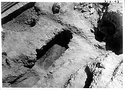
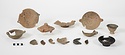
Two fragmentary unburned vases were found together on bedrock, beneath Roman and Byzantine fill. Disturbed earth over bedrock for several ... Early Protogeometric ... Smithson: Grave XXXVI:PG). Early fill over bedrock. No remains.
Two fragmentary unburned vases were found together on bedrock, beneath Roman and Byzantine fill. ... The excavator noted "cinders" among the Early Iron Age pottery in the fill in the immediate vicinity, which may further support the existence in the area of early tombs. |
Pit (Well?) under Building A, Room 2. Coins:
9 May 1949 #1-#2
11 May 1949 #4
12 May 1949 #3 (not a coin, bronze fragment in lotted metal tins ΠΠ 295). Estimated Grid
Remains of coloring matter found with ... Hellenistic-Early Roman |
| Mycenaean Small Chamber tomb.
The cist measures 1,90m E to W, 0.75-0.90m N to S, max. depth -1.30m. Nothing was found in it; cleaned in modern times and used as a cesspool. Some of the SW part of it had ... Myc. IIIA, early 14th c. |
| Marcie Handler ... The pyre was revealed under a layer of mixed fill with pottery dating from the 3rd century B.C. to the 1st century A.D. Five pots were immediately visible (BZ 1318-1321, 1333) in a shallow pit surrounded ... 23 June-4 July 2006 ... The original floor surface above the pyre must have been disturbed some time in the early Roman period, and no floor surface was found between this pyre and the remains of pyre J 2:24, which was found lower down and slightly to the east. |
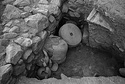
Mycenaean Well (S/1,2-13/20,14/1). Underneath the NE Room of the Library of Pantainos, along its S side, as a cutting in bedrock containing reddish fill with bits of green bedrock. The feature is rectangular ... 30 June-23 July 1975 ... The presence of Roman pottery and the absence of pottery from intervening periods (5th-4th c. B.C.) seems to indicate that the shaft of S 13:2 may not have been filled to the top originally (or the fill settled over centuries), and had been covered in some way, not to be rediscovered until the early Roman period.
... (layers I-III), Roman pottery from 66.10-65.00masl ? |
| James Artz Pirisino Daniele Kylindreas Miltiades ... Excavation in Room 3 of ΒΘ West revealed 5 ceramic vessels in a row against the eastern face of Wall 12. 3 complete vessels (ΒΘ 122, 124, and 125) were catalogued, along with the base of a plain glazed ... 9th-11th c. A.D ... The fragmentary remains of a ceramic pithos (ΒΘ 178) were revealed after the removal of a reused threshold block above the pithos. ... A plaster layer was exposed and removed over the course of several baskets in the southern half of the eastern portion at an average elevation of 53.883m, and ceramic material from these layers date from the late 11th-early 13th century AD. ... Plain glaze ware; Constantinople white ware; monochrome glaze; green and brown painted ware; combed ware; ridged ware; gouged ware; amphora toe; incised coarse ware; Roman lamp fragment and red wares; classical red and black glaze (including geometric, archaic, and classical); coarse base with strange shape, handle and neck close to base; coarse handles, bases, rims, and body sherds; micaceous body; cooking ware, including joining lid fragments; painted and unpainted plaster; roof and floor tile fragments; pithos lid, rim and body fragments; worked stone; stone revetment; bone; metal; glass |
|
|