|
|
| Excavation and Cleaning along the East Side of the Great Drain, 1951 ... R. C. Wood ... There had been four major Byzantine dwelling units in the northern part of section Ε. Two of them had been removed during earlier campaigns. Excavations manage to establish the outline of the four houses, ... 9 Apr-7 Jul 1951 ... There had been four major Byzantine dwelling units in the northern part of section Ε. ... The demolition of Byzantine walls and street levels gave many architectural fragments from the Temple of Ares, and also several inscriptions.
Two monument bases that had stood along the west side of the Great Drain were found beneath the Byzantine debris. |
| Sections Rho and Eta 1937 ... James H. Oliver ... Byzantine settlements in Sections Η and Ρ were removed and the foundations of the Temple of Ares exposed.
The most noticeable feature was the road serving as the main thoroughfare in the neighborhood from ... 24 Feb 1937 ... Byzantine settlements in Sections Η and Ρ were removed and the foundations of the Temple of Ares exposed.
The most noticeable feature was the road serving as the main thoroughfare in the neighborhood from the earliest Byzantine times until present days. A vast amount of road filling was removed as well as a series of rooms. In earlier times this section formed an open area around the Temple of Ares. |
| Preliminary Report on the 2008 Excavation Season ... John McK. Camp II ... Excavations took place in three sections, two north of Hadrian Street (ΒΗ and ΒΘ) and one in the old area south of the Tholos (Γ).
In Section ΒΗ, layers in, over and behind the building identified as the ... 10 Jun-1 Aug 2008 ... In Section ΒΗ, layers in, over and behind the building identified as the Painted Stoa were excavated to down below the middle Byzantine walls. The back wall and the interior colonnade were explored and detailed information about the building construction were gained. ... Mostly late fills were dug but the top of Byzantine walls came to sight in some places, as was large worked blocks that may have come from one or several Classical buildings.
... Some fill contained pottery of the 8th and 7th centuries B.C., perhaps indicative of earlier houses or disturbed burials. |
| Agora Excavations Preliminary Report - Summer 2014 ... John McK. Camp II ... Excavations in 2014 were carried out in three sections: ΒΘ, ΒΓ and ΒΖ.
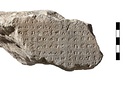
In Section ΒΘ, overlying the Painted Stoa, the Byzantine houses of the 11th century A.D. were further exposed in the western part ... 9 Jun-1 Aug 2014 ... In Section ΒΘ, overlying the Painted Stoa, the Byzantine houses of the 11th century A.D. were further exposed in the western part and two more pithoi were found. The eastern half was dug deeper; a pithos discovered at a lower level suggests an earlier phase of the Byzantine settlement. Reused blocks, of which some may be associated with the Painted Stoa, were recovered from the walls. A fragment of an inscribed opisthographic stele turned out to be part of the records of the Poletai.
|
| Section ΝΝ
Season of 1939 ... Rodney S. Young ... Section ΝΝ lies at the mouth of the valley between Pnyx and Areopagus, which was the important thoroughfare from the Agora to the Pnyx and to the southern parts of the city, as well as to the Piraeus Gate, ... 26 Sep 1938-24 Jun 1939 ... The whole section was cleared down to ancient or Byzantine levels. Extensive remains of private houses and a bath of the Roman period were discovered, as well as walls of houses from earlier periods. |
| Preliminary Report on the 2001 Excavation Season ... John McK. Camp II ... Excavations were carried out at the northwest of the Agora in sections ΒΖ and ΒΕ, and in the area of the Eleusinion in section ΕΛ.
In Section ΒΖ, the investigation of the settlement of the 11th century ... 11 Jun-3 Aug 2001 ... The lowest floor levels of the buildings were excavated down into layers of the 7th to 9th centuries, exposing the Byzantine walls to their full depth and the upper parts of the late Roman walls beneath. ... This material lay directly on bedrock leaving no sign of earlier activity in the area. |
|
|