|
|
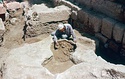
Klepsydra: Pits or cuttings beneath Paved Court ... Mycenaean ... Klepsydra: Pits or cuttings beneath Paved Court |
Deposit in bedrock cuttings, probably from a household. (Panathenaic Way Cut III, E1 and E2).
E1: Mixed 7th-5th c. B.C.
E2: Late Geometric-Early 6th c. B.C. Coins:
19 May 1959 #5-#7 ... 5th c. B.C and earlier ... Deposit in bedrock cuttings, probably from a household. |
Cutting in bedrock (Panathenaic Way Cut II, Cutting C1); loose gravelly filling over bedrock including a number of terracotta figurines. Lot ΠΑ 61? P 26458 is probably a slip. One fragment noted as from ... 4th c. B.C ... See notebook entry , p. 632. Cuttings C1 and E2 confused? |
| N.A. Doenges Evelyn Lord Smithson ... "Near or in Grave" (width 0.50m)
Grave to the east of the southeast corner of the great court of the Gymnasium. Shallow and superimposed on Well N 11:5. It is a simple cist oriented north and south, with ... 750-725 B.C ... The other two skulls were found in the area of the grave, but above it, and since there were other grave-like but empty cuttings in the vicinity it is likely there was a small group of graves here. |
| Circular pit and irregular cutting north of it. Diam. of pit ca. 0.80m; Dimension of irregular cutting ca. 1.00x1.20m. The pit was dug into bedrock and filled with red earth which was packed with undisturbed ... Second half of 7th c. B.C ... The presence of ochre, of trial pieces and of lumps of burnt clay suggest that both cuttings contained refuse from a nearby workshop. |
Hellenistic-Early Roman fill over bedrock, along west side of Kolonos Agoraios. Consistent dumped filling; occasionally there is a late Roman fragment intruded from the filling above, but this seems not ... 26-29 February 1936
2-12 March 1936 ... Consistent dumped filling; occasionally there is a late Roman fragment intruded from the filling above, but this seems not to affect the deposit which suggests some large scale operation, serving to level the area and to fill in the pits and grave cuttings of earlier periods. |
Accumulated fillings in a system of underground drains at west end of section ΔΔ with northward continuation into and across Section Υ.
The filling in the "underground passages" in section ΔΔ appears to ... 3rd c. B.C.
2nd c A.D ... ; but drain channels, pits and cuttings, etc. in Υ are partly Early Roman, some mixed to Late Roman or later.
|
|
|