|
|
| Homer A. Thompson ... Cremation burial (trench-and-hole) under S. edge of E-W Street, southern burial. In some records as Grave XLVI.
Neat trench, rectangular as preserved, but may have originally been square, cut partly through ... Early Geometric I ... In some records as Grave XLVI.
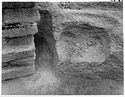
Neat trench, rectangular as preserved, but may have originally been square, cut partly through earth, partly into bedrock, to a depth of about 0.25m. The north side of the trench was destroyed by the a Turkish cess pit. ... Be that as it may, a deep, circular urn-hole was cut into the southeast corner of the pyre trench to a depth of 0.45m below the level of the floor, and measuring 0.35m in diameter.
|
| North of House G (RSY=Pyre 13).
Concentration of artifacts, small pieces of bone, and burnt material in stratum, no pit discerned. The pyre is cut by the trench of a wall of a Roman house to north. It ... 290-250 B.C ... North of House G (RSY=Pyre 13).
Concentration of artifacts, small pieces of bone, and burnt material in stratum, no pit discerned. The pyre is cut by the trench of a wall of a Roman house to north. |
| Mycenaean Grave to W of Pier 12 (Burial 11).
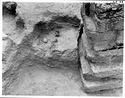
The northern part of the tomb had been cut away by the foundation trench for the south stylobate of the Square Building that preceded the Stoa, and the dromos, ... Myc. IIB-IIIA:1 ... The northern part of the tomb had been cut away by the foundation trench for the south stylobate of the Square Building that preceded the Stoa, and the dromos, if one existed, must have been lost in this operation. The chamber was small with an original east-west dimension of 1.60m and a preserved north-south dimension of 1.20m, the walls preserved to a maximum height of 0.90m. ... Although it might be argued from the single internment and the absence of any preserved dromos that this was a pit grave, the location of the body along the edge of the cutting would seem rather to indicate a small chamber tomb that has been cut away at the north. |
N-S Cut on 20m. line (area of Road, area of Stoa, area N of Stoa)
various levels and dates over the three areas.
Investigations to the northwest of the market square in the area of the road that bordered ... Protogeometric to Late Roman ... Investigations to the northwest of the market square in the area of the road that bordered it to the north.
... Plundered trench of early N-S wall: geometric to 4th c. B.C.
Area North of Stoa:
Habitation earth above gravel: gray minyan, protogeometric
See also cut on 50m. line (E-F 2-3:2). |
| Homer A. Thompson ... Cremation burial (trench-and-hole) under S. edge of E-W Street, northern burial. In some records as Grave XLVII.
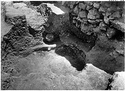
The western part of the offering trench of the tomb was lost to a Turkish cess pit, and ... Middle Geometric I ... The western part of the offering trench of the tomb was lost to a Turkish cess pit, and disturbances at least as early as the 7th c. B.C. had cut away the upper part of the cinerary urn and the adjoining trench filling. ... What survived was the south and east section of the original grave, including a strip of the pyre trench, reddened from burning to a depth of 0.05m, and below it a shallow urn-hole, roughly square, ca. 0.60m to the side, cut through earth almost to the level of bedrock, to a depth of about 0.30m.
|
| Mycenaean Grave at SE corner of Pier 12 (Burial 9).
There are no traces of dromos, which must have been located at the north and have been cut away by the trench four the south stylobate of the Square ... Myc. III A:1 ... There are no traces of dromos, which must have been located at the north and have been cut away by the trench four the south stylobate of the Square Building. The dimensions of the chamber are 1.60m east-west by a preserved length of 1.40m north-south. The walls were preserved to a height of 0.065m, and the grave was full of broken bedrock with a little soft brown silt around the bones. |
| C.G. Thomas ... Geometric grave. Bones discarded.
Tomb located about 2m west/west-southwest of the EG1 child inhumation, beneath the restored line of a hypothetical wall connecting the western "apse' and the south wall ... Middle Geometric II ... A roughly rectangular trench was cut through earth into bedrock, except at the southeast where it was wholly cut into earth, to a depth of 0.15-0.20m. ... Oriented more or less to the points of the compass, the trench measured about 0.80m (east-west) by about 0.70m (north-south). ... Remnants of a stone packing over the trench survived on the west side and for a short distance along the north.
|
Burial disturbed. Located in Middle Stoa, north aisle, "upper trench", piers 3 and 4. Two individuals: small child (ca. 5 yrs. old) and adult female.
In its disturbed state the burial was found (at elevation ... First half of 7th c. B.C ... Located in Middle Stoa, north aisle, "upper trench", piers 3 and 4. ... In its disturbed state the burial was found (at elevation -57.58m E to -57.52 W), resting against the cut scarp of the bedrock in a pocket 0.65m deep and 0.70m across; evidently, it was originally covered by a mass of cobblestones. ... B.C., when a quantity of Proto-Attic and Early Protocorinthian pottery was dumped into the feature. |
|
|