|
|
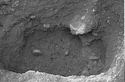
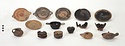
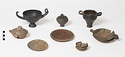
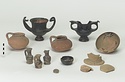
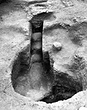
| A flask-shaped storage pit or cellar, cut in the rock at the south edge of the levelled top of Kolonos Agoraios. Filled late in first quarter of 6th. c. B.C. (2.95m from east to west by 2.70m from north ... First quarter 6th. c. B.C. |
Tiled well (diam. 0.78m); height of tiles 0.61m. Water level -5m. Well found at bottom of Byzantine pit, uppermost tiles cut down. Coins:
7 July 1947 #1-#2 ... Post-Herulian |
Mixed filling in a well cut rectangular pit. Debris of the second half of the 5th. c., deposited as late as the second quarter of the 4th. c. B.C ... 4th c. B.C. and earlier |
Diameter 0.95m; water level -9.10m.
Plais shaft cut in stereo from bottom of slender flask-shaped cistern. Scanty fill from house destruction in 5th c. A.D.; Christian lamps; unfinished statuette of Castor ... Late Roman |
Well. Construction, use and dumped fillings of the Hellenistic period. Tile-lined well with a packing of jars behind the tiles; the well cut through (Fill 4) the passage of a cistern (B 21:25). At 9.00m ... Hellenistic ... Tile-lined well with a packing of jars behind the tiles; the well cut through (Fill 4) the passage of a cistern (B 21:25). |
| Rodney S. Young ... RSY/JP Disturbed Geometric burial over "Sacrificial Pit VI" (Grave B 21:22). Grave IX in notebook. Bones discarded?
Pottery found in the upper filling of a sixth century cremation pit, which had perhaps ... Middle Geometric II/Transitional to Late Geometric ... RSY/JP Disturbed Geometric burial over "Sacrificial Pit VI" (Grave B 21:22). Grave IX in notebook. ... Pottery found in the upper filling of a sixth century cremation pit, which had perhaps cut through a Geometric inhumation to which the disturbed human bones close by may have belonged. |
| Pyre in House T, Room 2 through floor of second period (RSY=Pyre 5) in the industrial area west of the Areopagus.
4th. c. BC.
Concentration of artifacts, burnt bone, and charcoal in floor makeup consisting ... 375-350 B.C. |
| Pyre in Room 2, area west of street (RSY=Pyre 12).
In courtyard. Artifacts, bone, ash, carbon, and cinders in pit in floor sequence. The rectangular pit was cut into a white strosis with marble chips (ΠΠ ... 315-300 B.C. |
| Rubbish Pit . Pit cut through a house floor. In courtyard, beside door to room 3. Artifacts, bone and scattering of large cinders in roughly rectangular pit dug through floor bedding and covered by red, ... 325-300 B.C. |
| Mycenaean tomb: Myc. III A:1-2.
SAI
Small rectangular chamber, 2.30m wide by 1.80m deep,, entered from the east through a dromos 1.10m wide which contracted to a doorway 0.92m. wide. the doorway preserved ... 2nd half of 14th c. |
| A cave-in not long after the digging of this shaft destroyed its possible usefulness as a well and thereafter it was used as a dump. Two principle periods of such use were noted, and within these several ... Ca. 575-480 B.C. |
| Pyre in cut in E-W street, layer 7 (Pyre 14). North edge of Piraeus street, west of the Great Drain Bridge, in the area west of Areopagus.
RSY-Pyre.
Pottery, a little burnt bone, and patches of charcoal ... 250-240 B.C. |
Two chambers connected by a tunnel, all filled at the same time, but with slight Hellenistic disturbance. Chamber A, to west at 14/ΛΗ, B to east at 14-15/ΛΒ on grid for section RR.
Cistern system ca. 20.00m ... Ca. 325-275 B.C ... Chamber A, to west at 14/ΛΗ, B to east at 14-15/ΛΒ on grid for section RR.
... B.C. very possibly ca. 277/6 (see Garden article), the southerly side of Kolonos, outside the Precinct Wall, was levelled off and the double cistern were cut down and filled p. 833. |
| Geometric Burial. Burial B in notebook.
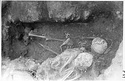
Overlay E 14:13. Skeleton lay on smoothed bedrock, head southward, arms folded on chest, hands below chin. Legs, cut off by later disturbance, probably bent, with ... Late Geometric ... Geometric Burial. Burial B in notebook.
Overlay E 14:13. Skeleton lay on smoothed bedrock, head southward, arms folded on chest, hands below chin. Legs, cut off by later disturbance, probably bent, with raised knees.
|
Mycenaean Tomb under Valerian wall (Burial 12).
It was impossible to fix the limits of the tomb in any direction, since at the north and south it was cut by the wall, an operations could not be extended ... Myc. III B |
| Mycenaean Chamber Tomb opposite ΣΑ pier 15. It was discovered about 20m to the west of Pier 15 of the Stoa of Attalos and almost in a line and a few meters south of Tomb XX. although the entire upper part ... Myc. II-IIIA/B |
| Debris filling in a bronze casting pit and workshop, characterized by mold fragments but including also a few plain vases and fragments of wine jars. Third quarter of 4th. c. BC.
The pit was cut into the ... Ca. 350-325 B.C. |
Well cut through cistern at 40/Θ on Kolonos Agoraios (E 11:1). Two use periods plus an upper dumped fill from which the following objects: B 319, I 3994, SS 5745, T 1235. Coins:
6 April 1936 #18-#21
7 ... First half of 1st c. A.D.
4th-early 5th c. A.D ... Well cut through cistern at 40/Θ on Kolonos Agoraios (E 11:1). Two use periods plus an upper dumped fill from which the following objects: B 319, I 3994, SS 5745, T 1235. |
| Mycenaean Grave to W of Pier 12 (Burial 11).
The northern part of the tomb had been cut away by the foundation trench for the south stylobate of the Square Building that preceded the Stoa, and the dromos, ... Myc. IIB-IIIA:1 |
Well 15: Mycenaean. It was situated about 35 meters down the slope northwest of the exit of the Mycenaean Fountain.
Well circular or roughly oval in section.
Diameter max. width to -4.0: ca. 1.50, below ... Late Mycenaean ... The bottom of the shaft was rough, blocked by a ledge of rock too hard to cut, which still bears in two places the marks of a pointed tool with which it was tested. About 0.30m below, a late Roman pit which cut into the north side sherds occurred in fair quantity and the fill seemed to be pure.
... Seems to constitute a dump fill from neighboring houses of the Mycenaean III B period, and is somewhat earlier than the major part of the dump fill of the Fountain. |
| (Grave XXIX: EG).
Rectangular cutting with remains of charred human bones and both burned and unburned pottery fragments. Bones discarded.
Rectangular trench cut through earth into bedrock, oriented east-west ... Middle Geometric I |
| Eugene Vanderpool Homer A. Thompson ... Mycenaean Grave to W. of "Court Room" below Stoa Terrace with "Ballot Box" (Grave XXIX).
Unusual type, conforming neither to our pit nor to our cist graves, and consisted of two parts. The outer part was ... Mycenaean III A-B |
Mycenaean Deposit (Gully) in front of NE Stoa (corrected from P 7:1).
It consisted of a series of irregular pits, some gradually linked up with one another to form what seemed a natural gully. The largest ... Mycenaean IIIA-B |
Construction fill below floor of Brick Building.
Areas involved:
a) Western portion of Room A: packing below floor.
b) Room B: packing below floor of northern,larger room.
c) Fill over water channel in ... First quarter 2nd century, before its end ... Areas involved:
a) Western portion of Room A: packing below floor.
b) Room B: packing below floor of northern,larger room.
c) Fill over water channel in smaller, southern room B; channel discovered by builders of Brick Building,rebuilt by them and covered over.
d) Foundation trench of earlier building beneath Brick Building, filled and covered by builders of Brick Building.
e) "Apparently from below floor of building" (nb.p. 1282).
... Lot 20 "Ash, Carbon and Slag Fill, against the west face of dividing wall between Rooms A and B" of 1936 excavations including P 19790, SS 5379 and coin ΣΑ-16. It was believed to antedate the construction of the building since the wall of the building seemed to cut it. However, HAT digging in the same area in 1950 (p. 2245), describes what appears to be the same stratum (he does not specifically mention the earlier excavations) as lying on the floor of Brick Building here. |
| The cistern was lined with stones at the top with an opening 0.80 m in diameter. For the most part, it seemed to cut into bedrock except along its northern edge where some 5th c. B.C fill remains and main ... 2-19 July 2010 |
| Mycenaean Chamber Tomb.
Only the bottom 0.10 to 0.20m of the chamber was preserved along with the partial skeletal remains of two or three occupants. The plan revealed a square chamber (1.80m by 1.80m), ... Myc. III A 1:2 (14th c.) |
| John Camp ... Protogeometric grave (female inhumation) located about 0.60m northwest of T 15:1. It consisted of a roughly rectangular pit, with the corners slightly rounded, oriented approximately north-south. The pit ... "Submycenaean"/Early Protogeometric |
Built against the south wall of the annex to the Poros Building
west of the Areopagus. At the west the upper layer of marble chips carried against it, the lowest were cut by it.
Part of same system as ... 225-100 B.C ... At the west the upper layer of marble chips carried against it, the lowest were cut by it.
Part of same system as D 17:3 and D 17:4.
Object B 874 is from the top fill but not related to the upper or lower fills proper; no subdivision. |
Well (diameter 0.91m, water level -7m) in House H, Room 10 (and pit over). Plain shaft cut in stereo; pit at mouth of well,reused as drainage pit at start of tile drain running west.
Scanty use filling ... Ca. 425-400 B.C ... Plain shaft cut in stereo; pit at mouth of well,reused as drainage pit at start of tile drain running west.
... a) use and lower dumped filling (425-400 B.C.)
b) Filling behind tiles (450-400 B.C.)
c) Abandonment filling (3rd c. |
| Mycenaean Chamber Tomb occupies a considerable part of the western half of section ΕΕ; lies about half way up the north slope of the Areopagus towards its eastern end, just below the highest point of the ... Myc. III A:1 ... The rock from which it is cut, is the greenish clayey shale which underlies most of the Agora area.
... It was originally several meters longer but its northern end was cut off by a late Roman retaining wall. ... Across the east and west ends of the chamber there is a low rock-cut bench (average width 0.75m; average height 0.60m). |
| Rodney S. Young ... Grave 20 (E.L. Smithson: Grave X: PG). Bones discarded. Pit tomb, inhumation (on bier or in coffin?), perhaps of a child. Little ash and carbon in the filling, but the grave offerings were unburned.
JP ... Developed Protogeometric ... JP
Deep rectangular pit, 1.72m long and 0.70m wide, cut into bedrock to a depth of 0.83m, oriented east-southeast to west-northwest. the skeleton at the bottom of the pit had mostly disintegrated, except for a shin bone in the eastern half of the tomb. ... Sterile.
b) To a depth of 0.12-0.15m, : "ash and cinders with a few burned bits of nonhuman/animal bones. |
| An extensive cistern system on the lower north slope of the Areopagus, south chamber with blind tunnel extending further south (south tunnel); north chamber; drawshaft further north, extends to north tunnel ... Ca. 320-240 B.C ... The system went out of use, no doubt because of the repeated caving in of the soft bedrock in which it was cut. Thus the blind tunnel leading off from the draw-shaft was first shortened 0.50m by a wall of field stones set in clay and carefully plastered on the face toward the shaft. ... Cistern System, 45/Β and 45/ΙΑ (Hell. Group B) (ΣΤ = 45/Β, 45/Ζ, 46/Ζ, cf. |
| Extract from notebook ΠΘ XIX, pp. 3644-3646. Well at 105/ΝΗ (report on sorting of pottery, July 19, 1951 - H.S. Robinson).
"Not a useful well" HSR.
Well dug to 1.50m., vi/9/36; dug from 1.50m. to bottom ... Early Roman; use fillings of 2nd. c. B.C. and 1st. and 4th. c. A.D.; dumped filling of late 4th. c. (HSR)
Fill I: 2nd. c. B.C.
Fill II-V: to second half of 4th. c. A.D.
Fill VI: mixed to Byzantine ... Well dug to 1.50m., vi/9/36; dug from 1.50m. to bottom (22.80m.), iv/9/37 - iv/23/37. Cut in bed-rock (no tiles reported); diameter at mouth: 1.04m.; depth 22.80m.
... occurred in cont. 7-5, extending over into cont. 4 (now in Box no. 361-B).
The above fills, apparently of the 2nd cent. |
|
|