|
|
Fillings associated with early houses on the lower north slopes of the Areopagus; various levels and dates.
Both houses were built in the 6th century B.C. and destroyed by the Persians; both also have ... 6rd c. B.C.-3rd c. A.D ... Southwest House, Rooms I-VIII, 42-55/ΚΖ-ΜΖ:
The earliest house had a court on the west with a Well (B) and two small rooms at the north. ... The latest period of the house is the Herulian destruction.
Central House, Rooms IX-XI, 42-55/ΙΖ-ΚΖ
From 1957 excavations of these houses see P 25888, P 25895, L 5298. |
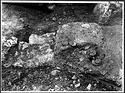
| Pyre 1 in Central House, Room XI, strosis 3. Sacrificial pyre with characteristic small vases amid carbonized twigs and bone.
Near north side of courtyard. This pit was cut slightly into strosis 3 (lot ... 1st quarter 4th c. B.C ... Pyre 1 in Central House, Room XI, strosis 3. ... This pit was cut slightly into strosis 3 (lot Φ 231), a 5th c. floor associated by the excavator with phase 2 of the house. Non-joining fragments of pyre pots in strosis 2 above (lot Φ 228) suggest that the pyre may have been dug from that level. The pyre is approximately contemporary with the renovation of the house that initiated phase 3 in the first half of the 4th c., so it could be associated with that event. |
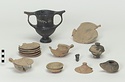
| Pyre 2 in Central House, Room X, under strosis 9. Signs of burning, carbonized food, animal bone.
In room south of courtyard. concentration of artifacts, bone, and charred material in floor makeup, no ... 290-275 B.C ... Pyre 2 in Central House, Room X, under strosis 9. ... The objects were found in digging a hard floor with a white clay surface (strosis 9, lot Φ 217), the earliest floor associated with phase 3 of the house and probably dating in the second quarter of the 4th c. ... The alternative is to downdate the floor, which is difficult to reconcile with the other stratigraphy in the house. the date of the pyre indicates that it could be associated with the abandonment of the house, which took place in the first half of the 3rd c. |
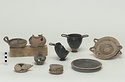
| Pyre in north central room of house, measuring 0.50m east-west by 0.35m north-south. Pottery, bone, and burnt material in pit dug into layer IIb (crushed bedrock floor: lot Ω 464, 4th c.) and covered by ... 350-325 B.C ... Pyre in north central room of house, measuring 0.50m east-west by 0.35m north-south. ... The stratigraphy around the pyre cannot be physically connected to the architectural history of the house, but the date of the pyre would be consistent with a dedication at the time of the rebuilding or during the subsequent reoccupation. |
| Dorothy Burr Thompson ... Child's Grave (E.L. Smithson: Grave XXVIII: G).
Cf. Container Lot ΣΤ 165 (fill over geometric grave).
Neat, rectangular, unlined trench, cut into bedrock to a preserved depth of 0.20m,below the level ... Early Geometric I ... Neat, rectangular, unlined trench, cut into bedrock to a preserved depth of 0.20m,below the level of the floor of the so-called Geometric House. The tomb was located in the area between pits A and D, and was just over 2m to the east of the preserved west wall of the Geometric House. ... In addition to the shells, the skeleton of an animal, identified in the field as "probably a piglet", was placed to the left of the skeleton, along the central part of the southwest side of the tomb pit.
... Two other empty trenches were found within the area of the Geometric House, ,thought to be rifled tomb pits. |
Evidence of stratification into five layers, although joins between the layers. Layer VI added when the construction of the Roman building above required it. No subdivisions assigned.
Flask-shaped cistern ... Early 3rd-late 2nd c. B.C ... Layer I: red earth in the central depression, probably the accumulation of the last period of use of the cistern as a source of water. ... Layer VI: Supplemental filling prior to construction of Roman house |
|
|