|
|
Containers 24-72.
Masses of pottery; including many BHWJ's; lamps XVIII and XXIV
Coins:
12 June 1937 #14-#53
13 June 1937 #1-#7 (from earth of 12 June)
13 June 1937 #8
14 June 1937 #1-#3
15 June 1937 ... First half 1st c. A.D ... First half 1st c. A.D ... Γ:94/ΛΕ |
| Coins:
16 June 1981 #89
17 June 1981 #94-#95, #100 (not a coin).
19 June 1981 #103-#104, #335-#336
23 June 1981 #111-#112 ... 9th-13th c. A.D. |
Well at the southeast foot of Kolonos Agoraios.
Use filling of 1st c. A.D.; dumped fillings of 3rd c. and of early Byz. times. Coins:
15 June 1937 #1-#2 (earth)
16 June 1937 #14-#20 (earth)
17 June 1937 ... 1st c. A.D.=POU ... 1st c. A.D.=POU ... Γ:94/ΛΕ |
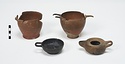
| A compact group of four complete vases and a lamp, found on a house floor; possibly the remains of a sacrificial pyre but without evidence of burning or the characteristic votive vases.
Layer II, "nest ... 425-400 B.C. |
Cistern-chamber on the northwest side of Kolonos Agoraios, 10 to 12m west of the end of the Hellenistic Building. Dimensions at bottom 2.50m x 2.75m.
The west chamber of a cistern system composed of two ... Use filling early 1st-2nd c. B.C ... Use filling early 1st-2nd c. B.C ... ΛΛ:94/ΝΣΤ |
A cistern leading to the east of the road leading from the southwest corner of the market square. Filled all at one time, last quarter of 2nd. c. B.C. (nbp. 493).
Included are the Hellenistic finds from ... Late 2nd c. B.C ... Late 2nd c. B.C ... Γ:94/Θ |
Coins:
9 June 1937 #1
10 June 1937 #1-#11
11 June 1937 #1-#30
12 June 1937 #1-#13 (from earth of 11 June) ... 2nd c. A.D ... 2nd c. A.D ... Γ:94/ΛΕ |
Rectangular cutting, not entirely preserved, west of underground drain. Contained good black glazed pottery, some stamped, and a little coarse ware, along with bits of bone and part of a skull ... Third quarter 5th c. B.C ... Third quarter 5th c. B.C ... ΔΔ:94/ΙΕ |
Hellenistic cistern, part of the same system as 94/ΝΣΤ (D 4:1) and connected with it by a passage. Later cleaned out for reuse and filled with destruction debris of the late 4th c. A.D. Coins:
23 March ... Second half 4th c. A.D ... Hellenistic cistern, part of the same system as 94/ΝΣΤ (D 4:1) and connected with it by a passage. Later cleaned out for reuse and filled with destruction debris of the late 4th c. A.D. |
| Includes finds from layer II and III of cistern passage. Coins:
1 April 1937 #1 (east end of passage)
14 April 1937 #2-#8
15 April 1937 #1-#7
16 April 1937 #1 ... Second half 1st c. A.D ... Second half 1st c. A.D ... ΛΛ:94/ΝΣΤ |
Includes finds from layer II and III of cistern passage. Coins:
1 April 1937 #1 (east end of passage)
8 April 1937 #8-#10
9 April 1937 #4
10 April 1937 #1-#4
12 April 1937 #1
13 April 1937 #4 ... Late 1st-early 2nd c. A.D ... Late 1st-early 2nd c. A.D ... ΛΛ:94/ΝΣΤ |
Furnace Dump from N. Hypocaust in Bath to East of Poros Building. Coins:
26 March 1948 #4-#8
27 March 1948 #1-#3
29 March 1948 #2-#7
1 April 1948 #2-#3
3 April 1948 #14-#15
7 April 1948 #16-#27
8 April ... Second half 3rd c.-first half 4th c. A.D ... Second half 3rd c.-first half 4th c. ... ΟΟ:94-97/ΙΕ-ΙΣΤ |
Coins:
16 April 1937 #1-#2
17 April 1937 #1 ... Early 1st (or 2nd) c. B.C ... Early 1st (or 2nd) c. B.C ... ΛΛ:94/ΝΣΤ |
Well at 96/Ι in arm of cistern at 94/Θ (F 15:2). Probably the rebuilding of an earlier well.
P 3149, P 3150, P 3154 are jars from packing in cistern arm; construction fill - early Roman.
P 4588 is listed ... Second half of 3rd c. A.D.=POU |
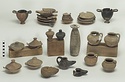
| Grave V, under room 18 in House 3, plus burned deposit at 94/IΘ. Identified as sacrificial pyre by SIR on Agoraios Kolonos:
In southeast corner of house 3. 35 artifacts, bone and charred material in pit, ... Ca. 300-275 B.C ... Grave V, under room 18 in House 3, plus burned deposit at 94/IΘ. Identified as sacrificial pyre by SIR on Agoraios Kolonos:
In southeast corner of house 3. 35 artifacts, bone and charred material in pit, in floor sequence. ... The pyre lay below two floors: a lower floor not closely datable and an upper floor with pottery largely of the 3rd c. The pyre is more likely to be associated with a reflooring and perhaps installation of the basins than the original construction. |
|
|