|
|
House R, fill under drain tiles and fillings associated with house K in industrial area, including what was C 19:15, plus C 19:16 and
C 19:17.
a) House built as dwelling in second half of 5th.c.
b) Used ... Ca. 5th and 4th c. B.C ... C 19:5 ... C 19:5 |
Patch of early fill, disturbed. 20/9/1962: Tin 145 is checked and is chiefly late archaic, but some of the coarse ware is late 5th with 4th c. B.C., and a few bits are 4th c. A.D ... Late 6th.-early 5th c. B.C ... C 14:5 ... C 14:5 |
Pit (Well?) under Building A, Room 2. Coins:
9 May 1949 #1-#2
11 May 1949 #4
12 May 1949 #3 (not a coin, bronze fragment in lotted metal tins ΠΠ 295). Estimated Grid
Remains of coloring matter found with ... Hellenistic-Early Roman ... C 17:5 ... C 17:5 |
Cistern System #1e: Shaft at 11/ΞΑ.
Agora XXIX: "Well (not cistern shaft, as in Agora XII) ... Communicates with water system through small hole (see C 8:1) probably fortuitously. Single fill, mostly of ... 350-300 B.C ... C 8:5 ... C 8:5 |
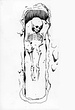
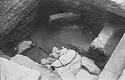
| Dorothy Burr Thompson ... Grave 12 in notebook. Cut in bedrock. (E.L. Smithson: Grave VII: PG) Few bones (discarded). Rectangular cutting in bedrock.
JP ... Early Protogeometric ... C 9:5 ... C 9:5 |
Near the Poros Enclosure. Diameter 0.76m. water level -1.20m. Plain shaft sunk in the stereo ... 14-22 July 1947 ... C 18:5 ... C 18:5 |
Marble Chip Fill at 67-69/ΚΑ-ΚΖ (now C 19:5). Asterisk: C 19:15* ... Marble Chip Fill at 67-69/ΚΑ-ΚΖ (now C 19:5) ... Asterisk: C 19:15* |
Pit in House R, West Room. Grouped with and published with C 19:5. Asterisk: C 19:17* ... Grouped with and published with C 19:5 ... Asterisk: C 19:17* |
Tiled basin at ΚΗ (66-67/ΚΖ). Finds grouped with and published with C 19:5. Asterisk: C 19:16* ... 22 July 1947 ... Finds grouped with and published with C 19:5 ... Asterisk: C 19:16* |
Coins:
22 February 1936 #4-#13
26 February 1935 #1-#2
27 February 1936 #1-#4
28 February 1936 #3-#5 |
Well with 4th. c. fill, no well deposit at the bottom. Coins:
2 April 1936 #1
3 April 1936 #8-#19
4 April 1936 #11
8 April 1936 #3-#4
22 May 1936 #5
25 May 1936 #2
27 May 1936 #2
28 May 1936 #2-#5
29 May ... Second half A.D. 4th. c ... Well with 4th. c. fill, no well deposit at the bottom ... Coins:
2 April 1936 #1
3 April 1936 #8-#19
4 April 1936 #11
8 April 1936 #3-#4
22 May 1936 #5
25 May 1936 #2
27 May 1936 #2
28 May 1936 #2-#5
29 May 1936 #1 |
Tins 1-5.
"D" ware; a medallion plate; the jar with flaring mouth and purplish glaze and gouged decoration, a 28 lamp fragment and one fragment of combed ware ... 4th. c. A.D. |
Cistern System #1f: Shaft at 1/ΝΘ = Well A. Scanty dumped filling. Coins:
19 February 1936 #2-#3
20 February 1936 #16-#20
21 February 1936 #5-#7
22 February 1936 #1 ... Mid-4th to 3rd c. B.C. |
Great Drain fills, including "packing over elliptical tiles" and "gravel fills". The central drain area covered by the sections below; other sections are with other deposits. Coins:
9 May 1947 #2-#5
16 ... 1st c. A.D. |
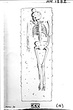
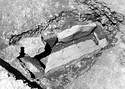
| Rodney S. Young ... Grave 4 in notebook (E.L. Smithson: Grave XX: PG). Bones discarded. Grave of older child.
JP
Rectangular pit, cut into bedrock to a depth of 0.26m, approximately 0.97m long and 0.36m wide. Tomb oriented ... Late Protogeometric |
Except for A 2355 and I 3871, the other finds of 'upper fill' are actually from the 'change of fill' recorded on 24 April 1936, nbp. 1500. Coins:
19 March 1936 #1-#4
21 March 1936 #1-#2
24 April 1936 #5-#6 ... 16 March-24 April 1936 |
| Grave 1 in notebook (E.L. Smithson: Grave XXV: PG). No remains. Probable trench-and-hole.
JP
Roughly circular pit measuring 0.39m in diameter cut into bedrock to a depth of 0.72m. Pyre refuse-described ... Late PG/EG I |
Coins:
30 July 1947 #3-#11
31 July 1947 #4-#19
1 August 1947 #1-#9
4 August 1947 #1-#20
5 August 1947 #3-#20
6 August 1947 #1-#38
7 August 1947 #1-#21
8 August 1947 #1-#41
9 August 1947 #3-#6
57-59/*
66-67/* ... 28-31 July 1947
6-9 August 1947 |
Cistern System #1b: Shaft/manhole and gallery at 18-19/ΞΑ-ΞΓ.
Objects divided between the two features, shaft and gallery, according to deposit notebook list, not according to remarks on cards. 22 February ... Late 1st c. B.C.-early 1st c. A.D. |
(Roman Group J). The upper fill to a depth of ca. 16.00m. was of earth scooped up elsewhere and thrown in ... The latest piece noted from this fill was a TC fragment dated late 4th to 5th(?) c. BC. From ... 2nd.-3rd. c. A.D ... The latest piece noted from this fill was a TC fragment dated late 4th to 5th(?) c. BC. From 16.00m. to the bottom there was a heavy deposit of well pottery. ... Coins:
19 March 1936 #1-#4
21 March 1936 #1-#2
24 April 1936 #5-#6
Coins found in going through earth from well after drying:
2 May 1936 #1
5 May 1936 #1-#3
6 May 1936 #1-#4
11 May 1936 #1-#4
14 May 1936 #1-#4 |
Square pit in bedrock southwest of the Hephaisteion. Many marble chips from the construction of the temple of Hephaestus were found here together with a large quantity of pottery and other objects ... Ca. 450 B.C.
Ca. 390-380 B.C. |
Late Roman mixed destruction fill.
The fill in both the staircase and the cistern chamber was the same mixed destruction fill containing a large quantity of Hellenistic pottery mixed in with late 3rd-early ... 4th. c. A.D ... The fill in both the staircase and the cistern chamber was the same mixed destruction fill containing a large quantity of Hellenistic pottery mixed in with late 3rd-early 4th c. A.D ... Coins:
21 April 1936 #1-#2
22 April 1936 #1
24 April 1936 #1-#4
25 April 1936 #1-#5
27 April 1936 #1-#9
28 April 1936 #1 |
Well cut through cistern at 6/ΝΕ (C 9:7).
The stele I 3244 in position in the cistern over the mouth of the well is listed with the cistern deposit C 9:7. Coins:
26 February 1936 #2-#4
27 February 1936 ... A.D. 1st ... Well cut through cistern at 6/ΝΕ (C 9:7).
The stele I 3244 in position in the cistern over the mouth of the well is listed with the cistern deposit C 9:7 ... Coins:
26 February 1936 #2-#4
27 February 1936 #2-#10
28 February 1936 #3-#6
29 February 1936 #2
2 March 1936 #2-#3
3 March 1936 #1-#6
4 March 1936 #2-#4
5 March 1936 #1-#2 |
Roman well, stratified.
Finds from the earth (not recorded in a subdivision):
P 7995, P 8036, P 21834, SS 6338, IL 483, IL 486, BI 309, BI 310,
BI 314.
According to the excavator the shaft had been cleaned ... 2nd-4th c. A.D. |
| Rodney S. Young ... Destroyed urn cremation. No remains. Originally assigned as part of Tomb C 9:14 (Grave 7)
JP
"Large fragments of an urn were found in the packing of a Hellenistic water channel which cut through a LPG ... Final Mycenaean/Submycenaean ... Originally assigned as part of Tomb C 9:14 (Grave 7)
JP
"Large fragments of an urn were found in the packing of a Hellenistic water channel which cut through a LPG burial area and obliterated the urn and urn-hole of LPG grave C 9:14." ... P 6723, although surely an urn, rust-stained inside from the iron jewelry and within a meter of Grave C 9:14, is much earlier than the offerings in that grave and must have come from still another burial trench in the line of the water channel; a narrow burned strip along the edge of the channel opposite the fragments may be part of that trench.
... Agora XXXVI mentions (p. 298) as part of Grave 5 (should read 7) |
Well in the bottom of chamber cistern at 106/ΛΓ, stratified. A soft spot in the bedrock at the west side of the well caved in and was packed with typical coarse Roman first century amphoras; the well was ... A.D. 200-150 |
| James H. Oliver ... (E.L. Smithson: Grave IX: PG). Two children's skeletons one on top of the other. Cf. PD 329 for PD 430 for second skeleton, same deposit.
PG grave about 25m. SW of Cistern A at 46/ΜΔ.
[In some records, ... Developed Protogeometric |
Hellenistic-Early Roman fill over bedrock, along west side of Kolonos Agoraios. Consistent dumped filling; occasionally there is a late Roman fragment intruded from the filling above, but this seems not ... 26-29 February 1936
2-12 March 1936 |
Small deposit including red figured fragments ... Second and third quarters of 4th c. B.C. |
Fillings immediately antedating the building of the Stoa.
Cf. Hesperia 6 (1937), p. 20 and the debris of a pottery works behind the Stoa (H 7:1). |
Well at 56/ΚΖ, just south of the south wall of the northern Late Roman Building ... Second half of 2nd c. - early 3rd c. A.D. |
Exploration over bedrock inside the Tholos; levels of 6th c. B.C ... 6th c. B.C. |
Well at 74/Ι, on the lower north slope of the Areopagus.
Use fill from early 1st to 3rd c. A.D.
Dump fill from 4th c. A.D. Coins
9 April 1938 #2
9 May 1938 #1 Container 20 (lost) p. 1529 ... 1st c. to 3d c. A.D. |
| Susan I. Rotroff ... Grave 2 (bis). Cut into by builders of I 5:2. No remains.
Possible contents in I 4-5:1 Layer C (= layer 6, lower building fill), catalogued as ΒΓ 2065 - ΒΓ 2125 ... Middle Helladic or later Bronze Age (date uncertain) ... Cut into by builders of I 5:2. No remains.
Possible contents in I 4-5:1 Layer C (= layer 6, lower building fill), catalogued as ΒΓ 2065 - ΒΓ 2125. |
Small pit north of Wall C (appr. 0.50 E-W x 0.35m N-S). Coins:
11 August 1994 #1125-#1127 ... 3rd c. B.C. |
Well A
Mostly uniform dumped fill. use level probably late. The well head (A 2753) had evidently been broken up and thrown in as soon as the well went out of use. Dumped filling, second quarter of 7th ... 7th century B.C. |
| Grave XXV in notebook = RSY Grave 4. PD 731-b ... 750-725 B.C. |
Coins:
10 April 1937 #5 ... 4th-3rd c. B.C. |
Unfinished well cut in bedrock to the southwest of the Tholos; dumped filling containing much material of the 7th c. B.C. but extending into the 6th ... 7th-ca. 570 B.C. |
Pit in shop I of Roman Stoa, 2.50m. behind the Royal Stoa. Most of the pottery dates to the third quarter of the 5th c. B.C. Many of the vessels were marked with a ligature, indicating that this was the ... 3rd quarter 5th c. B.C. |
Digging abandoned at 17.10m.
Nbp. 2863: The fill in the mouth to -6.50 was a dump of mixed hellenistic and late roman sherds. From -6.50 to -11.00m. small stones with a few late roman sherds 4th-5th c ... 4th-5th c. A.D. |
Well south of the apse of Room 3, Roman House H. Cut through bedrock, diameter ca. 1.15m, stopped at ca. -10.80m because of danger of collapse. Water at very top, up to bottom of parapet between well and ... 2nd-4th c. A.D. |
Cistern at 79/Γ (= 80/Δ) on lower north slope of the Areopagus. Filling of 2nd c. B.C. with some later intrusions (Turkish pottery indicates disturbance).
Single Knidian stamped amphora handle dates around ... Hellenistic-Turkish |
| Susan I. Rotroff ... Burial 3 beneath the floor of the Stoa Basileios. It consisted of a rectangular pit cut into bedrock to a depth of 0.44m, lined on all sides and covered with an admixture of narrow stone slabs of soft ... Final Mycenaean/Submycenaean |
The fill in this cistern is Byzantine with considerable admixture of Greek IV-III c. B.C. Coins:
7 March 1932 #9
9 March 1932 #1
10 March 1932 #1-#2
11 March 1932 #2
12 March 1932 #1 ... 11th-12th c. A.D. |
Investigations within the Stoa of Zeus, the north part, various levels.
Notebook references: Stoa Trench E Layers IV and V, Stoa Pits A, B and C, and Layers I and II of area between back wall and retaining ... 5th c. B.C. |
House C, Room 5, small hoard. Deposit created by A.W. and first appears in his thesis (Biblio. below).
"Another small hoard or purse of Herulian date", A.Walker (1980), p. 127. Coins:
23 June 1947 #7-#13 ... Ca. 267 A.D ... House C, Room 5, small hoard. |
| Pyre in Room 2, area west of street (RSY=Pyre 12).
In courtyard. Artifacts, bone, ash, carbon, and cinders in pit in floor sequence. The rectangular pit was cut into a white strosis with marble chips (ΠΠ ... 315-300 B.C. |
| Phaidon Street Cistern: North Chamber
Sullan destruction debris. One of two chambers connected by tunnel.
Two latest coins date to 87/86. Gray ware lamp of first quarter of 1st c. A.D. indicates disturbance ... 2nd c. B.C. |
Pre-Stoa Pit beneath floor of Shop I ... 2nd c. B.C. |
Cistern shaft at 63/ΚΓ. Part of H-I 16-17 system. Contents of 3rd c. disturbed.
Part of extensive cistern system, of which one chamber, three drawshafts, and two blind tunnels were excavated (H 16:2, ... 3rd c., disturbed |
Well near west edge of level area south of the Hephaisteion. Dumped filling thrown in near end of 4th. c. but by far the greater part belonging to the 30 years before 350 B.C.
Diameter of shaft 0.98m ... Ca. 380-350 B.C ... Dumped filling thrown in near end of 4th. c. but by far the greater part belonging to the 30 years before 350 B.C.
... Coins:
8 April 1936 #5
9 April 1936 # 2-#3 |
| Tom Milbank ... An unlined and relatively narrow (ca. 0.82m. in diameter) well cut through hard-pack and bedrock. Although three periods of use can be discerned in the stratigraphy of the well below a depth of ca. 5.47m., ... Middle Geometric I |
Fill in abandoned cistern, lower terrace adjacent yo the Eleusinion on the north.
Uncatalogued material: 189 sherds, 4 objects. Many kernoi fragments.
Objects : loom weights; lamp.
Early ware : Gray Minyan; ... Mid. 4th c. B.C. |
Pit near SW corner of Hellenistic Bldg. The object catalogued is one of three TC molds found at the location ... 5th.-4th. c. B.C. |
| Mycenaean Chamber Tomb with niches.
One of the few tombs found in the Agora that has an almost architectural regularity with squares chamber (1.75m wide by 2.10m deep) and axially centered dromos (4m long ... Myc. III A 1:2 |
Connected with G 14:3.
There was a layer of Late Roman fill. It rested over a layer of 2nd c. B.C Hellenistic and then another of 4th c. B.C Hellenistic; the passage between the two cisterns contained ... Late Hellenistic |
| A flask-shaped storage pit or cellar, cut in the rock at the south edge of the levelled top of Kolonos Agoraios. Filled late in first quarter of 6th. c. B.C. (2.95m from east to west by 2.70m from north ... First quarter 6th. c. B.C. |
Drain Trench at 62/ΜΗ.
The presence of a number of fairly well preserved vases of good quality suggested to the excavator the possibility that the cutting might once have contained a burial. No skeletal ... 325-300 B.C. |
Cistern connected by tunnel to another chamber filled in Byzantine period. Small Hellenistic deposit on floor. somewhat contaminated by Byzantine fill above
No stamped amphora handles later than 3rd c.; ... 250-190 B.C. |
| David Scahill ... Behind northeast corner of Classical Building; east wall C. Below Hellenistic levels and early Classical pit. Chamber cut through bedrock, depth ca. 0.90m., diameter ca. 2m., roughly square in shape, angling ... LH III A:1 |
Evidence of stratification into five layers, although joins between the layers. Layer VI added when the construction of the Roman building above required it. No subdivisions assigned.
Flask-shaped cistern ... Early 3rd-late 2nd c. B.C ... Later intrusion represented by type 50B lamp and of late 2nd to early 1st c. Moldmade bowls with thick walls and small indistinct figures similar to those on bowls in G 5:3 and some examples in Thompson's Group C. ... Coins:
3 June 1937 #1-#4
4 June 1937 #5-#9
7 June 1937 #1-#4 |
Essentially uniform fill of III-IV c. A.D. with a Byzantine upper fill. Coins:
14 June 1937 #1-#3
15 June 1937 #2
16 June 1937 #1
17 June 1937 #1-#2
18 June 1937 #1-#4
19 June 1937 #1-#4
9 June 1938 #1-#3 ... Late 3rd-mid-4th c. A.D ... Essentially uniform fill of III-IV c. A.D. with a Byzantine upper fill ... Coins:
14 June 1937 #1-#3
15 June 1937 #2
16 June 1937 #1
17 June 1937 #1-#2
18 June 1937 #1-#4
19 June 1937 #1-#4
9 June 1938 #1-#3
10 June 1938 #1
13 June 1938 #1
15 June 1938 #1-#4
5 July 1938 #1-#3 (dump) |
Well at 20/ΙΔ.
No POU fill. Bottom packed with sherds, including roof-tile fragments. Above this, were six meters with a "fair quantity" of sherds; then the top meter and a half contained a great quantity ... Ca. 420-390 B.C. |
Well D: Archaic
Well on the northwest slope of the Acropolis. Debris filling with scanty pottery remains; most of the pottery is earlier than the lower limit. Diameter at top ca. 1.20m; bottom ca. 1.10m ... End of 6th c. B.C. |
Ancient fill in cistern tunnel leading to north; contained undisturbed fill which produced late Hellenistic sherds; it had been refilled in modern times ... 2nd c. B.C. |
Use filling of early to late 2nd c. A.D., and dumped filling of late 2nd c. Coins:
16 April 1948 #1-#6
17 April 1948 #5
28 April 1948 #1 ... POU 2nd c. A.D ... Use filling of early to late 2nd c. A.D., and dumped filling of late 2nd c ... Coins:
16 April 1948 #1-#6
17 April 1948 #5
28 April 1948 #1 |
Deposits containing much ash and charcoal, probably to be associated with the Persian sack. Layers IV-VI of trial pit between Stoa piers IV and V ... 1st quarter 5th c. B.C. |
Well at 69/ΛΕ (diameter 0.95m).
Narrows at bottom. Footholds on east and west. Uniform fill. Bones found in the well make it likely that it had cut through a grave, as it was itself overlain by one ... Late 8th c. B.C. |
Well in Court J, House of Greek Mosaic ... Early 4th c. A.D. |
Bits of broken molds and iron waste; no objects catalogued ... 4th-3rd c. B.C. |
Note of 20-III-52 (deposit nb): Have looked up notebook pp. 1101 ff. The fill of this well was certainly Roman, also some part of the fill behind the tiles - but is that only a part tunneled as a passage ... 2nd-3rd c. A.D. |
Coins:
12 April 1933 #1-#2 ... Early 12th c. A.D. |
A filling lying over a cobbled floor in a house-complex on the lower north slopes of the Areopagus.
Area in front of E-W retaining wall, just above cobble pavement, disturbed by coins and pottery as late ... 375-275 B.C. |
Actually 1 meter into section Δ, the well lies under a filling of primarily Hellenistic date which had been thrown in as underpinning for the support of a 2nd c. A.D. Roman tile-mosaic floor.
POU is 15.80-16.35m ... First half of 1st c. A.D ... Actually 1 meter into section Δ, the well lies under a filling of primarily Hellenistic date which had been thrown in as underpinning for the support of a 2nd c. A.D. Roman tile-mosaic floor.
... Coins:
19 March 1934 #8
20 March 1934 #1-#3
21 March 1934 #3-#5
23 March 1934 #1-#3, #6-#8
30 March 1934 #39 |
| Pyre 2 in Central House, Room X, under strosis 9. Signs of burning, carbonized food, animal bone.
In room south of courtyard. concentration of artifacts, bone, and charred material in floor makeup, no ... 290-275 B.C ... The objects were found in digging a hard floor with a white clay surface (strosis 9, lot Φ 217), the earliest floor associated with phase 3 of the house and probably dating in the second quarter of the 4th c. The pyre is substantially later, however, and must have been dug down into strosis 9, although no pit was detected by the excavator. The alternative is to downdate the floor, which is difficult to reconcile with the other stratigraphy in the house. the date of the pyre indicates that it could be associated with the abandonment of the house, which took place in the first half of the 3rd c. B.C.
Cf. Hesperia 20 (1951), p. 122 ff ... Coins:
5 May 1958 #1 (above pyre) |
| Second century B.C. fill with early 13th c. A.D. fill in mouth.
The Byzantine objects from the mouth are P 13713-P 13718, L 3585.
Lower fill contained bones of many infants and dogs.
The bones from this ... Mid-2nd c. B.C. |
Hellenistic cistern, part of the same system as 94/ΝΣΤ (D 4:1) and connected with it by a passage. Later cleaned out for reuse and filled with destruction debris of the late 4th c. A.D. Coins:
23 March ... Second half 4th c. A.D ... Later cleaned out for reuse and filled with destruction debris of the late 4th c. A.D ... Coins:
23 March 1937 #2
24 March 1937 #1
27 March 1937 #1-#2
29 March 1937 #2-#3
30 March 1937 #1-#5
1 April 1937 #1 (passage)
7 April 1937 #3-#4
8 April 1937 #1-#7
9 April 1937 #5-#9
12 April 1937 #5-#7 |
Well dug through N 18:1 (cistern at 79/ΜΗ) on the lower north slopes of Areopagus; the cistern was the northern chamber of a system; the southern chamber is at 84/ΝΣΤ (N 19:1).
A single dumped deposit ... 3rd-4th c. A.D. |
| Mycenaean Small Chamber tomb.
The cist measures 1,90m E to W, 0.75-0.90m N to S, max. depth -1.30m. Nothing was found in it; cleaned in modern times and used as a cesspool. Some of the SW part of it had ... Myc. IIIA, early 14th c. |
Figurine Deposit in Roman Building 4, Room 20, strosis 1. Coins:
13 April 1937 #1 ... To 4th c. A.D. |
Clay pit with clear light yellow clay thoroughly suitable for pottery making ... 1st-early 2nd c. A.D. |
9th-10th c. A.D ... 9th-10th c. A.D ... J/10-5/5 |
| Rodney S. Young ... Grave 5 in notebook.
The grave had been somewhat disturbed by the digging of Well B. The hydria lay on its side; in it was found the skeleton of a small child lying on its side with the knees drawn up ... Late 8th-early 7th c. B.C. |
Unfinished well in corridor of Poros Building ... Third quarter 5th c. B.C. |
| Terracotta deposit in SW corner of Room K and E of Roman Wall L. Roman layer of red, compact earth.
Baskets 50,52,54. Coins:
18 July 2002 #1282
19 July 2003 #1295 ... 4th c. A.D. |
Excavations in Byzantine Building ... 2nd quarter 4th c. B.C. |
Deposit alongside Greek House I, perhaps giving the construction date of the second phase. Deposit list title it as : outside of east wall of Roman House H ... Last quarter of the 4th c. B.C. |
Cistern system, 88/ΝΓ (shaft and passages). Apparently a dumped filling of Roman times, drawn mostly from some Hellenistic deposit. Coins:
31 March 1937 #1-#5
1 April 1937 #4-#5
3 April 1937 #1-#2
5 April ... Hellenistic and Roman, 4th c. A.D. |
Northern Manhole to Water Channel [R 9-10], East of Shop 14 ... 2nd c. B.C. |
Rubble and mortar pithos built over and into line of zig-zag drain. Excavated upside-down. Loose fill. No coins ... 18 A.D with mostly 16 A.D. c ... 18 A.D with mostly 16 A.D. c ... Q/4,5-5/14,15 |
Represents excavated levels V-IX. Coins:
5 July 1971 #857 ... Late 5th c.-300 B.C ... Late 5th c.-300 B.C ... J/10-5/5 |
| Pit in Layer 9, lined on the sides and bottom with small stones ... Late 5th c. B.C ... Late 5th c. B.C ... K/3-5/15,5/16 |
Burial disturbed. Located in Middle Stoa, north aisle, "upper trench", piers 3 and 4. Two individuals: small child (ca. 5 yrs. old) and adult female.
In its disturbed state the burial was found (at elevation ... First half of 7th c. B.C ... Two individuals: small child (ca. 5 yrs. old) and adult female.
... The burial has been heavily disturbed in the 7th c. B.C., when a quantity of Proto-Attic and Early Protocorinthian pottery was dumped into the feature. |
Trial cut at 26/ΙΣΤ-ΙΖ, Layer I; Circular Building, 22m south of Eleusinion. P 30171, P 30172, L 5818 added on 7 May 1973 ... 4th c. B.C. |
Pit with marble chips (disturbed); working chips of the Hephaisteion construction. A few vases apparently contemporary with the building of the temple ... 5th c. B.C. to ca. 450 but disturbed. |
| Pyre in House T (= House D), Room 2 (5th c.) and fill east of pyre.
Earlier than the other pyres of this house.
Pottery, slivers of burnt bone, and heavy deposit of carbonized material and cinders in ... Ca. 420-410 B.C. |
Pits in area 96-100/ΝΕ-ΝΘ (lower east slopes of Hill of the Nymphs, near extreme west edge of excavated area).
Scanty debris filling in a pit. Many fills in areas A 19 and A 20 similar in character to ... 325-300 B.C. |
Pit in east Terrace.
Cf. container ΝΝ 109 ... 1st. c. B.C. |
Pit and well at eastern edge of Kolonos Agoraios with uniform fill.
Diameter 1.90m; straight round shaft ... Late 8th-first half 7th c. B.C. |
|
|