|
|
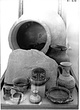
| Grave 2 in notebook. Child of about two (or 10?) months, body placed in plain pithos, which rested on its side at the bottom of a pit; the mouth closed with a stone slab.
The burial forms a group with ... 750-725 B.C ... Hesperia 19 (1950), pp. 330-331, pl. 104 a-c. |
| Cistern at 75/ΜΓ connected with cistern N 18:3 by tunnel.
Only coin is Bioiotian dating between 220 and 197. Only indications of date are 1st c. lamps, two long-petal bowls, and fragments of early Roman ... 1st. c. B.C. |
| Grave XVI in notebook = RSY Grave 3.
Bones of a young child found inside. Discarded? ... 6th. c. B.C ... 6th. c. B.C ... ΝΝ:104/ΙΓ |
Backfill of demolition of Great Monument beneath Middle Stoa.
[Soft pit below Layer II of south aisle (=fill of early "Great Drain")] ... Early 4th c. B.C. |
| Coins:
16 June 1981 #89
17 June 1981 #94-#95, #100 (not a coin).
19 June 1981 #103-#104, #335-#336
23 June 1981 #111-#112 ... 9th-13th c. A.D. |
Lower filling mostly of second half of 4th c. B. C. and earlier, but perhaps dumped in 3rd c. B.C. Upper filling mixed to Roman (4th c. A.D.). Pottery in container (9-22-58) is mostly second half of 4th ... Ca. 375-325 B.C. with late-3rd-century disturbance |
Back fill in an unfinished well, originally dug only to a depth of 3.80m. Apparently dug in the 3rd. c. B.C. and refilled at once; the filling contained a scattering of 5th. and 4th. c. fragments as well ... To early 3rd century. |
Use filling of first half of 1st c.; dumped filling of late 1st c.(?). This well, near its mouth, cuts off the end of the upper passage of the cistern at 53/Ε. Subdivisions:
.1=Dumped filling
.2=POU ... First half of 1st c. A.D. POU |
Sacrificial Pit VI in notebook = RSY Grave 18 See also B 21:23 ... Ca. 525-500 B.C. |
| Above bedrock in N.W. corner of room S, House of Greek Mosaic. Contents suggest "saucer-pyre" ... Late 4th-early 3rd c. B.C. |
Cistern at 60/ΙΕ; bell-shaped cistern with a channel 1.65m high and 4.60m long, leading to a dead end against bedrock. This channel runs north with a slight curve to the east and looks as though it was ... Second half of 3rd c. B.C.-Early 2nd c. B.C. |
Green and sandy fill in foundation. Coins:
15 May 1936 #1-#5 ... 4th c. B.C ... 4th c. B.C ... Γ:104-106/ΛΔ-ΛΣΤ |
Chamber of water system with one blind tunnel and two cisterns connected by tunnel. Pottery consistent throughout, late Hellenistic. Late 2nd c. B.C.
Ten stamped amphora handles. Most of bowls long-petal ... 100-75 B.C. |
Dumped fillings thrown in during second quarter of 1st c. B.C. containing mostly debris resulting from Sulla's sack in 86 B.C.
Agora XXIX, p. 464: Four fills distinguished during excavations ... but seemingly ... Late 2nd c. and early 1st c. B.C. POU; 110-75 B.C. |
| Cistern at 77/Μ on lower north slopes of the Areopagus. Bottom diameter of 2m connected by tunnel to cistern M-N 18:1.
Only stamped amphora handle dates slightly after 240. Latest coin dates about 200 ... 3rd c. B.C.-196/190 B.C. |
| Dumped filling of late 2nd c. B.C.; Roman Group F, dumped filling of second quarter to end of 1st c. B.C. on the lower northeast slope of the Areopagus.
Diameter at bottom -3.20m Upper fill: Latest coins ... Second quarter to end of 1st c. B.C. |
Pottery discarded ... Mixed to Roman, 3rd c. A.D ... Mixed to Roman, 3rd c. A.D ... Γ:104-106/ΛΔ-ΛΣΤ |
South Stoa II Construction Fill.
About 85 stamped amphora handles, many with parallels in building fills of Middle Stoa and Stoa of Attalos. Fragments of long-petal bowls confirm date after mid-2nd c ... To ca. 140 B.C. |
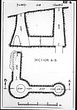
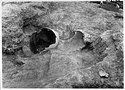
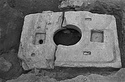
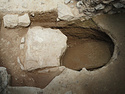
| Marcie Handler ... This deposit is a Mycenaean cist grave with two cover slabs, a type of burial described by Immerwahr in Agora XIII (pp. 103-104). Cist graves appear side by side with chamber tombs in the Mycenaean cemeteries ... LHIIB-LHIIIA:1 ... This deposit is a Mycenaean cist grave with two cover slabs, a type of burial described by Immerwahr in Agora XIII (pp. 103-104). Cist graves appear side by side with chamber tombs in the Mycenaean cemeteries of the Agora.
... The fill on top of poros slab (Lot ΒΖ 2135) included pottery dating mostly to the late 8th c. B.C., but also it included a few sherds of the first quarter of the 5th c. ... The upper fill covering the boulder on the west end of the cutting (Lots ΒΖ 2128 and 2130) dated to ca. 500 B.C., and the fill lying directly on top of the boulder (Lot ΒΖ 2131) dated to the late 8th c. B.C., indicating that the tomb was covered over in the late Geometric period. |
|
|