|
|
Scanty remains of use fill in lowest 0.30m. with Byzantine dump above ... 400-350 B.C ... Scanty remains of use fill in lowest 0.30m. with Byzantine dump above. |
| James Artz Pirisino Daniele Kylindreas Miltiades ... Excavation in Room 3 of ΒΘ West revealed 5 ceramic vessels in a row against the eastern face of Wall 12. 3 complete vessels (ΒΘ 122, 124, and 125) were catalogued, along with the base of a plain glazed ... 9th-11th c. A.D ... The primary types of glazed Byzantine pottery found in the fill included green and brown painted ware, plain glaze ware, Constantinople white ware, and monochrome glaze.
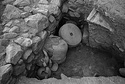
... The fragmentary remains of a ceramic pithos (ΒΘ 178) were revealed after the removal of a reused threshold block above the pithos. ... We also uncovered fragments of a Byzantine vessel at an elevation of 53.590m, which were later removed entirely (ΒΘ 302).
|
Rodney S. Young ... (E.L. Smithson: Grave XXXVI:PG). Early fill over bedrock. No remains.
Two fragmentary unburned vases were found together on bedrock, beneath Roman and Byzantine fill. Disturbed earth over bedrock for several ... Early Protogeometric ... Early fill over bedrock. No remains.
Two fragmentary unburned vases were found together on bedrock, beneath Roman and Byzantine fill. |
| Not completely excavated due to instability of chamber walls and water. Sherds of all periods - Greek, Roman and Byzantine - were found in it [nbp. 424].
Re-examined in 2010. Photos and notes on NB pages ... 10th c. A.D ... Sherds of all periods - Greek, Roman and Byzantine - were found in it [nbp. 424].
... Around its mouth is the remains of a square platform of tile, stone and mortar, with a segment of a square ceramic drain running along the northeast. |
|
|