|
|
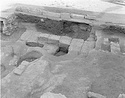
Grave in north peristyle of Hephaisteion. Grave LIX in notebook.
No mention of bones. Containers 473 and 474 represent filling between graves. Coins:
11 March 1939 #16 Neg. KK 391 ... Byzantine |
| Well South of Soft Yellow Poros Foundation. Dumped filling of a collapsed well, that, due to hazardous conditions, could not be cleared below- 2.50m. The well was partly cut on the east side by a Byzantine ... Protogeometric-Early Geometric II, ca. 850 B.C ... The well was partly cut on the east side by a Byzantine storage pithos, and on the south side it was disturbed by another, tile-lined, well of the Roman period (U 19:4), which had been used for water and then as a cesspool inn the early 20th century.
Filling almost entirely later Protogeometric, with a few sherds of Earliest Protogeometric, all apparently drawn from disturbed graves.
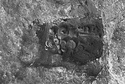
At -1.50m a complete and ordered skeleton (man of 45-50 years old), doubled up so that its thighbones were parallel to and to the backbone, lay on a rough stone slab. |
| Eugene Vanderpool ... Rectangular pit, oriented east-west, cut party into filling of Early Protogeometric pit-well (I 18:4), to a preserved depth of about 0.30m. A late Byzantine wall founded below the floor of the grave destroyed ... Middle Geometric I ... A late Byzantine wall founded below the floor of the grave destroyed the entire eastern half of the earlier burial. ... Although half of the tomb was entirely destroyed by later building activity, what survived constitutes one of the richest graves on the slopes of Areopagos and in Early Iron Age Athens. |
|
|