|
|
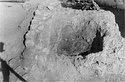
| Pit with traces of burning ... Probably 3rd qtr. 5th c. B.C ... Pit with traces of burning. |
Pit on north slope of Kolonos Agoraios. Traces of burning in the dirt fill; mixed in with this many fragments of fine pottery ... Ca. 450-420 B.C ... Pit on north slope of Kolonos Agoraios. Traces of burning in the dirt fill; mixed in with this many fragments of fine pottery. |
Pit at 57/ΚΑ; small pit on the lower north slope of the Areopagus, measuring 1.05x0.80mx0.80m deep. There were traces of burning and a few bones in it, since none of them are recognizably human it is probably ... 480 - 470 B.C ... Pit at 57/ΚΑ; small pit on the lower north slope of the Areopagus, measuring 1.05x0.80mx0.80m deep. There were traces of burning and a few bones in it, since none of them are recognizably human it is probably a refuse pit rather than a grave. |
Cistern at 53/ΝΕ, bottle-shaped, stucco-lined, in the east aisle of the peristyle of Roman House H (courtyard of Greek House G, just west of andron).
Lower diameter 2.73m.
Homogenous fill all apparently ... Into early 2nd century B.C ... Cistern at 53/ΝΕ, bottle-shaped, stucco-lined, in the east aisle of the peristyle of Roman House H (courtyard of Greek House G, just west of andron).
... Homogenous fill all apparently deposited at one time, traces of burning on much of the pottery. No discernible period of use fill.
Particularly fine series of Megarian bowls. |
Filling under North-South Road surface, apparently to raise the level of the road as thickness of fill varies depending on height of road. Fill sits on earliest, cobbled road layer. The road surface set ... Mid-6th c. B.C ... Filling under North-South Road surface, apparently to raise the level of the road as thickness of fill varies depending on height of road. ... The road surface set upon this fill consists of cobbling to the west and a hard packed surface to the east ... Some traces of burning. Much of the pottery is decorated with black figure. |
| Initially was recorded as disturbed saucer grave, but identified as pyre by SIR.
Found by gardener washing out of scarp during the winter rains. The location is just south of an east-west road; there ... 1962 ... Found by gardener washing out of scarp during the winter rains. The location is just south of an east-west road; there were traces of houses in this general area. There are signs of burning on some pottery. |
| Pyre in Room 8 of Roman House H. Concentration of artifacts, bone, and flecks of carbon in stratum, no pit discerned. the pyre lay within a red fill apparently contemporary with it, but with some later ... 300-290 B.C ... Pyre in Room 8 of Roman House H. Concentration of artifacts, bone, and flecks of carbon in stratum, no pit discerned. the pyre lay within a red fill apparently contemporary with it, but with some later intrusions; no trace of a floor above it survives. ... The pottery shows traces of burning. |
Well A (depth 10.20m, diameter 1.04m, water level 4m) outside the SW corner of the market square, to the east of the north-south road.
At the bottom of the well were scanty remains probably from a period ... Ca. 425-375 B.C ... Well A (depth 10.20m, diameter 1.04m, water level 4m) outside the SW corner of the market square, to the east of the north-south road.
At the bottom of the well were scanty remains probably from a period of use, but without whole water jars; above this lay a heavy deposit of mud, containing little pottery; the dumped filling in the top of the well was extremely fragmentary and carried considerable traces of burning. |
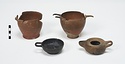
| A compact group of four complete vases and a lamp, found on a house floor; possibly the remains of a sacrificial pyre but without evidence of burning or the characteristic votive vases.
Layer II, "nest ... 425-400 B.C ... A compact group of four complete vases and a lamp, found on a house floor; possibly the remains of a sacrificial pyre but without evidence of burning or the characteristic votive vases.
... The surfaces of the lamp and the Corinthian skyphos show traces of burning. Neither burning nor bone is recorded (Young has not identified as pyre probably because of the early date, which would have made its burial after the abandonment of the house impossible). |
| In room A. Concentration of artifacts and burning in stratum, no pit discerned. The pyre lay below a Late Hellenistic fill with a smooth earth surface. It is described as a black patch of earth with sherds, ... 350-250 B.C ... Concentration of artifacts and burning in stratum, no pit discerned. ... Strosis II, on which the pyre rested, covered the walls of Room A, demonstrating that the pyre postdates a change of plan or abandonment of this part of the building, other parts of which survived to the Late Hellenistic period. The pottery shows traces of burning. No bone was recorded. |
Eugene Vanderpool ... Disturbed burial: Pocket in bedrock (Grave 11: PG). In some records as Grave XI. No remains. No cutting or traces of burning nearby
The coin listed here was found "cleaning bedrock", presumably at the ... Developed to Late Protogeometric ... No cutting or traces of burning nearby
The coin listed here was found "cleaning bedrock", presumably at the time the disturbed burial was found [5 March 1934 #5).
The vases constitute evidence for early burials on the southeast slopes of the Kolonos Agoraios, although no trace of graves, or of any robbed tomb pits, was preserved nearby. It is equally possible that the vases derive from a destroyed tomb on the southeast side of the hill proper, rather than its slopes. |
| Pyre in north central room of house, measuring 0.50m east-west by 0.35m north-south. Pottery, bone, and burnt material in pit dug into layer IIb (crushed bedrock floor: lot Ω 464, 4th c.) and covered by ... 350-325 B.C ... Pyre in north central room of house, measuring 0.50m east-west by 0.35m north-south. ... The stratigraphy around the pyre cannot be physically connected to the architectural history of the house, but the date of the pyre would be consistent with a dedication at the time of the rebuilding or during the subsequent reoccupation. There were extensive traces of burning, and teh pottery has been burnt. |
| Mycenaean Grave to W of Pier 12 (Burial 11).
The northern part of the tomb had been cut away by the foundation trench for the south stylobate of the Square Building that preceded the Stoa, and the dromos, ... Myc. IIB-IIIA:1 ... Mycenaean Grave to W of Pier 12 (Burial 11).
... The chamber was small with an original east-west dimension of 1.60m and a preserved north-south dimension of 1.20m, the walls preserved to a maximum height of 0.90m. ... Beneath the skull were slight traces of black, either from burning or from the decay of organic matter.
|
| Rodney S. Young ... Grave 19 (In some records as Grave VIII). No remains, no burned matter or traces of burning.
JP
A small cutting with a single offering. The pit may have been for a simple child/infant inhumation, with ... Early Protogeometric ... No remains, no burned matter or traces of burning.
JP
A small cutting with a single offering. ... The floor of the pit comprised unhewn fieldstones packed closely together. The pit yielded no evidence of human remains, but a few small sherds were noted, one classified "Geometric" (not inventoried), suggested that this too, may have been a robbed Early Iron Age grave. |
| Dorothy Burr Thompson ... Child's Grave (E.L. Smithson: Grave XXVIII: G).
Cf. Container Lot ΣΤ 165 (fill over geometric grave).
Neat, rectangular, unlined trench, cut into bedrock to a preserved depth of 0.20m,below the level ... Early Geometric I ... Neat, rectangular, unlined trench, cut into bedrock to a preserved depth of 0.20m,below the level of the floor of the so-called Geometric House. The tomb was located in the area between pits A and D, and was just over 2m to the east of the preserved west wall of the Geometric House. ... Slight traces of carbonized matter were noted at the southeast end near the cranium, with small specks of carbon throughout the earth fill,but no substantial traces of burning or any burnt pots. |
| Margaret Crosby ... Grave 1 (Grave XXVI: EG) Urn cremation (trench-and-hole), adult male?
[JP]
Boots or Booties Grave. Near the west branch of the Great Drain, about 100m to the southwest of the Agora horos inscription ... Early Geometric I ... Near the west branch of the Great Drain, about 100m to the southwest of the Agora horos inscription. ... The corpse had been cremated on a pyre, probably nearby at the ground-level of the time. There were no traces of burning on the bottom or the sides of the pit itself, which was in any case too small to have held the pyre. ... Rough walls of dry stone were built up to east and west of the deep hole containing the ash-urn; these served to support the ends of slab of a bluish-grey limestone placed as a cover to protect the amphora with its ashes. |
|
|