|
|
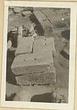
Top surface finished with toothed chisel and anathyrosis surface at right preserved; broken elsewhere. Cutting for large T-clamp partially preserved on line of break. Clamp has been carefully removed ... 9 February 1952 |
A 138 (Ζ 30) - A 144 (Ζ 36) are from the same series.
Right end of this block probably joins A 144.
Blue Hymettian marble.
Found at G/15-12/17 (Fall 2016). Pre-excavation, demolition of house 632β/16 ... 1933 |
| Corner. The shorter face of the block is less well finished than the longer, hence probably faced side of building. Rectangular dowels with pour channels for column base whose diameter was about 0.56m ... 1933 |
Rectangular dowel in bottom.
Rectangular dowels for column base in top, with pour channels. Lower part of back of block projects irregularly, showing how deep paving slabs were, ca. 0.20-0.25m.
Blue Hymettian ... 1933 |
| Top surface shows practically no wear but bottom is badly worn by reuse as a paving block.
Both ends show clamp position scratched on, and further back the clamps as executed.
Same workmanship and series ... 1933 |
Dowel in right end for course above still retains head. Iron hard to trace. The clamp at this end also retains some lead, both being worn down with surface of block by reuse.
Blue Hymettian marble.
A 138 ... 1933 |
| Bottom of sigillata bowl with low ring foot, a single groove around its outer face.
Rectangular stamp in center of floor. One line of letters with palm branch below: .
Red-brown clay. Red glaze somewhat ... 5 May 1952 |
| From a lateral horizontal cornice, a cyma reversa soffit molding with a vertical fascia high above it. The nosing molding is much battered; possibly an ovolo. In the top two rafter cuttings, and at each ... 10 May 1937 |
| Fragment Θ 26 a), from right side of inscribed block; fine picked on one side, rough picked on the back.
Fragment Κ 115 b), back and left side preserved. Fifteen lines of the inscription preserved.
Fragment ... 127/6 B.C ... Some of the main fragments were used in the filling of the south tower of the gate in the late Roman Fortification (Q 13); other main fragments came from modern house walls in this neighborhood, no doubt extracted from the Fortification; and a few were found in modern constructions 100m. and more to the north and west of the tower. ... The stele appears to have stood originally in front of the terrace of the Stoa of Attalos, about opposite Pier 5 from the south, and to have been broken up after the Herulian invasion for use as building material in the late Roman Fortification. ... Hesperia 4 (1935), p. 90.
BCH (1934), pp. 92-93. |
|
|