|
|
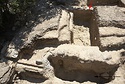
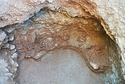
Burial disturbed. Located in Middle Stoa, north aisle, "upper trench", piers 3 and 4. Two individuals: small child (ca. 5 yrs. old) and adult female.
In its disturbed state the burial was found (at elevation ... First half of 7th c. B.C ... In its disturbed state the burial was found (at elevation -57.58m E to -57.52 W), resting against the cut scarp of the bedrock in a pocket 0.65m deep and 0.70m across; evidently, it was originally covered by a mass of cobblestones. ... Either at this date or during a later disturbance, the grave "cairn" was leveled, with the cobblestones strewn downward over the earthen slope of the bedrock escarpment. |
Brian Martens ... This deep stratum (ca. 030m) is delayed Persian destruction cleanup deposited in the 470s B.C. it contains about one generation's worth of pottery, almost exclusively dating between about 500-470 B.C ... 29 June-19 July 2017
12–15 July 2022 ... The dump of pottery raised the floor level of the building; atop J 1:18 was a layer of crushed bedrock and a renewed floor surface.
The deposit joins fill taken in 2013 that runs under the scarp of Wall G.
Addendum 2022: The collapse of Wall G’ allowed further work on deposit J 1:18 in the 2022 season. |
| Laura Gawlinski ... Ovoid pit cut into bedrock or sterile fill just north of preserved floor surfaces in the so-called Strategeion. Length (west-east) 2.6m; widens at 1.25m from the east scarp so that at west pit is 0.75m ... 4th B.C ... Ovoid pit cut into bedrock or sterile fill just north of preserved floor surfaces in the so-called Strategeion. Length (west-east) 2.6m; widens at 1.25m from the east scarp so that at west pit is 0.75m wide, at east 0.85m wide. May continue slightly into east scarp.
Uncovered directly under smaller pit of marble chip debris (see Lot Γ 383; Basket 4, p. 3985). |
| Brian Martens ... It was partially excavated during the 2012 and 2013 seasons. The tomb, located at the center of Room III in the NE area of section ΒΖ, was found under fill surrounding perpendicular mid-to late 6th c ... LHIIIA ... The foundations, part of a now-absent structure through the area, were inserted deeply as the result of an anomaly in the soil: the collapsed tomb, cut into the hillside's soft bedrock. Leveling fill over Walls 17 and 18 indicates disuse within the first half of the 5th c. ... Large chunks of soft, blue-green bedrock were found throughout the fill, most probably from the collapsed bedrock walls or ceiling of the tomb.
... A strip of fill at the north side of the cutting, just below the scarp of Wall L remained unexcavated at the end of the season (J/17,18-1/10,11; 51.290-51.376 masl.)
2018:
We removed a final strip of fill in the chamber below the scarp under Wall K (J/17,19-1/10,11). |
| Brian Martens ... Mycenaean Chamber Tomb J 1:11, located in the area north of Wall K, was partially excavated during the 2014 season. At this point the full western extent of the chamber has not been located because of ... LHIIIA ... The southern edge of the dromos, cutting into the marl bedrock, was excavated up to Wall 7. Only a small portion of the northern edge, cutting into the rocky red virgin fill, could be revealed; the remainder is presently concealed under the scarp of still-standing Wall P. the stomion and its intact blocking wall were found behind a thin layer of fill centered at the western side of the chamber. |
|
|