|
|
Sand fill N of Base A.
... Because of the uncertainty of ground level contemporary with Base A and of the possibility of missing a continuous strosis or disturbance in this soft sandy fill, I have kept ... Last quarter 2nd-first quareter 3rd c. A.D ... Sand fill N of Base A.
... Because of the uncertainty of ground level contemporary with Base A and of the possibility of missing a continuous strosis or disturbance in this soft sandy fill, I have kept the pottery from the separate patches dug separately; hoping that when the pottery of 2nd and 3rd c. |
Pit in Bedrock South of Large Monument Base, just West of the Stoa of Attalos ... First half of 6th c. B.C ... Pit in Bedrock South of Large Monument Base, just West of the Stoa of Attalos |
Containers ca. 140-207. From containers ca. 170 to bottom, catalogued objects seem to represent a gradual accumulation from 1st c. A.D. to mid-3rd c. Divisions between are arbitrary and therefore combined ... Mixed post-pre-Herulian ... Divisions between are arbitrary and therefore combined in data base as 'lower fills'. |
| Homer A. Thompson ... Child's grave, Geometric.
The bones of a child about one month old had been placed into P. 25787, which was lying on its side. The upper side of the pot was cut away in later times. The mouth was closed ... Late 8th c. B.C ... The mouth was closed with the base P 25788. The four small pots were placed outside to one side. |
Dumped fillings thrown in during second quarter of 1st c. B.C. containing mostly debris resulting from Sulla's sack in 86 B.C.
Agora XXIX, p. 464: Four fills distinguished during excavations ... but seemingly ... Late 2nd c. and early 1st c. B.C. POU; 110-75 B.C ... Treated as one fill for data base.
Thirteen stamped amphora handles. |
| Rodney S. Young ... Grave 10 in notebook. No remains. Probably grave of a woman.
Only a small portion of the inhumation pit was preserved at the northeast edge of pit A, a large oval cutting of modern date dug for the construction ... Middle Geometric II ... The tomb was cut with a northeast-southwest orientation, interrupting the series of graves (Tomb XVII-XX), which radiate from the base of the hill.
No remains. |
Thra (ΘΡΑ) Well (East of Stoa Room 2). Heavy dumped filling, including figured, black and plain wares, and also a quantity of animal bones, mostly skulls of oxen. On many of these the horns had been sawn ... Ca. 520-480 B.C ... On many of these the horns had been sawn off sharply near the base; the freshness of the sawn surface suggested that this had been done at the time of slaughtering rather than while the animal was still alive.
|
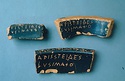
| Pit (6x10) in the valley between the Areopagus and the Hill of the Nymphs. Large cutting in bedrock with 540 ostraka, mainly of the late eighties of the 5th. c. B. C. Much pottery, principally of the early ... Ca. 500-450 B.C ... This deposit needs more work: check notebooks and data base to make sure all ostraka are recorded in both sources. |
| Eugene Vanderpool Homer A. Thompson ... Mycenaean Grave to W. of "Court Room" below Stoa Terrace with "Ballot Box" (Grave XXIX).
Unusual type, conforming neither to our pit nor to our cist graves, and consisted of two parts. The outer part was ... Mycenaean III A-B ... The narrow space was full of gray earth and clay with no trace of bones or any offerings, although the base of a goblet was embedded in the stones of the north side. |
| Rodney S. Young ... Grave 8 in notebook. Bones discarded. Fragments of an iron pin found on the chest and a fragment of a Protogeometric krater base found beside the body were not inventoried.
JP
Unlined roughly rectangular ... LH III/EPG (date uncertain) ... Fragments of an iron pin found on the chest and a fragment of a Protogeometric krater base found beside the body were not inventoried.
|
Michael Laughy ... Debris pit, located in Room 2 of ΒΘ East. Pit measures ca. 2.30 by 1.70m., and nearly a meter deep. The pottery from the pit dates ca. 10th-12th c. A.D. The fill of the pit consisted of soft, black charcoal ... 10th-12th c. A.D ... Lot T 199:
coarse body sherds, handles, rims; base; amphora handle; combed ware; ridged ware; cooking ware; monochrome glaze; polychrome sgraffito (late Byz); monochrome sgraffito (12th - 13th c and 13th - 14th); monochrome with tripod still on sherd (13th c onwards); slip painted ware; green and brown glaze (Late Byzantine); slip painted (Early Modern)
(mostly 12th-14th c. |
| Laura Gawlinski ... Bronze foundry north of bridge on Piraeus street, east of Great Drain.
Keyhole-shaped bronze casting pit, cut into bedrock.
2016: Continuation of the excavation of a rectangular pit with foundry debris, ... Late 6th-early 5th c. B.C.
(Late Archaic/ Early Classical) ... Seven standing mudbricks line the bedrock wall at south, surrounding a ceramic stand, hand-formed on a cut bedrock base. An iron rod projects from the center, traces of pouring channel at top, originally connected to some of the mold fragments.
|
| James Artz Pirisino Daniele Kylindreas Miltiades ... Excavation in Room 3 of ΒΘ West revealed 5 ceramic vessels in a row against the eastern face of Wall 12. 3 complete vessels (ΒΘ 122, 124, and 125) were catalogued, along with the base of a plain glazed ... 9th-11th c. A.D ... Excavation in Room 3 of ΒΘ West revealed 5 ceramic vessels in a row against the eastern face of Wall 12. 3 complete vessels (ΒΘ 122, 124, and 125) were catalogued, along with the base of a plain glazed flat-bottomed basin (ΒΘ 121). ... Plain glaze ware; Constantinople white ware; monochrome glaze; green and brown painted ware; combed ware; ridged ware; gouged ware; amphora toe; incised coarse ware; Roman lamp fragment and red wares; classical red and black glaze (including geometric, archaic, and classical); coarse base with strange shape, handle and neck close to base; coarse handles, bases, rims, and body sherds; micaceous body; cooking ware, including joining lid fragments; painted and unpainted plaster; roof and floor tile fragments; pithos lid, rim and body fragments; worked stone; stone revetment; bone; metal; glass |
| Mycenaean Chamber Tomb below Middle Stoa Terrace.
The tomb was entered from the west by a stepped dromos, at least 4.20m long by 1.10 to 1.50m. wide, splaying slightly toward the doorway, which was 1.26m ... Myc. IIIA:1 ... The tomb was entered from the west by a stepped dromos, at least 4.20m long by 1.10 to 1.50m. wide, splaying slightly toward the doorway, which was 1.26m high by 0.60m wide at the base with a lightly arched top. |
Washed-in filling at the base of the Acropolis cliffs, some 7m. east of the Klepsydra; the fill was characterized by teh fragments of a series of red-figured oinochoai of special shape, of the late 5th ... Late 3rd c. B.C ... Washed-in filling at the base of the Acropolis cliffs, some 7m. east of the Klepsydra; the fill was characterized by teh fragments of a series of red-figured oinochoai of special shape, of the late 5th c. |
|
|