|
|
Reused as part of a modern cistern; scanty remains of ancient fill towards bottom. No containers of pottery ... 1st c. A.D ... Reused as part of a modern cistern; scanty remains of ancient fill towards bottom. |
East-West Street (63-64/ΙΣΤ, etc.)
Packing in line of ancient east-west street along Areopagus north slopes.
Lower fills, predominantly late 6th-early 5th c. B.C.
Middle fills, last quarter of the 5th ... Various levels and dates ... Packing in line of ancient east-west street along Areopagus north slopes.
... These fills correspond closely to the apparent three periods of a house of which very scanty remains were observed directly to the south of the street: notebook House D. |
| Mycenaean Tomb to NE of Pier 19 (Burial #1)
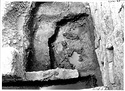
Most of the doorway and the dromos had been cut away by the ancient Stoa builders. The dimensions of the chamber were 2.90m wide by 1.60m deep. Unusual features ... Myc. III A:1 ... Mycenaean Tomb to NE of Pier 19 (Burial #1)
Most of the doorway and the dromos had been cut away by the ancient Stoa builders. ... Skeletal analysis revealed the remains of twelve interments. |
| Eugene Vanderpool ... Grave (adult female). (In some records as Grave XXXI).
The tomb was partly destroyed in antiquity; there are sherds of all periods down to Late Roman (and later) note din the fill immediately above it ... Middle Geometric I ... A modern well was partly cut into the northeast portion of the tomb as preserved, and an ancient block, reused in a modern wall, was founded directly on bedrock just to the southwest of the tomb.
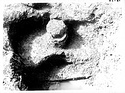
... The cinerary urn, contained the cremated remains of an adult female, aged ca. 30 years at death according to Angel, but aged 40-50 years at death in the more recent reanalysis.
The amphora also contained a few fragments of bronze and iron jewelry , described by the excavator as pins, which had disintegrated and were never inventoried: it is possible but not certain, that these were remnants of jewelry melted out of shape by cremation. six fragments of animal bone were also encountered inside the cinerary urn, together with the cremated human remains. Most of the fragments were identified as dog and were unburned. a few fragments of mudbrick in the upper fill of the well may also have come from the grave. |
| Mycenaean Chamber Tomb occupies a considerable part of the western half of section ΕΕ; lies about half way up the north slope of the Areopagus towards its eastern end, just below the highest point of the ... Myc. III A:1 ... The maximum preserved depth in front of the doorway is about 2.90m but originally it must have been a meter or two deeper, for the surface of bedrock has been considerably cut down here in modern and ancient times. The fill of the dromos was uniform throughout its length: soft clean greenish earth with pebbles and occasional small stones; few sherds. ... High above the chamber to the south, about five meters above its floor, is the remains of a wall of a late Roman house, part of which passed over the southwest corner of the chamber and had to be removed. |
|
|