|
|
Hellenistic fill, north of Temple of Ares, on either side of wall running east-west over 50/ΙΓ. Mostly coarse pottery including many stamped amphora handles.
Cf. also nb. P XII, pp. 2297-2298. Coins:
13 ... 275-200 B.C. |
Same filling as Theseion Street Deposit D 7:2 but separate list.
Perhaps also P 7904. Area disturbed by Turkish (50-56/ΜΓ-ΜΣΤ).
This is 3-4 m. west of Hephaisteion, and the hole was probably filled at ... Ca. 500-470 B.C. |
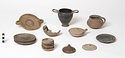
Deposit of fine table ware and lekythoi, both black-figured and red; the plain wares closely resemble those from the well H 6:5 ... 470-450 B.C. |
Use filling of first half of 1st c.; dumped filling of late 1st c.(?). This well, near its mouth, cuts off the end of the upper passage of the cistern at 53/Ε. Subdivisions:
.1=Dumped filling
.2=POU ... First half of 1st c. A.D. POU |
| Crevice in Rock (Grave?) at 70/ΝΣΤ (below modern surface accumulation).
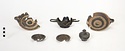
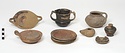
Identified as a sacrificial pyre, with characteristic banded plates and saucers, by SIR ... 4th c. B.C./300-250 B.C ... Hesperia Suppl. 47 (2013), no. 53, pp. 165, 166 figs. 6, 101 ... Agora XII, p. 389. |
Filling behind retaining wall of Stoa of Zeus. The remains of unfired clay adhering to the interior of various pieces make it probable that the material in this filling is a mass of debris from the floor ... Ca. 435-425 B.C ... Agora IV, p. 240 ... Agora XII, p. 392 ... Agora XXX, p. 363. |
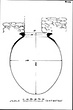
Well, neatly stone-curbed to bottom. Diameter 0.70m. The use filling, from about 3.50m to bottom, consisted chiefly of water-jars with a few small vases and some black-figured fragments.
Upper filling, ... Use filling of ca. 575-550 B.C. |
Cistern (diameter 0.90m) with two channels; the fill of the cistern proper, below the scant upper (Byzantine) deposit, appears to have been dumped all at the same time, to 325-275 B.C. Notebook says "all ... 325-275 B.C ... Agora XII, p. 387 ... Agora XXIX, p. 442 ... Agora XXX, p. 361. |
A filling lying over a cobbled floor in a house-complex on the lower north slopes of the Areopagus.
Area in front of E-W retaining wall, just above cobble pavement, disturbed by coins and pottery as late ... 375-275 B.C. |
| Pithos ay the bottom of the north slope of the Areopagus with single fill; Part of Hellenistic Group D.
One stamped amphora handle dates slightly after 146. Latest coin dates in first two decades of 2nd ... 160-130 B.C. |
| Burned deposit: Middle Terrace, south of Archaic cemetery.
RSY: Pyre 10.
Pottery, burnt bone, charred logs, and heavy burning, recovered by tunneling under the cement floor of a Late Hellenistic workshop, ... Ca. 325-300 B.C ... Agora IV, p. 235 ... Agora XII, p. 385 ... Agora XXIX, p. 439. |
| Pyre in Room 1, area west of street (RSY=Pyre 11).
Early in the third quarter of the 4th. c. B.C.
In courtyard. Artifacts, bone, and cinders in irregular pit in floor sequence. The pit had been dug into ... 350-330 B.C ... Hesperia 20 (1951), p. 127, pl. 53 b (Pyre 11) ... Agora XII, p. 384 ... Agora XXIX, p. 436. |
Rectangular pit at 54/ΛΓ.
The pit's plan is irregular; its measurements approximately 2.00x1.10x1.15m. The wall foundations run a little over a meter deep at 53/ΛΓ-ΛΕ, consist of irregularly shaped and ... Ca. 450-425 B.C. |
| Pyre in Room 2, area west of street (RSY=Pyre 12).
In courtyard. Artifacts, bone, ash, carbon, and cinders in pit in floor sequence. The rectangular pit was cut into a white strosis with marble chips (ΠΠ ... 315-300 B.C ... Hesperia 20 (1951), p. 128-129, pl. 53 c (Pyre 12) ... Agora XII, p. 384 ... Agora XXIX, p. 436. |
Cistern with two tunnels, the one entering its neck cut off by an early Roman well, the other, at the bottom not excavated.
Chamber conical in shape, with a depressed draw basin in the center of the floor ... Early Roman-3rd c. B.C. |
Associated with the Tholos.
Originally a well but after it had been in use for a short time the shaft was partially filled in and the upper part widened to form a large cistern.
The pottery falls into ... 335-250 B.C ... Hesperia 53 (1984), p. 345 ... Agora IV, p. 238 ... Agora XII, p. 389. |
Well associated with the Tholos, with scanty use fill but primarily dumped filling. Coins:
5 April 1934 #1-#4
10 April 1934 #1-#2
11 April 1934 #1
12 April 1934 #1
18 April 1934 #1-#2
19 April 1934 #1-#5 ... Ca. 350-294 B.C ... Agora IV, p. 238 ... Agora XII, p. 389 ... Agora XXI, p. 97. |
|
|