|
|
Ring foot. Rim flanged to receive lid; strap handles. Glaze badly peeled.
From the same deposit and workshop, a twin, P 14152, von Bothmer, loc. cit.; similar, P 24173 Q 15:2. For a neck fragment of somewhat ... Late 5th c. B.C. |
Common 5th century type. Others from the Agora are P 2362 R 13:4 Hesperia, IV, 1935, p. 515, fig. 27, 82; J.H.S., LXXXII, 1962, pl. V, 3, right; P 11015 B 15:1 Hesperia, XVIII, 1949, pp. 335-6, 99; P 21695 ... Context ca. 460-440 B.C. |
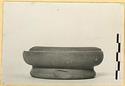
Ring foot. Rim flat on top. Reserved: resting surface and underside with glazed band, circle and central dot.
From the same deposit P 2310 Hesperia, IV, 1935, p. 476, fig. 1, 37, Pots and Pans, fig. 25, ... 450-425 B.C. |
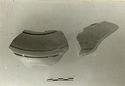
Part of foot and floor.
Very high ring foot, projecting slightly below. Inner junction reserved. Decoration inside: two zones of irregularly placed palmettes, with two circles between.
Similar, Izmir, ... Late 5th c. B.C. |
Mouth and part of handle missing. Restored on analogy of P 16672 (see below).
Flaring ring foot, low; concave handle, the upper attach- ment fixed below the narrow drip-ring. As restored, double curve ... Ca. 400 B.C. |
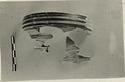
Lip and center of bowl missing.
Horizontal ribbing on bowl. Lip black; bowl intentional red.
The drawn profile of this phiale has been assisted by reference to P 23118 H 12:15-S, a similar ribbed phiale ... Ca. 500 B.C. |
Ring askos, the sides rounding over into large central opening; saucer mouth; spout tilted back against handle. Buff slip or surfacing; good black glaze on rim, inside and out, on top of handle and for ... Context ca. 520-490 B.C. |
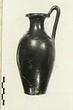
Tall-necked trefoil jug, rim ridged. Coarse buff clay; dull red glaze wash reaching to near foot. Imitation Cypriot (?).
The shape is like the Attic 4th century jugs such as 1621, Pl. 73, but the fabric ... Context ca. 375-350 B.C. |
| Broken above and below.
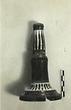
Small tapering stand for a lamp or an incense burner (?) broken over half way up by a large bead.
Pinkish buff clay; the bead black; horizontal bands of black glaze around the ... 3 June 1938 ... Agora XII, no. 1354, p. 331, pl. 44. |
Rim flat on top, sloping inwards. Rounded boss. The boss is surrounded by a ring of ovules and one of impressed palmettes. Reserved: interior of boss, top of it with circle and dot, and the rim; the rest ... 425-400 B.C. |
| Mended from three pieces. Black glaze in poor condition covers the entire vase.
Cf. Agora XII, no. 750. Well; uniform Greek fill. Leica, 3-314 ... 4 April 1933 ... Agora XII, no. 750 ... Hesperia 4 (1935), p. 476, no. 44. |
| Flat base rim. Body tapers quickly and moves in. Broad glaze band at bottom. Pinkish buff clay with bits; gray core, light surface; black glaze mostly peeled. Seventh century well below east part of Odeion ... July 1946 ... Agora XII, p. 44, n. 117. |
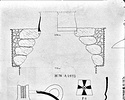
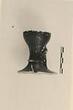
| Stand only preserved; mended from several pieces; part of base restored in plaster; broken above. Elaborately profiled; the base stepped; a broad collar, with concave profile, higher up. High hollow cone ... January-February 1950 |
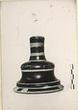
| Lower part of thymiaterion stand with high bell-shaped moulded base. Made up from two fragments; chipped. Narrow reserved bands on the base; alternating black and dilute bands on the stem.
Glaze dull ... January-February 1950 |
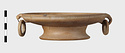
| Three joining fragments preserve the saucer and stand with one double ring handle. The ring from the second handle, broken off, is also preserved. Shallow saucer with flat-topped rim; high base with concave ... 22 April 1954 |
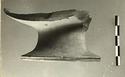
| The stem preserved with most of the wide flaring foot, and the center of the floor, with the start of the curve at the side. A groove around the outer face of the foot.
Fine pinkish-buff clay, with remains ... 30 April-10 May 1939 |
| Two non-joining fragments of a high dome-shaped lid with plain rim. The rim banded; above, zones separated by glaze bands and grooves; in each zone, eye-shaped holes.
Dull black glaze; reserved areas ... 17-24 May 1940 |
| Pear-shaped object, apparently complete, but perhaps chipped at top. Hollow and with a small hole in the top; bottom rounded.
Fine fabric of pinkish-brown clay; smoothly surfaced, perhaps with thin laquer(?); ... 15 May 1939 |
| A single fragment preserves the central part of the stem, broken off at both ends. A long tube, with a heavy spool-shaped moulding below the tapering tip. The lower part spreads out toward the base.
... 12 August 1947 |
| Part of the rim and base, and most of one handle missing; mended from several pieces. Flaring base, grooved on its outer face. Shallow body with plain flat rim. Kotyle handles at level of rim; a raised ... 10-12 June 1947 |
| About half of rim and some of foot missing. A small bowl with very heavy walls, sharply convex side and inturned rim; heavy foot.
Clay pinkish-buff. Surface finely finished. 639/17, shallow pit in N.E ... 13 June 1956 |
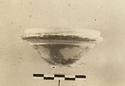
| Stem with base broken off. Conical bowl with flange on outside below rim, to receive lid.
Brown to black glaze, except on outer edge of rim. Possibly a lid(?). Well G. Leica, 83-250 ... 27-29 May 1936 |
| Part of the floor and the cylindrical stem and flaring foot of an unglazed dish. A groove around the outer edge of the foot.
Fine pinkish-buff clay; creamy slip. Unglazed. "Cistern", furnace waste pit, ... 27 May 1936 |
| A high stand; with flaring foot, broken off at the top; probably the base of a thymiaterion. Two reserved bands covered with white, and rays in black over the white. Seven bands of added white.
Attic ... 17-27 June 1935 |
| Much of lip and walls missing; restored in plaster. Domed lid with large knob ending in tiny button; lip slants in. Two rows of small holes carelessly punched in wet clay. Upper part of knob black; black ... 17-27 February 1937 |
| About half of rim and upper wall and all but stump of stand broken away. The small heavy bowl is rimmed by a vertical lip with a heavy keel below it, as if for a lid. Reserved: the edge of the lip, a shallow ... 23 May-3 June 1938 |
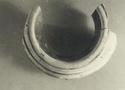
| Two non-joining fragments from the wall of a kothon or plemochoe. Raised rings one near top of wall, and a pair below shoulder.
Carefully made of pinkish-buff clay; unglazed but polished and decorated ... February 1947 |
| Foot entirely missing. Black glazed, partly fired red. Reserved inside, under the incurving lip. Well. Leica, 82-505 ... 31 May-5 June 1933 |
| Rather more than half the rim and lip preserved. None of the bottom or foot. The incurving lip is black glazed; the outside is ornamented with horizontal stripes of black, alternating with narrower stripes ... 31 May-5 June 1933 |
Half of rim, bases of handles, and a few fragments of lower body preserved; heavily restored.
Stubs of horizontal handles, round in section, joining just below rim and rising slightly. Two pairs of opposing ... 325-300? |
| Tall bell mouth; broad nearly flat shoulder; ring around base of neck. Band handle springing from junction of neck and shoulder.
Black glaze, rather dull; somewhat worn.
Cf. Agora XII, no. 1106. Well ... 1937 ... Agora XII, no. 1106 ... Hesperia 18 (1949), no. C 44, p. 326. |
| Handle and chips of rim missing. Low ring foot, convex sides rising to plain rim. Glazed inside and out. Glaze worn in places, mostly black, fired red on body near handle. Red fabric.
Cf. Agora XII, ... 28 June 1973 ... Red fabric.
Cf. Agora XII, nos. 772-774.
... Hesperia 44 (1975), p. 351, n. 33. |
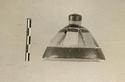
| Two joining fragments preserve the complete profile. Restored in plaster. Bell-shaped. Knob on top. Seven triangular openings on side. Exterior: horizontal bands of varying width alternately glazed and ... 19-23 March 1936 |
| Shaft broken at bottom. Minor chips throughout. A very heavy clay cylinder-shaft, pierced with a small vertical hole running up the center. At the top the cylinder flares out slightly and meets the crowning ... 7 June 1938 |
| Fragment from base and floor of an open glazed bowl.
Incised on interior:
Cf. Agora XII, no. 446. Well, main fill. 750 Leica PD 1133-51(K 5) ... 2-4 July 1932 |
| Complete except for chips. Mended and restored in plaster. Slightly concave bottom, elongated ovoid body, rising strap handle. Reserved: underside and within, below lip.
Good black glaze. Orange-buff ... 21 August 1973 ... Agora XII, no. 274 ... Hesperia 44 (1975), p. 361, n. 60 b, pl. 81:b. |
| Made up from four fragments; some pieces missing. Conical lid of thymiaterion with four triangular openings; ring knob with hollow top; downturned rim.
Knob reserved apart from dot on top. Upper part ... January-February 1950 ... Agora XII, no. 1346, pl. 44 ... Agora XXXI, p. 179. |
| Broken at both ends. A hollow tube with a kind of flaring collar around it, formed apparently of six leaf-like projections. A part of original edge of collar preserved. Three holes punched in collar in ... 28 May 1938 ... Agora XII, no. 1358, pl. 44 ... Agora XXXI, p. 176. |
| Much missing. Restored in plaster.
Thin, convex lid with knob on top. Upper surface lightly striated on wheel.
Gritty micaceous brown clay.
Cf. Agora XXXIII, no. 717. 4.60m. to bottom. Cistern. Leica ... 7-17 April 1936 |
| Fragment from top. Heavy cylindrical shaft (hollow) broken at lower end where it begins to flare out. Slight flare at top where it meets the crowning member, the vertical face of which is decorated with ... 3-5 May 1947 |
|
|