|
|
| Crevice in Rock (Grave?) at 70/ΝΣΤ (below modern surface accumulation).
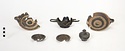
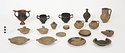
Identified as a sacrificial pyre, with characteristic banded plates and saucers, by SIR ... 4th c. B.C./300-250 B.C. |
Well associated with the Tholos, with scanty use fill but primarily dumped filling. Coins:
5 April 1934 #1-#4
10 April 1934 #1-#2
11 April 1934 #1
12 April 1934 #1
18 April 1934 #1-#2
19 April 1934 #1-#5 ... Ca. 350-294 B.C ... Agora IV, p. 238 ... Agora XII, p. 389 ... Agora XXI, p. 97. |
| North of House G (RSY=Pyre 13).
Concentration of artifacts, small pieces of bone, and burnt material in stratum, no pit discerned. The pyre is cut by the trench of a wall of a Roman house to north. It ... 290-250 B.C ... Agora IV, p. 235 ... Agora XII, p. 386 ... Agora XXIX, p. 440. |
Associated with the Tholos.
Originally a well but after it had been in use for a short time the shaft was partially filled in and the upper part widened to form a large cistern.
The pottery falls into ... 335-250 B.C ... Agora IV, p. 238 ... Agora X, p. 67 ... Agora XII, p. 389. |
|
|