|
|
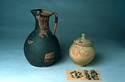
| Evelyn Lord Smithson ... Grave 3: (Grave XXVII: EG). Urn cremation (trench-and-hole), adult male. Carbonized figs and grapes included in inventoried objects (no number). [JP]
"Craftsman-Warrior" tomb: combination of weapons and ... Early Geometric I |
| Dorothy Burr Thompson ... Grave 2. Urn cremation (trench-and-hole). In some records as XXIII.
Variously labeled as grid 7/Δ, 7/Γ and 7/Γ-Δ.
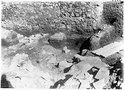
Rectangular pyre trench cut through earth into bedrock, with only the lowest 0.04m surviving ... Transitional Late Protogeometric/Early Geometric I |
| Dorothy Burr Thompson ... Grave 4 in notebook. (E.L. Smithson: Grave XLIV). No remains (not really a grave, note on p. 331).
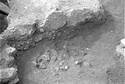
Roughly rectangular patch of unworked fieldstones, measuring about 1.20x0.80m neatly laid on bedrock, ... 19-21 March 1932 |
Dumped fillings thrown in during second quarter of 1st c. B.C. containing mostly debris resulting from Sulla's sack in 86 B.C.
Agora XXIX, p. 464: Four fills distinguished during excavations ... but seemingly ... Late 2nd c. and early 1st c. B.C. POU; 110-75 B.C. |
Cistern at 9/Β (10/Β on plan), at the NW foot of the Areopagus, some 200m to the west of the Coroplast's Dump. It had evidently belonged to one of the small houses in that thickly populated residential ... Second half 4th c. B.C. |
| An extensive cistern system on the lower north slope of the Areopagus, south chamber with blind tunnel extending further south (south tunnel); north chamber; drawshaft further north, extends to north tunnel ... Ca. 320-240 B.C. |
Part of the cistern system 44/ΙΓ - 46/ΙΑ - 42/Θ.
Objects with context as "cistern 44ΙΓ, mouth of 46/ΙΑ" are listed with D 12:2.
The following objects are from "earth", i.e. no context layer:
SS 5334, ... Late Hellenistic-Early Roman |
Well dug through cistern at 64/Γ. Seems to have been stratified; four fills recorded but here treated as one as divisions are rather "arbitrary".
Agora V, p. 126: Constructed in late 1st c.; use filling ... 3rd c. A.D. POU (before 267 A.D.) |
POU 3.50-10.30m. dumped filling of 5th or 6th century. Coins:
10 May 1949 #1
16 May 1949 #1
17 May 1949 #1-#2
19 May 1949 #1-#2
20 May 1949 #1-#12
21 May 1949 #1-#4 from dump
23 May 1949 #1-#3 from dump ... 3rd-5th c. A.D. |
Cistern connected by tunnel to another chamber filled in Byzantine period. Small Hellenistic deposit on floor. somewhat contaminated by Byzantine fill above
No stamped amphora handles later than 3rd c.; ... 250-190 B.C. |
Accumulated debris on the west side of the market square.
Related layers added 1999/2000 (JWH), e.g. "Gravelly layer above burning", "Clearing Classical floor", "Lowest level above bedrock", "Below burning", ... First half of 5th c. A.D. |
Sand fill N of Base A.
... Because of the uncertainty of ground level contemporary with Base A and of the possibility of missing a continuous strosis or disturbance in this soft sandy fill, I have kept ... Last quarter 2nd-first quareter 3rd c. A.D. |
| Extract from notebook ΠΘ XIX, pp. 3644-3646. Well at 105/ΝΗ (report on sorting of pottery, July 19, 1951 - H.S. Robinson).
"Not a useful well" HSR.
Well dug to 1.50m., vi/9/36; dug from 1.50m. to bottom ... Early Roman; use fillings of 2nd. c. B.C. and 1st. and 4th. c. A.D.; dumped filling of late 4th. c. (HSR)
Fill I: 2nd. c. B.C.
Fill II-V: to second half of 4th. c. A.D.
Fill VI: mixed to Byzantine. |
Investigations to the south of the Metroon, in the passageway between the Metroon and the Tholos; accumulated layers, from the Geometric and earlier periods to the 3rd and 2nd centuries B.C.
Cf. Hesperia ... Geometric to second c. B.C. |
|
|