|
|
| Lucy Talcott ... Light-boned person. Bones discarded. No grave goods ... LH III/EPG (date uncertain) |
| Pyre in layer 8a in SW corner of Room 7 of Greek House δ.
Oval pyre; 0.60 (n-s)x 0.35 (e-w).
The pyre was covered by the surface of layer 8 and extended slightly into layer 9 below it. Small bone fragments, ... 325-300 B.C. |
Rodney S. Young ... (E.L. Smithson: Grave XXXVI:PG). Early fill over bedrock. No remains.
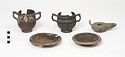
Two fragmentary unburned vases were found together on bedrock, beneath Roman and Byzantine fill. Disturbed earth over bedrock for several ... Early Protogeometric |
Cistern at 53/ΝΕ, bottle-shaped, stucco-lined, in the east aisle of the peristyle of Roman House H (courtyard of Greek House G, just west of andron).
Lower diameter 2.73m.
Homogenous fill all apparently ... Into early 2nd century B.C. |
Sand fill N of Base A.
... Because of the uncertainty of ground level contemporary with Base A and of the possibility of missing a continuous strosis or disturbance in this soft sandy fill, I have kept ... Last quarter 2nd-first quareter 3rd c. A.D. |
Dumped fillings thrown in during second quarter of 1st c. B.C. containing mostly debris resulting from Sulla's sack in 86 B.C.
Agora XXIX, p. 464: Four fills distinguished during excavations ... but seemingly ... Late 2nd c. and early 1st c. B.C. POU; 110-75 B.C. |
A well (diameter 1.10m) at the east edge of the valley road leading from the SW corner of the Agora, about 90m SW of the Tholos. The mouth of the well was subsequently covered by the east wall of the Great ... Ca. 500-480 B.C. |
| Anne McCabe ... Enchytrismos burial of an infant in Byzantine Room C, L/15-2/13, at 52.915m. Although disturbed by roots, the skeleton (AA 373) was articulated and lay parallel to Wall 1, with head at the NW and feet ... 14-15 June 2007 |
| Evelyn Lord Smithson ... Grave 3: (Grave XXVII: EG). Urn cremation (trench-and-hole), adult male. Carbonized figs and grapes included in inventoried objects (no number). [JP]
"Craftsman-Warrior" tomb: combination of weapons and ... Early Geometric I |
Cistern with two tunnels, the one entering its neck cut off by an early Roman well, the other, at the bottom not excavated.
Chamber conical in shape, with a depressed draw basin in the center of the floor ... Early Roman-3rd c. B.C. |
Well East of Stoa Room 11; no appreciable change in pottery top to bottom; dumped fill of Augustan times. Coins:
4 May 1950 #1-#3
15 May 1950 #1 Estimated Grid ... Late 1st c. B.C.-early 1st c. A.D. |
Well dug through cistern at 64/Γ. Seems to have been stratified; four fills recorded but here treated as one as divisions are rather "arbitrary".
Agora V, p. 126: Constructed in late 1st c.; use filling ... 3rd c. A.D. POU (before 267 A.D.) |
Evidence of stratification into five layers, although joins between the layers. Layer VI added when the construction of the Roman building above required it. No subdivisions assigned.
Flask-shaped cistern ... Early 3rd-late 2nd c. B.C. |
| Pyre in layer "9d" in SW corner of Room 6 of Greek House δ. Ashes and fragments of small bones ... Ca. 225 B.C ... Hesperia Suppl. 47 (2013), no. 2, pp. 100-101, figs. 4, 15, 19, 20 ... Agora XXIX, p. 467. |
| Well in Room 6 of Street Stoa U/2,U/3-13/15.
Associated with the building lying under the Roman Street Stoa. Its fills divided into 5 separate layers, with the bulk of finds belonging to Layer 1, the ... 14 June-21 August 1973 |
| Cistern at 77/Μ on lower north slopes of the Areopagus. Bottom diameter of 2m connected by tunnel to cistern M-N 18:1.
Only stamped amphora handle dates slightly after 240. Latest coin dates about 200 ... 3rd c. B.C.-196/190 B.C. |
Well at 15/ΙΕ = Pocket in side of Turkish Pit at 15/ΙΔ.
Shallow well on the lower slopes of the Acropolis, east of the Panathenaic Way, in the area later occupied by the Archaic Building.
Located 3.5m ... 700-675 B.C. with intrusions |
At 67/ΙΗ, at the northeast slope of the Areopagus.
Cistern with drawshaft, 4.60m deep. The drawshaft had been cleared to bottom in the eighteenth or nineteenth century, and some of the fill in the main ... Most second half of 3rd c. B.C. |
Accumulated debris on the west side of the market square.
Related layers added 1999/2000 (JWH), e.g. "Gravelly layer above burning", "Clearing Classical floor", "Lowest level above bedrock", "Below burning", ... First half of 5th c. A.D. |
| Extract from notebook ΠΘ XIX, pp. 3644-3646. Well at 105/ΝΗ (report on sorting of pottery, July 19, 1951 - H.S. Robinson).
"Not a useful well" HSR.
Well dug to 1.50m., vi/9/36; dug from 1.50m. to bottom ... Early Roman; use fillings of 2nd. c. B.C. and 1st. and 4th. c. A.D.; dumped filling of late 4th. c. (HSR)
Fill I: 2nd. c. B.C.
Fill II-V: to second half of 4th. c. A.D.
Fill VI: mixed to Byzantine. |
|
|