|
|
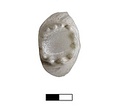
| The bottom of a small bowl with rounding walls preserved.
The ring foot formed by a series of small irregular projections.
Colorless glass.
Similat to G 297. Roman House B, room 8, at the floor.
Found ... 4 August 1947 |
Narrow projecting rim, rounded on top, flat beneath; spreading ring foot.
Also with projecting rim, P 13759 U 23:2-POU ... Context ca. 500 B.C. |
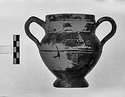
| Complete except for chips. Flaring ring foot, deep rounded body wall with groove at point of greatest diameter. High vertical rim, thickened at center. Band handles, rim to shoulder.
Glaze fired unevenly, ... 20 April 1949 |
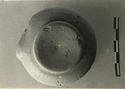
| Lower part; outside unglazed, black glaze inside.
Household accounts (?) scratched in very small letters on bottom.
Type VIIB of Corinth collection, type 25A' of Agora collection.
Layer II. 572 Leica ... 22 July 1946 ... Hesperia 25 (1956), p. 21, no. 95 ... Agora IV, no. 300, p. 71, pl. 23. |
|
|