|
|
Room C Fill of Floor at (T/13,14-13/17,19) No information. |
| Identified as pyre by SIR.
In room E. Burnt "pocket" found while digging red earth that contained late Hellenistic pottery, including a fragment of Pergamene (discarded). No pit was discerned, but concentration ... 3rd quarter 4th c. B.C. |
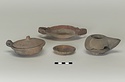
| Sacrificial Pyre = Pit in floor (identified as pyre by SIR); with the characteristic small plates and saucers. "Saucer Grave" at 12/ΚΑ.
Dimensions: 2m (length)x 0.70 (width).
North of north wall of building ... First half 4th c. B.C. |
| Hellenistic Pyre below packed clay floors of Room 2; west of Late Roman wall extension, below tile platform terracotta drain installation, bordered on the north by bedding foundation stones of crosswall ... Ca. 300 B.C. |
Tile-lined Well in Room 2 of Street Stoa (5/8-13/13), ca. 0.64m in diameter. Tiles set in pairs for each circuit, tops carefully lettered for placement, one hand-hole per tile. Actual well earlier (?) ... 21-26 June 1972 |
Cistern in Room 12, House C=House N.
Simple flask-shaped chamber with draw shaft, in House M, Room 1; no tunnels. Excavated as single fill, but later analysis of material suggested two fills. Coins:
24 ... 4th. c. B.C. |
| Handler ... Found in an area of disturbed fill north of a floor surface in Room 4 of the Classical Commercial Building. The floor surface (n. 3 on the west side of Room 4) was preserved at 52.503-52.544 masl., and ... 2nd half 4th c. B.C. |
Grave in south peristyle of Hephaisteion. Grave LXIV in notebook.
No mention of bones. Coins:
13 March 1939 #21-#23
14 March 1939 #7 Neg. KK 395 ... 13-15 March 1939 |
Tiled well, ca. 30m south of the Tholos. Associated with Building D. Hellenistic Group A with Late Roman fill in upper 3.00m. Objects A 245 and P 4597 are from fill on floor around well-head, contemporary ... 325-260 B.C. |
Coins:
26 May 1936 #2-#3
Fragments of "A" ware and of micaceous water jars; no basket-handled water jars; and a lead seal with the name and portrait of Hadrian ... Late 2nd.-early 3rd. c. A.D. |
No period of use. Below the upper (Early Roman) dump extending down to ca. 6.10m. was a dumped fill of broken pottery in great quantity, including a high proportion of red-figured fragments. Masses of ... Ca. 430-400 B.C.
Late 1st c. B.C.-mid 1st c. A.D. |
| Well in Room 6 of Street Stoa U/2,U/3-13/15.
Associated with the building lying under the Roman Street Stoa. Its fills divided into 5 separate layers, with the bulk of finds belonging to Layer 1, the ... 14 June-21 August 1973 |
| Disturbed pyre in NE stoa area.
In western room of westernmost shop building. A patch of ash i or at the level of layer 2 (lot Ι 189d), partially destroyed by modern wall. Pottery from layer 2 dates ... 400-350? |
| North of House G (RSY=Pyre 13).
Concentration of artifacts, small pieces of bone, and burnt material in stratum, no pit discerned. The pyre is cut by the trench of a wall of a Roman house to north. It ... 290-250 B.C. |
Fillings in a well on south slope of Kolonos Agoraios. The shaft reached a depth of 20.28m., but produced no use filling. The lower part, from water level at 12.60m. to bottom, provided only mud and gravel ... Ca. 425-400 B.C. |
| Laura Gawlinski ... Burial of a woman (young adult female ca. 18-20); precise dating difficult due to disturbance by later features, but the amount of Neolithic and Geometric pottery extracted from the trench is significant ... Prehistoric |
| Laura Gawlinski ... Well in courtyard of Early Building I, adjacent to wall of Room B. Tile lined; upper course in situ, lower two collapsed probably in antiquity. Letters inscribed on rims (eta, phi, omicron, theta). Medium ... First quarter of the 4th c. B.C. |
| Margaret Crosby ... Grave 1 (Grave XXVI: EG) Urn cremation (trench-and-hole), adult male?
[JP]
Boots or Booties Grave. Near the west branch of the Great Drain, about 100m to the southwest of the Agora horos inscription ... Early Geometric I |
Well at 63/ΙΒ (in House H, Room 15). Upper fill mixed Hellenistic to 2nd c. or later. Probably thrown in in Early Roman times when House H was built. Contained many figurines; probably part of Koukla factory ... 12 August 1947 |
| Anne McCabe ... Enchytrismos burial of an infant in Byzantine Room C, L/15-2/13, at 52.915m. Although disturbed by roots, the skeleton (AA 373) was articulated and lay parallel to Wall 1, with head at the NW and feet ... 14-15 June 2007 |
|
|