|
|
Wall fragment with turn of shoulder. Thin matte glaze on inside. Max. dim. 0.028.
Satyr (face, long shaggy beard, left shoulder) to right. Preliminary sketch.
The satyr seems closest to those by the ... Ca. 480 B.C. |
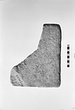
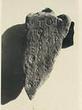
| Fragments of an inscribed stele.
Two joining fragments show letters; thickness of stone preserved; back rough picked.
Left side shows toothed chisel, with drafted edge; right side possibly cut subsequent ... Early 3rd. century B.C. |
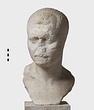
| Nose broken away, a deep score in the forehead; surface much rubbed. Eyes, mouth, chin and ears damaged.
Portrait of a man of mature years; the head turned slightly to the left, the hair close-cut and ... Middle of 1st c. B.C. |
P 6294 a, b
Two nonjoining sections preserving about one-fourth of rim.
Plain wall, horizontally faceted. Top of painted motifs toward medallion. Dolphins leaping right, with white dot rosette in field; ... 240-220 |
| Handle and part of base preserved.
The base is marked off by two incised circular grooves, inside of which is the beginning of the signature.
Pierced handle, triple grooved below; double above with herringbone ... 3 April 1936 |
| Fragment preserving profile, most of nozzle, and part of left side.
Flat bottom; short unbridged nozzle; open top; elaborately profiled wall, the lower concave on top, and projecting a little beyond the ... 16 April 1936 |
| Below two bands on the rim in a panel defined by bands of vertical lines, a long thin dog, head missing.
Glaze brown to red. Well. Leica, 81-598 ... 13 May 1937 |
| Fragment from left side of inscribed stele.
Broken top, bottom and at right.
Left side dressed smooth, with the back edge beveled to the rough picked back; the front edge much chipped, so that the first ... 5th. century B.C. |
|
|