|
|
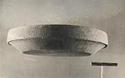
| Profile in general like P 8499 (Ι 921), but broader in proportion to the depth, and more carefully made in every way.
Hard micaceous pinkish-buff clay; orange-red paint, thickly and evenly applied, but ... May-June 1936 ... Agora V, p. 61, no. K 14. |
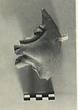
| Broken all round, save at one point beyond the hair, where a bit of the finished edge is preserved.
The fragment seems to be a bit of the eye, cheek and hair of a person wearing a most elaborate hairdress ... 18 May 1933 ... Agora VI, p. 61, pl. 14, no. 585. |
| Fragment from the left side of face, broken all around, preserving part of eye, nostril and mouth.
Red clay, buff at inner surface. Leica ... 5 June 1936 ... Agora VI, p. 61, pl. 14, no. 590. |
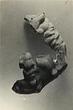
| First interpretation: Face of a goat-like satyr or faun.
The whole right side of the face missing. Mended from many pieces. Finished edges at the back.
Wild wavy hair, long pointed ear, flattened nose, ... 26 March 1934 ... Agora VI, p. 61, pl. 14, no. 578. |
|
|