|
|
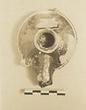
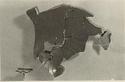
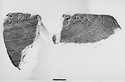
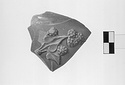
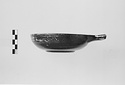
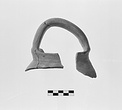
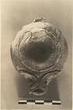
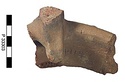
| Fragment broken all around, from upper wall of convex-bodied vase. The wall at the top turns inward to form a concave cover(?) over the pot, part of which is preserved. A broad blunt spout is let into ... 3 May 1939 ... Agora XII, no. 2011, fig. 14, pl. 96. |
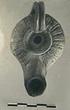
| Handle and end of nozzle broken off.
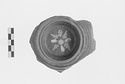
Flat watch-shaped body; ring foot. Side lug not pierced. Wheel made.
Metallic black glaze; scraped groove around filling hole and around outer edge of shoulder.
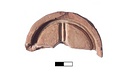
Type ... 12 April 1937 ... Agora IV, no. 413, p. 96, pls. 14, 41. |
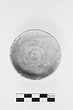
| Ring base. Grooved from wheel.
Pink clay with buff slip. Ca. 2.54YR 6/6 and ca. 5YR 6/3.
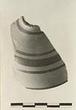
Much blackened inside and over more than half of outside Well. Leica, 96-1-25 ... 16 April 1932 ... Agora XXXIII, no. 96, fig. 15, pl. 14. |
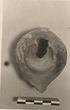
| Lamp with incised decoration on nozzle. Vertical band handle broken away.
Shallow, double convex body. Wheel made.
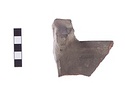
Rim indicated only by groove scratched through glaze round filling hole; a similar scratched ... 2 April 1932 ... Agora IV, no. 414, p. 96, pls. 14, 41. |
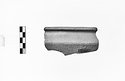
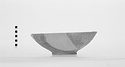
| A single fragment preserves the ring foot, floor and part of the wall of a bowl of rather heavy fabric. Plain heavy ring foot, rather high.
Inscribed within foot ring:
Black glaze, somewhat worn, all ... 23 May 1939 ... Agora XXI, no. F 96, p. 36, pl. 14. |
| About two-thirds of rim missing. Restored in plaster. Shape as P 8515 (Ι 937), but slightly lower in proportion to width; the rim thinner and more flaring. No marked ridges on the lower body.
Coarse ... May-June 1936 ... Agora V, p. 67, no. K 96, pl. 14. |
Ring foot; thickened rim. One high double handle. Convex upper and lower walls meeting at an angle. Glaze, fired brown, on neck outside and in, on outer part of handle, for a band above the point of greatest ... 500-480 B.C. |
| Ring foot.
Pinkish buff clay; slipped, the slip much peeled.
Hellenistic. Well 9. Leica, 96-1-30 ... 24 May 1935 |
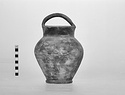
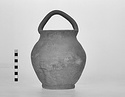
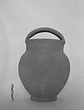
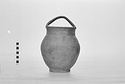
| Mended from many pieces; few scraps missing. Low ring foot, straight neck, unridged handle.
Light gray clay with dark bits. Ca. 10YR 7/3; surface ca. 2.5Y 8/2. Cistern, POU, containers 4 and 5. 3009 ... 20 April 1949 |
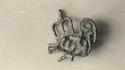
| An inscribed ornament in the shape of a bird.
One of the feet of the bird is missing.
The bird faces right and is carrying a curiously shaped object on his back. At the back is a projecting piece of bronze ... 12 April 1933 |
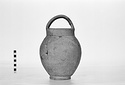
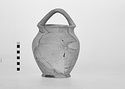
| Intact. Ring foot and short plump body with straight lip. Low unridged handle.
Micaceous brownish clay with grits, 5YR 6/8; unglazed. Well. 1896 Leica, XVIII-59, 96-5-3 ... 14 June 1939 |
| Joins P 9161. Fragment of a very large plate, from the floor inside the foot. Pairs of grooves around floor.
Rectangular stamp (incomplete) off-centre, suggesting that there were four:
Western Sigillata ... March-April 1936 |
| Joins P 9166. Floor fragmentary. None of rim preserved. Wide low ring foot. At edge of floor, low raised band. Rouletted band between double grooves on floor over foot.
Buff clay, red glazed.
Western ... March-April 1936 |
| Intact except small chips and cracks.
Buff clay with bits. Tiled well. Leica, 96-4-33 ... 16 June 1955 |
| Ring base. Adhering to the side with a bit of heavy cement is a fragment of roof tile.
Coarse pink clay (5YR 6/8) showing sharp ridges from wheel. Traces of cream slip. Blackened within. Well. Leica, ... 16 April 1932 |
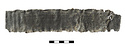
| Letter on lead tablet.
Found rolled up. Unrolled complete.
For the inscription.
Uncertain, no subdivision. Well, redigging earth, presumambly of lower levels. 1345 Leica, 96-41-4, 96-41-(5), 96-41-6, ... 28 July 1971 |
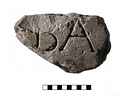
| Inscribed fragment.
Inscribed face only preserved.
Part of two letters preserved.
Pentelic marble. Found in the wall of the modern house 636α/7 [636/7 on Vrysaki map], over the East Stoa. Leica ... 23 January 1935 |
| Broken around the edges; restored in plaster. Large Western Sigillata plate with heavy base ring. On the floor is a broad band of rouletting and in the center a stamp:
Buff clay, red glaze. On bottom ... 15 April 1937 |
| Corner of inscribed block.
Funeral base.
Fragment Κ 14 a), top and left side preserved; broken away on the right, the back, and below.
Part of one line of the inscription preserved, with three letters ... Ca. 500 B.C. |
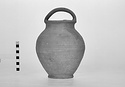
| Intact except for small chips from lip and base. A rather low water jar with very short neck and wide mouth finished with a plain lip slightly flattened on top. The handle rises to a point.
Coarse pink ... 10 June 1936 |
| Single fragment of rim with lug and bowl.
Shallow, round, pierced bottom. Angled wall, projecting rim, broad flat lip. Part of triangular lug projecting from interior of rim.
Coarse clay with white, ... 1935 |
| Handle missing.
Round nozzle; wide and narrow bars on shoulder. Beneath, "alpha".
Poor purplish-black wash.
Type XVIII of Corinth collection, type 53 of Agora collection. Cistern chamber. Layer IIb. Leica, ... 14 April 1937 ... Type XVIII of Corinth collection, type 53 of Agora collection ... Leica, LIX-67, LXIX-43, 96-67-13, 96-67-14 |
| The fragment curves in sharply at the bottom.
Good red glaze inside and out.
ADDENDA This motif is typical of Pergamene ware, 2nd. c. B.C. [HAT]. In accumulation over strosis. Leica, 92-10-17(18) ... 21 February 1934 |
| Fragment from floor and rim with handle stub. Shallow bowl; sharply inturned rim. Trace of vertical handle rising from rim.
Clay black at core, brown on surface, containing much fine grit.
Very similar ... 10 August 1961 |
| Inscribed fragment.
The left side sawed smooth, but not original; elsewhere broken.
Part of five letters preserved; a small leaf decoration between the first and second.
Pentelic marble.
ADDENDA With ... 3rd. century A.D. |
| Mold broken in half.
Impressions for upper half of outer ring and one complete spoke preserved.
Reddish pink clay.
Mold for T 4370. Koroplast's dump. 7035 ff. 96-35-19, 96-35-20, 95-65-19, 95-65-20 ... 25/28 July 1995 |
| A section of a small funnel, inverted pear-shape. Filled out in plaster. Carefully made; substantial fabric.
Pinkish-buff clay; unglazed inside. On the outside bands of firm red glaze. Horos Terrace ... 8-10 April 1953 |
| Small segment of wall and rim, with one lug. Part of horseshoe-shaped brazier. Vertical wall with two wheel-run grooves on exterior. Slightly projecting rim, rounded on top. Lug projects towards inside ... 29 April 1953 |
| Thin square slab of lead.
Carelessly incised on the side, the letter delta (Δ).
Late Roman fill. Leica ... 23 February 1938 |
| Intact. Low ring foot with convex resting surface. Flat rim, sharply incurving. Horizontal handle attached at rim. Glazed black, with reserved resting surface, handle panel, and inside of handle. Stacking ... 19 July 1996 ... Fine-grained, pinkish-buff fabric.
Cf. Agora XII, no. 747, ca. 480 BC ... 97-60-8, 97-60-9, 97-60-10, 96-64-14, 96-64-15, 96-64-16, 96-64-17, 96-64-18 |
| The lower part of a large dish on a high base, glazed inside and out. On the outside, incised lines filled with red, and rows of white dots. Underneath, a pattern composed of four yellow leaves and four ... 26 April 1934 |
| Shallow pyre saucer. Intact, but cracked, and chips missing from rim. Evidence of burning. Slightly concave underside with string marks. Convex wall, plain rim.
Light orange, fine-grained clay. Thin ... 3 July 1996 ... Thin red-brown wash.
See Agora XXIX, no. 1469, 350-300 B.C ... 97-55-14, 97-55-15, 97-55-20, 96-64-23, 96-64-24, 96-64-25, 96-64-26 |
| Nozzle, handle, and bit of top missing.
Wreath in relief on shoulder.
Remains of black wash.
Light red clay.
Type XIX of Corinth collection, type 54D of Agora collection. Cistern chamber. Layer IIb. Leica, ... 14 April 1937 ... Type XIX of Corinth collection, type 54D of Agora collection ... Leica, LIX-71, LXIX-44, 96-67-13, 96-67-14 |
Half of upper body and one-third of lower body restored; foot, stem, and handles missing.
Ribbed lower body with scraped groove and square molding at base. Projecting, overhanging flange below rim. Grapevine ... 275-260 |
| The handle preserved, with part of rim and shoulder. Straight rim with slightly thickened edge; two shallow grooves on handle.
Reddish-buff clay. Light slip. Cistern, middle fill, lowest container. Leica, ... 9-12 February 1937 |
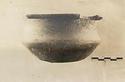
| Three fragments preserve bottom and section of wall and rim. Restored in plaster. Large, rather shallow bowl with sides curving slightly from plain rim to small foot.
Very coarse clay, reddish outside, ... May 1947 |
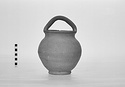
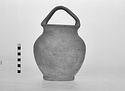
| Almost complete (chip off neck). Ring foot; low wide neck; rolled rim; handle rises to an angle.
Soft coarse buff clay, poorly baked. Well by Attalos pier III, first POU fill. 2371 Leica, 96-4-34 ... 18 April 1951 |
| Part of handle and much of side wall missing. Low foot ring; plump body with low neck and slightly flaring lip. Slender handle, round in section.
Fine buff clay, unglazed. Cistern, west of Bouleuterion ... 2 May 1934 |
| Handle and end of nozzle missing.
The dots small and elongated; underneath, "alpha".
Glaze wash red to black.
Type XX of Corinth collection. Cistern chamber. Layer IIb. Leica, LIX-66, 96-67-13, 96-67-14 ... 14 April 1937 |
| About one-eighth of rim and upper wall, with one lug. Vertical wall with two wheelrun grooves ca. 0.03 below rim. Outwardly thickened rim, rounded on top. Inwardly projecting lug, broken at top. Thick ... 29 April 1953 |
|
|