|
|
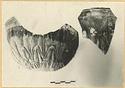
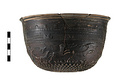
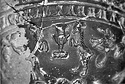
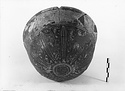
Barbotine Cup Or Jug.
Lower body and most of wall and rim restored.
Ovoid body, upper two-thirds decorated with five rows of barbotine bosses. Body angles in to rim at top. Low rim, convex to outside ... Context of 110 to early 1st century after Christ |
Ring foot. Plain rim. Totally glazed.
Similar and perhaps earlier is P 21901 N 7:3 Hesperia, XXII, 1953, pl. 29, 67, miscalled a bowl. Another early one: P 6520 E 13:1 ... Ca. 430 B.C. |
Ring foot; plain rim, rounded on top, inturned. Glazed inside and out. Reserved: resting surface and underside.
Smaller, but like, P 21903 N 7:3 Hesperia, XXII, 1953, pl. 29, 70 ... 450-425 B.C. |
Handle and mouth missing.
Flat projecting bottom; high breast. Bottom reserved. Glaze worn on body.
From the middle of the 5th century: P 21916-7 N 7:3 Hesperia, XXII, 1953, p. 82, fig. 3, 59 and 58, ... 470-450 B.C. |
Intact.
Scraped groove between moldings of foot; reserved resting surface; pointed underside. Ivy-leaf thumb rests. Ivy garland running right. Leaves on incised stems alternate with dot rosettes.
Dull ... 275-250 |
Mouth and part of handle missing. Restored on analogy of P 16672 (see below).
Flaring ring foot, low; concave handle, the upper attach- ment fixed below the narrow drip-ring. As restored, double curve ... Ca. 400 B.C. |
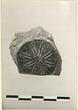
Lower part of moldmade body and upper part of footpreserved.
Cup or small krater. Low, broad stem, flaring out and up to foot at bottom. Rosette medallion faintly visible on underside. Wall: long petals ... 100-86 |
Foot and part of lower body preserved.
Flaring, molded foot with raised edge; broad, beveled resting surface.
Short, thick stem. Medallion visible underneath: very worn gorgoneion surrounded by calyx ... 200-175 |
| Under half preserved, from rim to bottom. Three rows of leaves increasing in size towards top with flower(?) between upper leaves. Segment of medallion preserved.
Pinkish-buff clay, glaze shading black ... 9 April 1949 |
| Medallion: large eight-petalled flower.
Pinkish-buff clay. Glaze black on interior, red on exterior. Piers 13-14 east, to strosis level of bottom of 9th course. Fill over floor of Square Building. 710 ... 11 July 1949 |
| Rectangular stamp. Finished Cistern; fill 3; boxes 12-13. Ἐπ' ἰερέως
Ξενοφάν
του 4379 Leica ... 30 April 1947 |
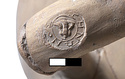
| Curve piece.
Circular stamp with small boukranion in centre. Study: Die 1* Cistern, lower fill; with containers 13-16. Δαμοκρά[τευς τοῦ Ἀριστοκ]λ̣ε̣ῦ̣ς̣
boukranion
(in O framed) Leica ... 8 June 1939 |
| Rim fragment.
Below lip, a scraped groove. Upper zone of egg and dart. On wall, forepart of deer leaping, looking back.
Pinkish-buff clay. Good black glaze. Attic. Pier 13 west, strosis bottom of 8th ... 8-9 July 1949 |
| Mended from numerous pieces. Wall fragments and about one-fifth of rim missing. Restored in plaster. Central medallion: Gorgon head surrounded by pointed leaves, with darts between tips of leaves. Lower ... 23 May 1969 |
| Slip badly flaked. Finished Pier 13, west; cleaning strosis bottom of 9th course; fill over floor of Square Building. [ Ἐπὶ] Ξε[ν]οφάν[ευς] Leica ... 9 July 1949 |
| One small fragment missing. Two upper terminal bands: horizontal spirals and leaves above; egg and dart below. Body: antithetic goats and krater group; Erotes, bird and garland, and cluster of grapes, ... 9 April 1949 |
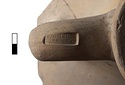
| Curve fragment.
Long rectangular stamp. Hellenistic sand fill, Great Drain south. Ἐ̣πὶ Δαμ[ι(]
Φιλίπ(π)ου
(Ε lunate, framed) 5494 Leica ... 16 July 1947 |
| About two-thirds preserved; mended from many pieces. Restored in plaster. On the bottom, a rosette with traces of miltos in a groove around it. On the body, between narrow pointed petals radiating from ... 4 April 1933 |
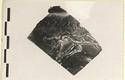
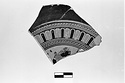
| Wall fragment.
Above, an upper zone of alternating masks and lotus(?). Below, an animal pierced by a spear.
Pinkish-buff clay. Black glaze. Piers 17-18 east, layer with burning overlying good strosis ... Late 3rd. or early 2nd. c. B.C. |
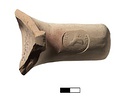
| Red on top of handle between stamp and rim and over part of stamp.
Round stamp with rose. Dip: red on top of hdl btw stp and rim and over part of stp* Finished Pier 13, west; cutting strosis at bottom ... 8 July 1949 |
| Jar top with neck and both handles preserved.
Stamps on both handles. Missing fragment of neck.
Prof: PD 1454-79,80* Cistern; container 13. a) Ἐπὶ Ξενο
στράτου
b) Θεσμοφορί(ου)
Δίσκου Leica PD ... 12 May 1939 |
| Most of nozzle broken away.
On the deeply concave discus the figure of a draped woman in relief. Apparently a maenad, she trips to right, her left hand raised to height of head; in her outstretched right ... 5 May 1936 |
| Fragment from the interior medallion. The border consists of alternating tongues of black and red bound on both sides by concentric circles and alternating dot bands. Within is the head and left shoulder ... 16 June 1931 |
| Large fragment of neck; whole jar, cylindrical neck preserved from below lip to junction with shoulder. Handle of thick Rhodian type, rising from junction with neck, preserved to just beyond the stamp ... 24 May 1932 ... Hesperia 75 (2006), p. 364, table 1 ... Hesperia 32 (1963), pp. 323, 325, 333, nos. 7, 13, fig 1 ... Agora XXII, pp. 102, 108 (Conc p. 119). |
|
|