|
|
Rodney S. Young ... Shallow round pit scraped out of bedrock. Grave 18 in notebook. The confusion here is that P 5347 found in the grave was catalogued in B' but the large bowl fragment (P 6482) was catalogued in B (see nb ... 700-650 B.C. |
Stoa Construction Fills (n.b. for all Stoa and pre-Stoa fills later than construction filling of Square Peristyle see P-R 6-12)
Over 100 stamped amphora handles in fill. No long-petal bowls, but one fragment ... Before ca. 150 B.C. |
Filling of Middle Drain (Tr. H+F in Section Ζ). Sand and gravel filling of the old course of the west branch of the Great Drain, a large (ca. 1.00m. deep and 1.30m. wide) underground channel in the area ... 150-100 B.C. |
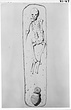
| Grave 14 in notebook.
Length of shaft 2.12m; width 0.46m; depth from cover 0.60m. Man's skeleton stretched NE-SW with head at NE. Offering at foot of shaft, with the skyphos in the mouth of the pitcher ... 750-725 B.C. |
Middle Stoa Building Fill (with filling to S) (See also Κ: H-I-J 14-15 and Λ: K-M 13-14)
This deposit is not definitive and must be considered with the above deposits before details are entered into database; ... To ca. 180 B.C. |
| An extensive cistern system on the lower north slope of the Areopagus, south chamber with blind tunnel extending further south (south tunnel); north chamber; drawshaft further north, extends to north tunnel ... Ca. 320-240 B.C. |
Great Drain South (ca. 70-113, from SW edge of section as far north as the Roman Bath) Hellenistic Sand Fill. Silted-up filling of the southern branch of the Great Drain, abandoned due to some damage at ... 4th. c.-86 B.C. |
Roman Water Mill: construction fill in footing trench of mill race wall Coins:
24 April 1933 #2-#30, #39-#40, #43-#44, #46-#67, #69-#76, #82-#95
25 April 1933 #30, #32-#35, #37-#40, #42-#43, #45, #47 ... 450-475 A.D. |
Accumulated debris on the west side of the market square.
Related layers added 1999/2000 (JWH), e.g. "Gravelly layer above burning", "Clearing Classical floor", "Lowest level above bedrock", "Below burning", ... First half of 5th c. A.D. |
|
|