|
|
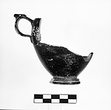
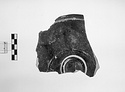
| Three joining fragments seem to preserve the complete profile.
Heavy discoid base. Raised knob at center of floor. More or less straight sides. Possibly broken at top. Well on lower north slope of Areopagus ... 14 April 1937 |
Flaring rim.
1926 and 1927 stand for the chytrai in common use in the decades just before and just after 500 B.C. See also, from Corinth, C-37-2058, -2060: Hesperia, VII, 1938, p. 597, fig. 21, 159, 161 ... Context ca. 520-480 B.C. |
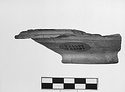
| Three joining fragments a), and two non-joining fragments. Ring foot with resting surface slightly bevelled to inside. Nippled underside. Foot moulded on outside, with scraped groove, offset on lower body ... 22 May-6 June 1935 |
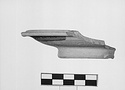
| About one-third remains. Ring foot; rim, rilled, slopes downwards.
Splotchy glaze, chiefly worn, on inside only; red stacking circle. I.e. back fill in plundered trench but perhaps better as part of Stoa ... 27 August 1953 |
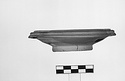
| About one-quarter preserved with complete profile. Nearly level rim profile; rim grooved; narrow ring foot.
Pinkish-buff clay. Red glaze shading to black on interior, only. Piers 17-18 east, layer with ... 9 July 1949 |
Rim and wall fragment. P.H. 0.052; est. diam. at rim 0.10.
Owl (feet missing). To left and right, part of an olive sprig. Dilute glaze: dots on face.
Johnson (AJA 59, 1955 [ pp. 119--124], p. 121) suggests ... Third quarter of the 5th century B.C. |
| About half preserved; center of floor, part of foot and parts of rim and wall missing; restored in plaster. Steep rim profile; rim grooved; relatively deep bowl; narrow ring foot.
Dark buff clay. Thin ... 8 August 1949 |
| About half of foot and quarter of floor; small segment of rim. Full profile except for tip of overhanging rim. Ring foot with flat resting surface, scraped groove around central reservoir; glazed groove ... 16 April 1952 |
|
|