|
|
Flaring ring foot; bell handles. Reserved: underside with two circles; zone above foot decorated with thick lines; handle-panels; outside edge of rim. Added red: two bands, one below the handles, one above ... Early 6th c. B.C. |
Eight non-joining wall fragments, a and b with rim and strengthened with plaster. Band on inside at rim, a narrower one 0.068 below rim. Glaze fired red on inside, slightly misfired below figures on outside ... Ca. 460-450 B.C. |
Round mouth with slightly flaring rim; strap handle from neck. Argive monochrome.
Two others from 6th century burials: P 15252 B 21:4 Hesperia, IX, 1940, p. 303, fig. 43; XX, 1951, pl. 39 a (Grave 5-2); ... Context ca. 520-480 B.C. |
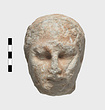
| Small head, the face, especially chin and nose, damaged. The back, and the neck below the chin, broken away.
Short shallow wavy lines indicate the hair, close to the head. The ear is simply a depression ... 17 March 1933 |
Wall fragment with turn of shoulder. Max. dim. 0.098.
Eros (head missing) flying to left, holding out a fillet. In front of him is the back of the head and the left shoulder of a woman to left. Behind ... Probably second quarter of the 4th century B.C. |
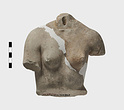
| The fragment first found preserves the upper left side of the torso of a nude female figure. The head, made in one with the front part of the neck, was attached separately; pinhole preserved. The left ... 1947, 1949 |
| Mended from two fragments, the point lacking.
The head is shaped like a Corinthian capital, with leaves under the corners, and a square abacus. On the abacus is seated a winged Eros, with legs crossed ... 21 March 1934 |
Domed askos. Low ring foot, broad plain-rimmed spout; strap handle concave in section; around lip a wheelrun groove, another partway down the spout and a pair around top of wall. Pinkish clay, gray at ... Context ca. 500-480 B.C. |
|
|