|
|
Well at 69/ΛΕ (diameter 0.95m).
Narrows at bottom. Footholds on east and west. Uniform fill. Bones found in the well make it likely that it had cut through a grave, as it was itself overlain by one ... Late 8th c. B.C. |
Well 8 (in Tholos), put out of use by a fall of the rock walls and replaced by well G 11:3. Scanty use filling at and near the bottom, separated by a mass of fallen rock from a debris filling in the upper ... Ca. 550-500 B.C. and 480 B.C. |
| Rodney S. Young ... Grave 10 in notebook. No remains. Probably grave of a woman.
Only a small portion of the inhumation pit was preserved at the northeast edge of pit A, a large oval cutting of modern date dug for the construction ... Middle Geometric II |
Well East of Stoa Room 11; no appreciable change in pottery top to bottom; dumped fill of Augustan times. Coins:
4 May 1950 #1-#3
15 May 1950 #1 Estimated Grid ... Late 1st c. B.C.-early 1st c. A.D. |
Well at 19/ΛΓ.
The cistern S 19:3 and the well S 19:8, together with a Roman well, S 19:1, had collapsed to form a large pit S 19:5.
Top to -8.5m: Byzantine dump to 11-12th c. A.D.
-8.50m to -15.00m: 4th ... Mid 3rd century A.D. |
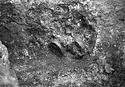
Grave 11 in notebook. Grave disturbed by diggers of pit A.
Only skull and left arm of man's skeleton remained in position, head toward N.E. Cover slabs were piled near head ... Late Geometric |
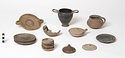
| Pyre in Room 1, area west of street (RSY=Pyre 11).
Early in the third quarter of the 4th. c. B.C.
In courtyard. Artifacts, bone, and cinders in irregular pit in floor sequence. The pit had been dug into ... 350-330 B.C ... Hesperia 20 (1951), p. 127, pl. 53 b (Pyre 11) ... Agora XII, p. 384 ... Agora XXIX, p. 436. |
|
|