|
|
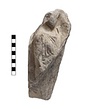
| Slice of the left side of a votive relief. Smooth surface preserved of left side and back; broken at diagonal at top of left corner and bottom right corner.
Standing female, perhaps a goddess, preserved ... 19 August 1977 ... Agora XXXV, no. 54, pl. 16. |
One handle restored.
Scraped groove in resting surface; concave underside. High, slightly concave stem. Tapering upper body. Rising, flaring spurs.
Lustrous black glaze. Illegible graffito under foot ... Ca. 275 |
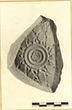
The center has a four-petaled rosette surrounded with concentric ridges; from the outer ridge radiate small triangles; between them, and from their points extend palm branches and palmettes, alternating ... 15 July 1931 |
NM 16117
Two lines retrograde.
Line 1:- Τλεσίας-
Line 2:-.A.- Votive dump. |
Both handles restored.
Brownish buff clay with black grit; unpainted.
Cf. S.A. Immerwahr, The Athenian Agora, XIII, The Neolithic and Bronze Ages, Princeton. 1971, p. 252, nos. 433-435, p. 260, no. 473 ... LH III B |
Full profile preserved; at least two-thirds of side missing. Restored in plaster. Shallow bowl; flat bottom; broad outcurved lip, set off from floor.
Soft reddish-buff clay. Covered with yellow-buff slip ... February-April 1937 ... Agora V, no. F 54, p. 16, pl. 65. |
Small parts of rim and wall restored.
Flaring ring foot; rounded resting surface; nippled underside.
Deep lower body, concave and inclined upper body; no groove in wall.
Ivy-leaf thumb rests. Olive ... 250-240 |
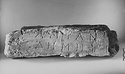
| Inscribed fragment.
The left side, much weathered, is preserved; otherwise broken.
Part of three lines of the inscription preserved.
Hymettian marble. Found in the wall of the modern house 636α/16 [636/16 ... 22 January 1934 |
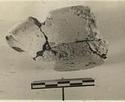
| Heavy fragment of coarse red clay, unglazed; probably from a rain tile of Laconian type.
Incised on smoother concave side: Green sand at bottom of drain. 2352 Leica DA 15266 ... 12 June 1939 ... Agora XXV, no. 194, pp. 12, 16-17, 20, 54. |
Part of one handle and small areas of rim restored.
Scraped groove in resting surface; deeply concave underside. Tapering stem. Sharply rising spurs with pronounced flare. Lustrous black to dull brown ... 290-275 |
Three-fourths of rim restored; foot, stem, and handlesmissing.
Pointed lower body, high upper body. Ivy garland running right.
Dull black glaze, badly peeled above stacking circle, shiny black inside ... 275-265 |
| Broken away behind.
Lamp with pointed nozzle as type XVIII of Corinth collection.
On floor of mould, signature in two lines. Also inscribed in the clay before baking, on under side of mould: "B", and on ... 21 March 1936 |
| Inscribed fragment of early Christian epitaph.
Inscribed face only preserved.
Christian grave stone with part of preserved cross in upper left corner.
Four lines of the inscription preserved.
Hymettian ... 15 December 1937 |
Inscribed fragment of columnar grave monument.
Broken at back and below.
Three lines of the inscription preserved.
Hymettian marble. Found in modern wall, at the north foot of the Areopagus. Leica ... 5 February 1937 |
Banded decoration; underside reserved, with broad resting surface and two circles and dot.
For the foot, cf. B.S.A., LIII-LIV, 1958-59, p. 164, fig. 7, 26, Ismir from Old Smyrna, and London 1947. 7-14 ... 575-550 B.C. |
About one-third of base and part of lower wall preserved. Medium high foot, straight-sided, concave below; fairly steep wall.
Gritty brown clay, gray at core; thin red burnish inside and out. Well 9, ... 6-13 March 1939 |
Outcurved rim flattened on top; low disc foot with slightly spreading profile.
1804-1806 illustrate the shapes and rim profiles of the latter part of the third quarter of the 5th century; the foot may ... Context ca. 435-425 B.C. |
Rim Of Large Bowl?
Small section of rim and stub of handle.
Rim steeply beveled to inside and slightly undercut; two shallow grooves below rim inside and two deep grooves outside. Handle round in section, ... Early Roman context |
Wall fragment. Glaze slightly pitted. Max. dim. 0.048.
Woman(?) seated to left on a decorated cloak. All that remains of her is her lap. At the right, part of another figure. Relief contour. White: woman ... Probably late 5th or early 4th century B.C. |
Fragment from the body and beginning of shoulder. Concentric ares (F.M. 44) in zone on body; plain inside.
Fine clay, pinkish buff at surface, tan buff at core; shiny red glaze.
Cf. E. French, B.S.A ... LH IIIA 2-IIIB I |
|
|