|
|
Well shaft cut through a cistern channel which was then packed with three amphorae (P 3123, P 3125, P 4201) of 1st or at latest early 2nd c. A.D. (These three amphorae could be considered with F 15:2) ... 3rd-4th c. A.D ... Well shaft cut through a cistern channel which was then packed with three amphorae (P 3123, P 3125, P 4201) of 1st or at latest early 2nd c. ... (These three amphorae could be considered with F 15:2).
Objects SS 2040, SS 2041, SS 2043, P 3143, P 3144, MC 73, I 1454 are included with F 15:2, cistern fill (pp. 81, 573).
... Those as from the recommencement on 2/3 are clearly from the top of the well- ie at 3m below (see p. 58)
Remark on p. 460 seems ambiguous. |
Sand fill N of Base A.
... Because of the uncertainty of ground level contemporary with Base A and of the possibility of missing a continuous strosis or disturbance in this soft sandy fill, I have kept ... Last quarter 2nd-first quareter 3rd c. A.D ... Sand fill N of Base A.
... Because of the uncertainty of ground level contemporary with Base A and of the possibility of missing a continuous strosis or disturbance in this soft sandy fill, I have kept the pottery from the separate patches dug separately; hoping that when the pottery of 2nd and 3rd c. A.D is published a more precise date for the lower fill will be possible [p. 3062].
... 3 April 1952 #5-#6
5 April 1952 #25-#26
12 April 1952 #4-#6
14 April 1952 #13-#14
15 April 1952 #8-#10
25 April 1952 #7-#8
26 April 1952 #8-#11
28 April 1952 #1-#2 |
| Grave 14 in notebook.
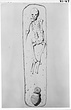
Length of shaft 2.12m; width 0.46m; depth from cover 0.60m. Man's skeleton stretched NE-SW with head at NE. Offering at foot of shaft, with the skyphos in the mouth of the pitcher ... 750-725 B.C. |
Mycenaean well under East Building Terrace steps (No catalogued pots). Rectangular in shape, 0.90x0.60m.
Abutting against the back of the East Building Terrace steps to the south. Yielded much thrown bedrock ... 14 July 1967 |
A small flask-shaped cistern on the lower southeast slope of Kolonos Agoraios. Lined with hydraulic cement and containing a large quantity of glazed table ware and a fair amount of coarse ware; a homogeneous ... 350-325 B.C. |
Called a Middle Helladic Well in the notebook ... Middle Helladic |
Rectangular shaft neighboring the well D 17:12. Dug only to a depth of 4.40m. and provided with two galleries or channels extending from it. Apparently never intended as a well. Refilled with the dug bedrock ... 4th c. B.C. |
Irregular pit in bedrock; deposit chiefly of terracotta figurines, with a small amount of pottery ... 6th c. B.C. |
| Mycenaean Chamber Tomb opposite ΣΑ pier 15. It was discovered about 20m to the west of Pier 15 of the Stoa of Attalos and almost in a line and a few meters south of Tomb XX. although the entire upper part ... Myc. II-IIIA/B |
Exploration in the peristyle of the Heliaea (1960); evidence for rebuilding in the third quarter of the 4th c. B.C. with some disturbance as late as 1st-2nd c. A.D. Date of reconstruction ca. 325 B.C ... Ca. 350- 325 B.C. |
Well to N of Nymphaeum at 115/ΙΣΤ. A good water supply but no evidence for a period of use.
Exceptionally heavy dumped filling, including much fine tableware, many wine- jar fragments and other objects ... Ca. 420-400 B.C. |
A small concentration of pottery in lowest 1.80m., possibly a use fill. Three fills above, with little pottery, ranging from Hellenistic to late Roman in date. Coins:
26 February 1934 #4-#6
27 February ... 325-200 B.C ... A small concentration of pottery in lowest 1.80m., possibly a use fill. ... We should check the grid reference of this well, a note (Section Γ, nb. VI, p. 1097) mentions that the grid 96/ΙΣΤ is preferable to 98/ΙΣΤ). |
South Stoa II Construction Fill.
About 85 stamped amphora handles, many with parallels in building fills of Middle Stoa and Stoa of Attalos. Fragments of long-petal bowls confirm date after mid-2nd c ... To ca. 140 B.C. |
Deposit of black glazed table ware found with a mass of bones, iron waste and burning. Coins (from above Hellenistic/associated floor):
7 April 1948 #10-#11 ... 375-325 B.C. |
Cistern at the southeast foot of Kolonos Agoraios.
Nbp. 2369: Two chamber cisterns, 88/ΛΔ and 100/ΚΘ, united by a long straight passage running almost due N-S. A draw shaft at 95/ΚΘ is set just off the ... Late 2nd-early 1st c. B.C.-86 B.C. |
| Well A, early 5th c. B.C. Near the Agora Boundary Stone, northwest corner of Middle Stoa; diameter at top 0.92m, widening to 1.15m and more below. Shaft neatly faced with stones to a depth of 0.70m below ... Ca. 520-480 B.C. |
Well E (diameter 1.10-1.20m) just outside the northwest corner of the southwest Fountain House.
Dug initially as a pit (J 15:2) partially covered by an early Roman wall ... Early 7th c. B.C. |
Digging abandoned at 17.10m.
Nbp. 2863: The fill in the mouth to -6.50 was a dump of mixed hellenistic and late roman sherds. From -6.50 to -11.00m. small stones with a few late roman sherds 4th-5th c ... 4th-5th c. A.D. |
Actually 1 meter into section Δ, the well lies under a filling of primarily Hellenistic date which had been thrown in as underpinning for the support of a 2nd c. A.D. Roman tile-mosaic floor.
POU is 15.80-16.35m ... First half of 1st c. A.D. |
Construction and upper fills. Well at 116/ΣΤ, cut less than one meter from a shallower and older well at 115/ΣΤ [D 15:1]. ... a fall of loose fill occurred from the earlier into the later well ...
Filling ... 2nd c. A.D. plus 6th c. A.D. |
Well at 115/ΣΤ (all the 5th c. fills of 116/ΣΤ). The lower part of the shaft contained a heavy deposit of pottery and other objects of the late archaic period, both coarse and finer wares; probably a post-Persian ... Ca. 500-480 B.C.-Roman |
A well (diameter 1.10m) at the east edge of the valley road leading from the SW corner of the Agora, about 90m SW of the Tholos. The mouth of the well was subsequently covered by the east wall of the Great ... Ca. 500-480 B.C. |
| Brian Martens ... Located in the southern section of Room I, now bound by the scarp of Wall U at the north,, the scarp of Wall L at the east,, and a modern pit at the south. At its now low elevations, excavated in the 2015 ... Third quarter of 5th c. B.C. |
Well (Hole) at 19/Ι(ΙΑ). Collapsed well creating a hole above; mixed fill in hole, early Byzantine in well proper. Coins:
26 April 1934 #12
27 April 1934 #28
28 April 1934 #38
1 May 1934 #3 ... Early Byz. |
A cistern leading to the east of the road leading from the southwest corner of the market square. Filled all at one time, last quarter of 2nd. c. B.C. (nbp. 493).
Included are the Hellenistic finds from ... Late 2nd c. B.C ... A cistern leading to the east of the road leading from the southwest corner of the market square. ... Included are the Hellenistic finds from "north cistern arm" and "south cistern arm" as recorded from well 96/I: SS 2040, SS 2041, SS 2043, MC 73, I 1454, P 3143, P 3144. See Deposit E 15:7.
|
A well on the lower south slope of Kolonos Agoraios. Last quarter of the 5th. c. B.C. But upper fill dated to 3rd. to mid-2nd. century B.C. and lower fill dated to ca. 425-400 B.C. in Agora XXX. Coins: ... 425-400 B.C. |
South House, Room 12, over pebble mosaic floor. Herulian destruction debris in a house. Coins:
29 April 1956 #1-#7
2 May 1956 #1-#3
9 May 1956 #1
26 May 1956 #1-#4
2 June 1956 #1-#4 PD 1350 ... 9 May 1956 |
| John Camp ... Protogeometric Grave about 0.60m to the southeast of T 15:2.
Unlined roughly rectangular-elliptical pit, oriented north-south, neatly cut into bedrock to a depth of 0.70m, with rounded corners. The pit ... Early-Developed Protogeometric |
| Extract from notebook ΠΘ XIX, pp. 3644-3646. Well at 105/ΝΗ (report on sorting of pottery, July 19, 1951 - H.S. Robinson).
"Not a useful well" HSR.
Well dug to 1.50m., vi/9/36; dug from 1.50m. to bottom ... Early Roman; use fillings of 2nd. c. B.C. and 1st. and 4th. c. A.D.; dumped filling of late 4th. c. (HSR)
Fill I: 2nd. c. B.C.
Fill II-V: to second half of 4th. c. A.D.
Fill VI: mixed to Byzantine ... Robinson).
"Not a useful well" HSR.
... After Christ: practically no fine ware except P 21656 (ΠΘ 3373) and frags. of a grey-ware platter; type XVIII and XX lamps (L 2988-89); numerous amphorae, including frags. of two with high pointed handles (cf. ... Containers 3-1 (ca. 21.00-20.20m.) represent a new period of use and appear to contain 4th cent. pottery: the late amphora P 10030 and another similar stored in tin no. 364; micaceous water jars shaped as P 14899 (one almost complete stored in tin no. 363); jugs as P 12824; gouged ware; XXVIII lamps (L 2985-7); jug in shape of boy's head (P 10004); very little fine ware; no coins.
|
| Grave XVII in notebook = RSY Grave 15.
Only lower half of skeleton preserved. Bones discarded? ... Last quarter of the 6th. c. B.C ... Hesperia 20 (1951), pp. 96-97, fig. 12 and pl. 44 a-b (Grave 15) ... Agora XXIII, p. 330. |
Great Drain South (ca. 70-113, from SW edge of section as far north as the Roman Bath) Hellenistic Sand Fill. Silted-up filling of the southern branch of the Great Drain, abandoned due to some damage at ... 4th. c.-86 B.C. |
Sandy Intrusion. Coins:
15 May 1933 #1-#25 A. Walker coin deposit ... 2nd c. A.D. |
The West Chamber of a double cistern lying between the northeast corner of the Theseion and the Annex to the Stoa of Zeus Eleftherios. ... Both chambers went out of use as water containers simultaneously ... 225-165 B.C ... Coins:
11 March 1932 #1 ( in nb. A V, p. 895)
15 March 1932 #3-#4 (in nb. A V, p. 919)
16 March 1932 #1 (in nb. A V, p. 921) |
Two chambers connected by a tunnel, all filled at the same time, but with slight Hellenistic disturbance. Chamber A, to west at 14/ΛΗ, B to east at 14-15/ΛΒ on grid for section RR.
Cistern system ca. 20.00m ... Ca. 325-275 B.C ... Two chambers connected by a tunnel, all filled at the same time, but with slight Hellenistic disturbance. Chamber A, to west at 14/ΛΗ, B to east at 14-15/ΛΒ on grid for section RR.
... Basically a single dumped filling; the presence in the filling of a few later objects ... possibly as late as the second half of the 3rd c., probably indicates a supplementary filling. |
Baskets 1-21 (containers 1-20). The following objects, although listed in deposit notebook as being from level .1, are from depths within the .2 range:
MC 318, MC 433-MC 437, T 1309, T 1394, T 1396, IL ... 110 to early 1st c. A.D ... The following objects, although listed in deposit notebook as being from level .1, are from depths within the .2 range:
MC 318, MC 433-MC 437, T 1309, T 1394, T 1396, IL 517, IL 548, IL 549, IL 1076, S 864, S 865, A 711, A 712, P 8939-P 8941, P 9033, P 9034, P 9514, P 9515, P 9540, P 9541, P 9814, P 11813-P 11815, P 11817, P 11824-P 11826, P 11832, P 11842, P 11843, P 11857, P 11867, P 11868, P 11876, P 11884, P 11886, P 11888, P 11889, P 11891, P 11893, P 11895, P 11898, P 11910, P 11911, P 20511-P 20513 ... Coins:
30 January 1937 #1
2 February 1937 #6-#8
4 February 1937 #1-#3
6 February 1937 #7-#10
8 February 1937 #7
9 February 1937 #5
10 February 1937 #14-#15
11 February 1937 #21
12 February 1937 #8-#11
13 February 1937 #1 |
A very homogeneous dumped filling and no period of use. Apparently a failure as a well.
T 263-T 289 resorted and reduced August 1967. Cf. BI 157 "from behind the curbing of the well by Stoa pier 3." Estimated ... Ca. 470-460 B.C. |
| Well in Room 6 of Street Stoa U/2,U/3-13/15.
Associated with the building lying under the Roman Street Stoa. Its fills divided into 5 separate layers, with the bulk of finds belonging to Layer 1, the ... 14 June-21 August 1973 ... Well in Room 6 of Street Stoa U/2,U/3-13/15.
Associated with the building lying under the Roman Street Stoa. ... At its bottom it was round with a diameter of 1.00m. hand-holes roughly 0.42m apart, were noted on its east and west sides.
... Lot ΡΡ' 396-now only a sack see U 13:1 tin report 25 July 2006.
|
| In room A. Concentration of artifacts and burning in stratum, no pit discerned. The pyre lay below a Late Hellenistic fill with a smooth earth surface. It is described as a black patch of earth with sherds, ... 350-250 B.C. |
| Dorothy Burr Thompson ... Grave 15 in notebook. Burial of child (E.L. Smithson: Grave XIV: PG). Single bone. Nb. says: few bones.
Skull fragment, few ribs and fingers (bones discarded). Negs. KK 24 and KK 30 431 ... Developed to Late Protogeometric |
Rodney S. Young ... Grave 15 in notebook.
Skeleton of infant inside the hydria which lay on its side, its mouth stopped by cup; a pitcher stood by the neck of the hydria ... 750-725 B.C. |
Well dug through cistern at 64/Γ. Seems to have been stratified; four fills recorded but here treated as one as divisions are rather "arbitrary".
Agora V, p. 126: Constructed in late 1st c.; use filling ... 3rd c. A.D. POU (before 267 A.D.) |
| A well at the northeast corner of Classical Building, behind back wall. Dumped fill appears to have occurred as a single event as there are joining sherds throughout.
POU date ca. first half 5th c. B.C.; ... 5th c. B.C. |
Essentially uniform fill of III-IV c. A.D. with a Byzantine upper fill. Coins:
14 June 1937 #1-#3
15 June 1937 #2
16 June 1937 #1
17 June 1937 #1-#2
18 June 1937 #1-#4
19 June 1937 #1-#4
9 June 1938 #1-#3 ... Late 3rd-mid-4th c. A.D. |
The East Chamber of a double cistern lying between the northeast corner of the Theseion and the Annex to the Stoa of Zeus Eleftherios. ... Both chambers went out of use as water containers simultaneously ... Ca. 200 B.C ... The East Chamber of a double cistern lying between the northeast corner of the Theseion and the Annex to the Stoa of Zeus Eleftherios. ... ... (Hesperia. 3 (1934), p. 345). Hell. Group C.
The following objects are published together with those from G 6:2 but were found in the west chamber of the cistern system which is deposit F 6:3: A 230, P 366, P 367, P 403-P 407, P 2387-P 2393, L 459, L 461, L 462, L 464, L 1114, L 1115, T 133, T 134.
|
Tile well at 52/ΛΣΤ, in the northern late Roman building in the room with the apse. The top was covered by a large stone, and the well had never been filled after the last period of use. water stood to ... Late 1st (?) cent.-early 3rd to 6th cent. |
A dumped filling including red figured fragments of the second quarter of the 4th c. B.C. Coins:
25 June 1931 #12 (in strosis above pottery deposit) 15 November 1952, going through the containers Tin 59-Box ... Ca. 375-350 B.C ... A dumped filling including red figured fragments of the second quarter of the 4th c. ... 15 November 1952, going through the containers Tin 59-Box 60, provided some substantial additions, broλκught together some pieces from the neighboring areas, p. 1862. |
"Fauvel Collection"
Collector's dump? Debris in the cellar of a modern house, probably once that of F.S. Fauvel.
The collection included vases of all periods, from Geometric to Turkish; a number of the ... Modern Context |
| A flask-shaped storage pit or cellar, cut in the rock at the south edge of the levelled top of Kolonos Agoraios. Filled late in first quarter of 6th. c. B.C. (2.95m from east to west by 2.70m from north ... First quarter 6th. c. B.C. |
| Construction filling of well N 20:3 which was dug through this cistern; a few later sherds at upper levels may result from late repairs to well tiling. Coins:
6 April 1938 #14-#15
8 April 1938 #4 Some ... Second half 1st c. A.D. |
| Hole at 57/ΛΣΤ = Pottery Dump at 57/ΛΣΤ. May well have accumulated on the spot where it was found, its fragmentary state being attributable to the later rubble wall laid over it.
Cf. also P 19982 (ΟΟ ... Ca. 400-375 B.C ... Cf. also P 19982 (ΟΟ 1047) from fill above ... Coins:
15 June 1949 #1-#2
Consistent collection of black glazed and figured table-ware, with a few coarse amphoras and a lamp fragment |
| Rodney S. Young ... Grave 5 in notebook.
The grave had been somewhat disturbed by the digging of Well B. The hydria lay on its side; in it was found the skeleton of a small child lying on its side with the knees drawn up ... Late 8th-early 7th c. B.C. |
| Well below Stoa Gutter opposite Pier 1.
Heavy dumped filling remarkable among Agora well-deposits both for the high quality and the good conditions of pottery of all sorts.
It represents the stock of a ... Ca. 520-490 B.C. |
Well cut through the floor of a cistern. Apparently a dumped fill in an unused well. Coins:
16 March 1934 #15 (illegible)
17 March 1934 #2
19 March 1934 #1-#4
20 March 1934 #1-#3
22 March 1934 #1
23 March ... 1st-early 2nd c. A.D. |
Well at 15/ΙΕ = Pocket in side of Turkish Pit at 15/ΙΔ.
Shallow well on the lower slopes of the Acropolis, east of the Panathenaic Way, in the area later occupied by the Archaic Building.
Located 3.5m ... 700-675 B.C. with intrusions |
| Mycenaean Chamber Tomb occupies a considerable part of the western half of section ΕΕ; lies about half way up the north slope of the Areopagus towards its eastern end, just below the highest point of the ... Myc. III A:1 |
Channel J (in ΗΗ)
Cutting that probably originally held a drain. Packed with amphoras and other coarse pottery. It tapped the poros aqueduct wall just East of our explanatory trench at the East end of ... 1st c. B.C. - early 1st. A.D. |
| Coins:
19 July 1995 #1254
20 July 1995 #1252
21 July 1995 #1268 Three additional finds, A 4916, IL 1909, T 4387, are from outside the well proper and not in the finds list but cf. pp. 7243, 7245 and section ... 4th-12th c. A.D. |
Classical commercial building, room 3, against south wall. Small fragments of pottery dispersed in fill overlying two floor levels (at 51.897 and 51.941 masl). Five objects of pyre type: ribbon-handled ... 4th c. B.C. |
| In NE corner of Room D. In a Byzantine vessel=P 34464.
The position of the vessel in the corner of the room suggests that the burial was made after the construction of Byzantine Walls G and E. This type ... 10th-11th c. A.D. |
Well at 9/ΙΣΤ-ΙΖ has been cleaned and stripped of its tiles and original filling and bedrock thrown back into shaft.
Joins between sherds from all levels.
No coins or lamps. Containers examined 5 March ... 1st c. B.C ... (J.W.H).
15 April 1961 VG however continues to regard P 14265 as early Roman, and one of a considerable sequence L.T. |
Courtyard Well (R/15-13/20).
The well went out of use as a result of the Herulian sack of 267 A.D. in the upper part of the well the well-head itself was found, one of the finest in the Agora collection ... 27 June-15 July 1975 ... Courtyard Well (R/15-13/20).
The well went out of use as a result of the Herulian sack of 267 A.D. in the upper part of the well the well-head itself was found, one of the finest in the Agora collection. ... November 2019: One tin with several bags was found outside of the Stoa of Attalus with a label a) ΡΡ' 362 b) Section ΡΡ p. 2125, July 21 1975. |
| Located in Middle Stoa, west, south aisle, beneath pressure pipe (cf. A 4900). The siting of the well is remarkable in its proximity to Well I 13:3, also Geometric in date, which was found in 1968 only ... Second half of 8th c B.C. |
| Eugene Vanderpool ... Grave. Bones discarded.
Burial lies over dromos of Mycenaean chamber tomb N 21-22:1. The roots of a tree had upturned the bones, but the head probably lay at the northeast ... Middle Geometric II |
Square Peristyle (Square Building) Constructions fill + other (square peristyle area); fragmentary and with some earlier material but in the main, where undisturbed, a homogenous deposit. Coins:
26 May ... Βefore 300 B.C. |
Cistern-shaft at the southeast foot of Kolonos Agoraios.
Nbp. 2369: Two chamber cisterns, 88/ΛΔ and 100/ΚΘ, united by a long straight passage running almost due N-S. A draw shaft at 95/ΚΘ is set just ... Upper fill, Late Roman with some Hellenistic.
Middle fill, Sullan debris to last quarter of 1st c. B.C.
Lower fill, 4th-3rd c. B.C.=POU and abandonment ... Nbp. 2369: Two chamber cisterns, 88/ΛΔ and 100/ΚΘ, united by a long straight passage running almost due N-S. ... E 14:1 and E 15:3.
Objects either from 95/ΚΘ (middle fill) or 88/ΛΔ (lower Hellenistic fill), but uncertain which (they are in the finds lists of both but not assigned to subdivisions PAF) are the following: P 5655, P 5656, P 5657, P 5659, BI 154, S 574, L 1788, IL 193, SS 4091.
... Coins:
10 May 1935 #1-#10
11 May 1935 #1-#10 (-1.10-2.00)
13 May 1935 #1-#11 (-2.00-2.80)
14 May 1935 #1-#16 (2.80-3.50)
15 May 1935 #1-#8 (to 4.10)
16 May 1935 #1-#3 (passage)
17 May 1935 #30-#32 (passage)
18 May 1935 #1-#2 (passage-probably fill of 100/ΚΘ-p.1635)
22 May 1935 #1-#3
23 May 1935 #11-#12 |
| Herm head deliberately buried in a pit with coins of the 2nd half of the 4th c. Head found at an elevation of 51.907. Bottom of the pit at 51.637 m. Coins:
27 June 1972 #199-#205
Bits of bronze, iron ... 2nd half 4th c. B.C. |
| Evelyn Lord Smithson ... Grave 3: (Grave XXVII: EG). Urn cremation (trench-and-hole), adult male. Carbonized figs and grapes included in inventoried objects (no number). [JP]
"Craftsman-Warrior" tomb: combination of weapons and ... Early Geometric I |
| Dumped filling mostly of 3rd c. A.D., but dumped as late as 5th century. Nbp. 143: The fill in this cistern was of three kinds: to within .60m. of the floor plain broken bedrock with no sherds; then a ... 10-17 February 1937 |
Evidence of stratification into five layers, although joins between the layers. Layer VI added when the construction of the Roman building above required it. No subdivisions assigned.
Flask-shaped cistern ... Early 3rd-late 2nd c. B.C. |
A 3rd. c. B.C. cistern and an unfinished rectangular cutting of the 2nd c. B.C. which destroyed some of its upper part. These two features are combined in this deposit; the following objects are identified ... 3rd-2nd c. B.C ... A 3rd. c. B.C. cistern and an unfinished rectangular cutting of the 2nd c. ... These two features are combined in this deposit; the following objects are identified as from the rectangular cutting: P 16675, P 16676, P 30434, P 30435,
L 4038.
... Coins:
7 May 1940 #1 (Hell. fill)
9 May 1940 #6-#11 (Hell. fill)
10 May 1940 #1-#5 (in cistern)
11 May 1940 #1-#4
13 May 1940 #4
14 May 1940 #1
15 May 1940 #1-#6
17 May 1940 #1-#5 |
| A cave-in not long after the digging of this shaft destroyed its possible usefulness as a well and thereafter it was used as a dump. Two principle periods of such use were noted, and within these several ... Ca. 575-480 B.C ... A cave-in not long after the digging of this shaft destroyed its possible usefulness as a well and thereafter it was used as a dump. ... Hesperia 15 (1946), pp. 265-336.
... This was sorted all together, and regrouped by "Kind', lettered under these numbers, as follows (6 tins).
a) Large black glaze amphora; other large pots.
b) Wine jars; black glaze.
c) Cooking ware.
d), e), f) Roof tiles, pithoi, tubs.
|
Investigations in the Hellenistic Metroon, various levels. Stoa Pits A, B, C, D, E, F, H and I (various layers).
Locations include:
SW corner of Primitive Bouleuterion; from contemporary filling alongside ... 8th-6th c. B.C. |
Well associated with the Tholos, with scanty use fill but primarily dumped filling. Coins:
5 April 1934 #1-#4
10 April 1934 #1-#2
11 April 1934 #1
12 April 1934 #1
18 April 1934 #1-#2
19 April 1934 #1-#5 ... Ca. 350-294 B.C. |
| Second century B.C. fill with early 13th c. A.D. fill in mouth.
The Byzantine objects from the mouth are P 13713-P 13718, L 3585.
Lower fill contained bones of many infants and dogs.
The bones from this ... Mid-2nd c. B.C ... The Byzantine objects from the mouth are P 13713-P 13718, L 3585.
... Coins:
14 June 1937 #4
15 June 1937 #1
24 June 1938 #1-#2 ... Well dug to -21.45m: June 17, 1938 (Nb. p. 1582); not finished. |
Investigations to the south of the Metroon, in the passageway between the Metroon and the Tholos; accumulated layers, from the Geometric and earlier periods to the 3rd and 2nd centuries B.C.
Cf. Hesperia ... Geometric to second c. B.C ... Hesperia 6 (1937), p. 131, fig. 71, for a section of the layers, and notebook p. 1169 for a sketch plan of the area delineated by this deposit.
... Coins:
15 April 1935 #1
16 April 1935 #1
24 April 1935 #1
14 July 1954 #2-#4
19 July 1954 #1 ... S 1869t, S 1870,
I 6686, I 6687, P 24285, BI 741. |
| Komos Cistern at 66/Κ, on the north slope of the Areopagus. Homogeneous fill.
Thirty-four stamped amphora handles. Eight Histiaian tetrobols, dating 170-160 at the earliest, found near top, possibly an ... Last quarter of 3rd c. B.C.-Early 2nd century B.C. |
| Tiled Well at S edge of E-W Road, 73/ΜΗ. Contemporary upper and lower fills separated by layer of sterile mud.
Latest coin dates ca. 200. Koan amphora handle with stamped handle dates slightly after 200 ... 210-160 |
Dumped filling in a well on the west slope of the Areopagus (apparently separate, no mends between them, but differing little in date) the bottom filling apparently thrown in towards the beginning of the ... Ca. 425-400 B.C. and earlier ... Apparently never used as a water supply. Three separated dumped fillings were noted, divided by layers of earth and mud; all were dumped in at about the same time, but each had somewhat distinctive characteristics ... CF. P 16566 "probably an intrusion from well at 32/ΛΑ".
Coins:
15 June 1939 #1 |
House R, fill under drain tiles and fillings associated with house K in industrial area, including what was C 19:15, plus C 19:16 and
C 19:17.
a) House built as dwelling in second half of 5th.c.
b) Used ... Ca. 5th and 4th c. B.C. |
Destruction Layer, Brick Building.
It represents material from the layer of fallen brick covering the floor and wall socles of the Brick Building and therefore marking the destruction of the structure ... To ca. 165 |
Filling of Middle Drain (Tr. H+F in Section Ζ). Sand and gravel filling of the old course of the west branch of the Great Drain, a large (ca. 1.00m. deep and 1.30m. wide) underground channel in the area ... 150-100 B.C. |
| Herulian Debris in a house on the lower slopes of the Hill of the Nymphs: House P = South House; Room 2 = Dining Room; Room 3 = Kitchen; Room 18; Room 23; Room 24. Coins:
9 August 1947 #1-#37, #47-#49 ... Mid 3rd c. A.D ... Herulian Debris in a house on the lower slopes of the Hill of the Nymphs: House P = South House; Room 2 = Dining Room; Room 3 = Kitchen; Room 18; Room 23; Room 24 ... The destruction debris from some of the rooms of this house was originally indexed separately, but after it became clear that the filling is one and the same they were combined under a single group number. An exception was made in the case of Room 12, at some distance from the main group of rooms; it is indexed as B 15:5 |
| Laura Gawlinski ... Circular pit uncovered in Early Building II, south of Room E latrine, adjacent to the preserved latrine floor surface. Continues beneath the latrine surface and the western scarp (unexcavated). Fill relatively ... Late 5th c. B.C. |
Cistern with two tunnels, the one entering its neck cut off by an early Roman well, the other, at the bottom not excavated.
Chamber conical in shape, with a depressed draw basin in the center of the floor ... Early Roman-3rd c. B.C. |
| An extensive cistern system on the lower north slope of the Areopagus, south chamber with blind tunnel extending further south (south tunnel); north chamber; drawshaft further north, extends to north tunnel ... Ca. 320-240 B.C. |
Cistern at the southeast foot of Kolonos Agoraios.
Nbp. 2369: Two chamber cisterns, 88/ΛΔ and 100/ΚΘ, united by a long straight passage running almost due N-S. A draw shaft at 95/ΚΘ is set just off the ... Use filling of late 4th-early 3rd c. B.C.
Accumulative fillings of late 3rd-early 2nd and late 1st c. B.C.
Upper dumped filling of 3rd c. A.D ... Nbp. 2369: Two chamber cisterns, 88/ΛΔ and 100/ΚΘ, united by a long straight passage running almost due N-S. A draw shaft at 95/ΚΘ is set just off the course of the passage to the east and opening into it.
... E 14:3 and E 15:3.
Objects either from 95/ΚΘ (middle fill) or 88/ΛΔ (lower Hellenistic fill), but uncertain which (they are in the finds lists of both but not assigned to subdivisions PAF) are the following: P 5655, P 5656, P 5657, P 5659, BI 154, S 574, L 1788, IL 193, SS 4091.
|
|
|