|
|
| Section ΜΜ
Summaries for 1936 ... Homer A. Thompson ... Three main ancient features were excavated within Section ΜΜ: the North Stoa, the South Building and the ancient East-West Street passing between the two buildings. After the destruction of the buildings, ... 10 Feb-25 May 1936 |
| Section ΟΟ: Preliminary Summary 1947 ... Margaret Crosby, Eugene Vanderpool ... Excavations in Section ΟΟ were taken place in four parts: the modern and Turkish road levels were removed; a part of the Great Drain, and drains connected with it, were examined; high Roman levels of Building ... 17 Mar-14 Aug 1947 ... Excavations in Section ΟΟ were taken place in four parts: the modern and Turkish road levels were removed; a part of the Great Drain, and drains connected with it, were examined; high Roman levels of Building A (Roman Bath) were dug and several rooms, a courtyard and two wells were uncovered; and in the South Central Area a number of houses, some wells and a kiln were uncovered. |
| Section Κ 1953 ... Eugene Vanderpool ... Excavations was carried out in the building fill in the area south of the Middle Stoa, and in the area between the South Stoa and the Fountain House. Work was also done to the porch of the Fountain House ... 23 Feb-30 Jul 1953 ... Excavations was carried out in the building fill in the area south of the Middle Stoa, and in the area between the South Stoa and the Fountain House. Work was also done to the porch of the Fountain House. A Late Roman cistern was cleared and three wells were dug. |
| Section ΜΜ
Season of 1939 ... Homer A. Thompson ... Section Μ was to be refilled this year and supplementary explorations took place to resolve some remaining obscurities. The most significant discovery was a road running northwest-southeast, probably the ... 20 Feb-8 Apr 1939 ... Originally an alley, it was buried in earth filling and formed into a new wider road in the Augustan period. It was bordered by a Doric colonnade on the north side and by buildings and enclosures on the south side, where also foundations of a monumental stairway giving access to the hilltop were revealed.
Apart from the roadways, an interesting discovery was a pit filled with refuse from the Persian destruction.
|
| Excavation Summary Section K: 1968 ... S. Grobel ... Excavations in Section Κ were conducted in the Marble Worker's Establishment, a series of rooms grouped around a courtyard. A cistern-well was discovered and excavated, as was a pit and a pyre burial ... 17 Jun-17 Aug 1968 ... Excavations in Section Κ were conducted in the Marble Worker's Establishment, a series of rooms grouped around a courtyard. A cistern-well was discovered and excavated, as was a pit and a pyre burial. ... In addition, a small area of the intersection between the South Street and Piraeus Street was excavated. |
| Agora Volunteer Report 2017 ... John McK. Camp II ... Excavations took place in three sections, ΒΘ, ΒΖ and ΟΟ, covering a time span from the 14th century B.C. to the 12th century A.D.
In Section ΒΘ work continued in later layers over and in front of the Stoa ... 12 Jun-4 Aug 2017 ... Excavations took place in three sections, ΒΘ, ΒΖ and ΟΟ, covering a time span from the 14th century B.C. to the 12th century A.D.
... In ΒΘ West, more of the remains of the Middle Byzantine settlement were explored; in ΒΘ East, deeper fills were excavated. A collapse of the fill over the Eridanos river opened up part of its south channel and it was possible to see large Doric column drums used as part of the channel construction. Excavation over the northern channel revealed a cover slab decorated with a large hoplite shield.
|
| Excavation Summary. Section ΒΔ: 1970 ... Stephen G. Miller ... This is a report of the first year of excavation in Section ΒΔ, a problematic area due to its limitation by the railroad on the south and the Hadrian Street on the north, and to the disturbances made by ... 6 Mar-15 Aug 1970 ... This is a report of the first year of excavation in Section ΒΔ, a problematic area due to its limitation by the railroad on the south and the Hadrian Street on the north, and to the disturbances made by the activities of the inhabitants in the area while digging for wells, pits, holes, foundations, etc. These disturbances had as a result that a significant quantity of earlier material had been destroyed. |
| Excavation Report 1958 ... Dorothy Burr Thompson ... This report covers the excavations in the southwestern side of Section Φ and in the area under Aischanes Street. The section had been excavated down to the Classical level in the previous season. Part ... 12 Mar-15 May 1958 ... Part of a street running north to south were explored. |
| Preliminary Report on the 1998 Excavation Season ... John McK. Camp II ... Most work this year was concentrated to a new area at the extreme northwest, where a modern building had been demolished. Fill from modern to Byzantine times were excavated. The principal feature uncovered ... 8 Jun-31 Jul 1998 ... Most work this year was concentrated to a new area at the extreme northwest, where a modern building had been demolished. ... The principal feature uncovered was the north-south road which runs through the area.
... The date of the tomb seems to be 14th century B.C.
A second chamber tomb was found a bit further north, rich in finds, including two bronze daggers and one knife blade.
|
| Preliminary Report on the 2005 Excavation Season ... John McK. Camp II ... Excavations were carried out in three sections in the summer of 2005: BZ, BH and Γ.
In section BZ, mostly Roman levels were excavated, dating from the 1st to the 5th centuries A.D. Much more of the north-south ... 13 Jun-5 Aug 2005 ... Much more of the north-south street was excavated, revealing a series of hydraulic installations, and the large drain along its east side was further exposed. West of the street evidence of a Roman bath was found. ... A large hoard of Athenian silver coins was discovered within the building. |
| Report on Excavations in the Athenian Agora 1990 ... T. Leslie Shear, Jr ... This is a report on the archaeological field work conducted in the Athenian Agora during the period from December 1989 to December 1990. The actual excavation period was preceded by preparatory operations ... 4 Jun-3 Aug 1990 ... This is a report on the archaeological field work conducted in the Athenian Agora during the period from December 1989 to December 1990. The actual excavation period was preceded by preparatory operations including the demolition of a newly acquired building.
... A well was dug and produced a large amount of pottery.
|
| Section Υ: 1958 Excavation Report ... Dorothy Burr Thompson ... Two areas at the north foot of the Areopagus were uncovered. The first area did not yield much of interest due to modern disturbances. Excavations of a well, three pits and a water channel produced however ... 3 Mar-3 May 1958 ... Excavations of a well, three pits and a water channel produced however ancients material.
... Some traces of the West Street running north-south with a water-channel underneath, appeared. ... Scanty remains of some houses were excavated: the South House, the North House, and the Southeast Houses (I and II) which was a complex of ten rooms. |
| Summary Report - Agora 2018 ... John McK. Camp II ... Excavations were carried out in Sections ΒΘ, ΒΖ and Ω.
In Section ΒΘ the investigations continued in the area in front of and above the Stoa Poikile. In ΒΘ East, built into a late structure, a large inscribed ... 11 Jun-3 Aug 2018 ... In ΒΘ East, built into a late structure, a large inscribed block was uncovered just south of the Eridanos river. ... As part of clearing and restoration by the ephoreia in Section Ω, excavations took place around a large Roman house of the 4th century A.D., mostly in the area of a mosaic from the 2nd century A.D. |
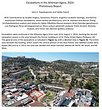
| Excavations in the Athenian Agora, 2024: Preliminary Report ... John K. Papadopoulos Debby Sneed ... A summary of the second excavation season in Section ΒΚ, in the area beneath the former building at 14 St. Philip Street.
The area was divided into three trenches and yielded mixed material from the Modern ... 10 Jun-2 Aug 2024 ... A summary of the second excavation season in Section ΒΚ, in the area beneath the former building at 14 St. ... The excavation followed a strategy of total collection and 100% dry sieving with flotation and phytolith samples from all the baskets.
... They counted the tiles and kept a sample.
Aerial and ground photogrammetry were conducted on a regular basis.
|
| Report on Excavations in the Athenian Agora 1992 ... T. Leslie Shear, Jr ... This is a report on the archaeological excavations in the Athenian Agora during 1992. The investigations continued in two areas: on the south side of Hastings Street and along the north side of Hadrian ... 8 Jun-7 Aug 1992 ... This is a report on the archaeological excavations in the Athenian Agora during 1992. ... In the northernmost section Byzantine levels were dug, revealing a complex of two rooms and a courtyard bounded by streets. Three large pithoi were found in one of the rooms. A well, first used in the Roman period and then reused in the Byzantine period ,was dug and produced a large number of finds, amongst them a herm head from the Classical period. |
| Preliminary Report on the 2007 Excavation Season ... John McK. Camp II ... Excavation continued this year in the sections ΒΖ, ΒΗ and Γ.
In Section ΒΖ South, two areas were investigated: the north-south road and the areas west of the road. In the road, hard-packed gravel surfaces ... 13 Jun-3 Aug 2007 ... In Section ΒΖ South, two areas were investigated: the north-south road and the areas west of the road. ... To the west, Hellenistic and Classical levels were excavated, and a pyre buried under a floor was exposed, dating to the late 4th or early 3rd century B.C.
... A draw-shaft and part of the tunnel of a Hellenistic cistern complex was found outside the building to the east. |
| Preliminary Report on the 2006 Excavation Season ... John McK. Camp II ... This summer the 75th anniversary of the beginning of the excavations and the 50th anniversary of the reconstruction of the Stoa of Attalos were celebrated.
Excavation were concentrated on two areas: northwest ... 13 Jun-4 Aug 2006 ... The 5th century B.C. as a construction date was confirmed.
... A large round tile-floored cistern was removed and revealed a smaller one immediately below, both dating to the 10th century A.D. ... In deeper layers, a pyre of early Hellenistic date was found. |
| Agora Excavations 1995 Preliminary Report ... John McK. Camp II ... Excavations continued in the areas of the Panathenaic Way, west of the Stoa Poikile, and in and around the Classical commercial building north of the Stoa Poikile.
In the Panathenaic way the exploration ... 12 Jun-4 Aug 1995 ... In the second half of the 5th century B.C. the road surfaces were carefully prepared, perhaps to then serve as a race track.
The exploration of the levels overlying the Classical commercial building continued and more of the walls of the third room from the south were found along with a cement lined basin. ... West of Stoa Poikile, the clearing of a late Archaic well was completed. |
| Preliminary Report on the 2004 Excavation Season ... John McK. Camp II ... All the work during the season 2004 was concentrated on the northwest corner of the Agora north of the Panathenaic Way.
In BZ North, the last remains of Byzantine fills and walls were removed and Hellenistic, ... 7 Jun-16 Jul 2004 ... In BZ North, the last remains of Byzantine fills and walls were removed and Hellenistic, early Roman and late Roman fills were explored. A gap in the archaeological record between the late Hellenistic/early Roman to late Roman periods was discovered. ... In Section BZ South, work continued in the North-South Road and in the building along its west side. ... Along the west side of the street a terracotta pipeline for fresh water was traced for much of the length of the excavated area.
|
| Preliminary Report on the 1999 Excavation Season ... John McK. Camp II ... Most of the work this season was concentrated in the northern half of Section ΒΖ where the Byzantine levels were further explored. Street walls along both sides of the north-south road were revealed and ... 7 Jun-30 Jul 1999 ... Street walls along both sides of the north-south road were revealed and part of three houses were uncovered. Several built pithoi were found within the houses, representing impressive storage capacity. A small hoard of copper coins dates the houses to the 11th century A.D. when the area after two centuries of abandonment became densely populated.
In Section ΒΕ excavation continued in the Classical commercial building where another pyre was discovered. A well was uncovered and was partly dug. |
| Report on Excavations in the Athenian Agora 1991 ... T. Leslie Shear, Jr ... This is a report on the archaeological field work conducted in the Athenian Agora during the period from December 1990 to December 1991. The actual excavation period was preceded by the demolition of a ... 10 Jun-9 Aug 1991 ... The actual excavation period was preceded by the demolition of a newly acquired building.
... It was possible to explore a section of the Eridanos River which passes through the Agora in a great masonry tunnel covered by large slabs. ... Work continued west of the Stoa Poikile in the area of the early Roman temple which was added to the Sanctuary of Aphrodite Ourania in the Augustan period. South of the sanctuary, at the edge of the Panathenaic Way, two complete stelai, used as cover slabs over a small drain, were discovered.
|
| Preliminary Report on the 2003 Excavation Season ... John McK. Camp II ... Excavations in 2003 were carried out largely in the northwest corner of the Agora known as Section BZ. The area was divided into two parts: the north-south road and areas to the west, and east of the road ... 13 Jun-25 Jul 2003 ... The area was divided into two parts: the north-south road and areas to the west, and east of the road.
... The main topographical feature was the north-south street which divided the area in two parts with late Roman walls on both sides of the street. West of the road, remains of a bath built in the 3rd century A.D. were excavated. |
| Preliminary Report on the 2001 Excavation Season ... John McK. Camp II ... Excavations were carried out at the northwest of the Agora in sections ΒΖ and ΒΕ, and in the area of the Eleusinion in section ΕΛ.
In Section ΒΖ, the investigation of the settlement of the 11th century ... 11 Jun-3 Aug 2001 ... The lowest floor levels of the buildings were excavated down into layers of the 7th to 9th centuries, exposing the Byzantine walls to their full depth and the upper parts of the late Roman walls beneath. A well was partially excavated, a stone-lined cesspit was uncovered and a large plaster-lined pit was discovered. The last of a modern basement was successfully cleared out. ... Further work was done in both of the two Mycenaean chamber tombs, dated to the 14th century B.C. A third chamber tomb was partially uncovered. |
| Agora 2019 - Summary Report ... John McK. Camp II ... Excavations were carried out in four sections: in Section ΝΝ in the southwest corner of the archaeological site, and in the northwest corner of the Agora in Sections ΒΖ, ΒΘ East and ΒΘ West.
Section ΝΝ ... 10 Jun-2 Aug 2019 ... Excavations took place in an area where a deposit of terracotta figurines had been found in the 1940’s. ... North of the tank, a corner of a marble bench or seat was uncovered. ... They were probably part of a large building or monument which now lies under the scarp.
|
| Preliminary Report on the 2008 Excavation Season ... John McK. Camp II ... Excavations took place in three sections, two north of Hadrian Street (ΒΗ and ΒΘ) and one in the old area south of the Tholos (Γ).
In Section ΒΗ, layers in, over and behind the building identified as the ... 10 Jun-1 Aug 2008 ... Excavations took place in three sections, two north of Hadrian Street (ΒΗ and ΒΘ) and one in the old area south of the Tholos (Γ).
... Behind the back wall a small fragment of a large terra cotta pipe was found in situ in middle Byzantine layers. Layers contemporary with the Stoa were not reached this season. A rubble wall may represent a late blocking of the interior colonnade, relatively common in the late Roman period.
|
| Preliminary Report on the 2009 Excavation Season ... John McK. Camp II ... Excavations were conducted in four sections: Γ, ΒΘ, ΒΗ and ΒΖ.
In Section Γ, the investigation of the Classical buildings south of the Tholos continued with the aim to find out if they were civil, commercial ... 8 Jun-31 Jul 2009 ... It was clarified that the complex consists of three houses grouped around a central courtyard. A well in the courtyard was emptied, and the finds recovered indicate a domestic or commercial use of the buildings. ... It became clear that it was a building with a least six adjacent rooms in a row opening on to the street in front. |
|
|