|
|
Great Drain South (ca. 70-113, from SW edge of section as far north as the Roman Bath) Hellenistic Sand Fill. Silted-up filling of the southern branch of the Great Drain, abandoned due to some damage at ... 4th. c.-86 B.C. |
"South Triangle" abandonment filling over Brown House (House A) in the industrial area. Layers 1-3 and layer 4, to floor of second period. As late as the 3rd. c. B.C. but composed largely of earlier material ... 3rd c. B.C. and earlier ... "South Triangle" abandonment filling over Brown House (House A) in the industrial area. ... For fillings connected with construction and rebuilding of house, see
A 20:6. |
| Listed in notebook as at 6/ΛΗ but later found to be at 12/ΛΗ.
Originally B 16:1.
Large cistern distinguished by a short (1.75m) blind tunnel running SW from its floor, and a shallow (ca. 0.80m originally) ... Ca. 150 B.C ... Large cistern distinguished by a short (1.75m) blind tunnel running SW from its floor, and a shallow (ca. 0.80m originally) settling basin just south of the cistern mouth. |
Fillings to either side of the Great Drain, in the southern part of the area west of the Areopagus; various levels, late 6th. and early 5th c. B.C. to Sullan destruction. Coins:
26 July 1946 #1-#2
30 July ... Late 6th. c. B.C.-1st. c. A.D. |
West Terrace, South End, Layers IV and V. Heavy dumped filling associated with terrace walls at the extreme south end of the excavations in the Areopagus industrial area. The proportion of figured and ... Ca. 420-390 B.C ... West Terrace, South End, Layers IV and V. Heavy dumped filling associated with terrace walls at the extreme south end of the excavations in the Areopagus industrial area. The proportion of figured and good glazed fragments is unusually high, including cups, squat lekythoi and other vases in greater part of the last two decades of the 5th. c. but with some material that goes back into the first quarter of the 5th. c. and a little that continues into the early years of the 4th. |
| Report on sorting of pottery, August 1951, by H.S. Robinson [nb p. 3666].
Cistern discovered and dug to 1.60m., vi/10/36; dug to bottom iv/22/37-v/6/37. Diam. At mouth 0.26m.; neck begins to widen out ... 1st. c. B.C. to post-Herulian ... Well-plastered, without footholds; at 2.90-3.85m. a passage opens out to the south, curving slightly eastward, for 5.00m., at which point it is blocked by fill from another (cistern?) |
Cistern (diameter 0.90m) with two channels; the fill of the cistern proper, below the scant upper (Byzantine) deposit, appears to have been dumped all at the same time, to 325-275 B.C. Notebook says "all ... 325-275 B.C. |
Well A (depth 10.20m, diameter 1.04m, water level 4m) outside the SW corner of the market square, to the east of the north-south road.
At the bottom of the well were scanty remains probably from a period ... Ca. 425-375 B.C ... Well A (depth 10.20m, diameter 1.04m, water level 4m) outside the SW corner of the market square, to the east of the north-south road.
At the bottom of the well were scanty remains probably from a period of use, but without whole water jars; above this lay a heavy deposit of mud, containing little pottery; the dumped filling in the top of the well was extremely fragmentary and carried considerable traces of burning. |
This deposit represents the Hellenistic fill from 50-54/ΣΤ-Η. A mixed green sand drain fill exists a bit father south (nbp. 135). Coins:
14 May 1934 #1-#175
15 May 1934 #1-#70 ... 14 May 1934 ... This deposit represents the Hellenistic fill from 50-54/ΣΤ-Η. A mixed green sand drain fill exists a bit father south (nbp. 135). |
| Homer A. Thompson ... PG grave to NW of Stoa Pier 19 (Tomb no. 5 in notebook). In some records as Grave XLII.
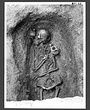
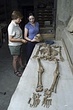
It consisted of a rectangular pit, oriented north-south, cut into bedrock. The sides of the pit were lined and the ... Earlier-Developed Protogeometric ... It consisted of a rectangular pit, oriented north-south, cut into bedrock. ... The skeleton of a child (7-8 years at death) was found on its back in a fully extended supine position, head to the south, filling the cist almost entirely. This was one of the better-furnished tombs: grave goods included a metal pin on either shoulder, with the pin-heads toward the south.
|
Dumped fill in a shaft which served as means of access leading to a water channel south of the Stoa of Attalos. Coins:
29 June 1933 #1 (disintegrated)
29 April 1936 #1-#3
4 May 1936 #1 ... Early 1st c. A.D ... Dumped fill in a shaft which served as means of access leading to a water channel south of the Stoa of Attalos. |
South Stoa II Construction Fill.
About 85 stamped amphora handles, many with parallels in building fills of Middle Stoa and Stoa of Attalos. Fragments of long-petal bowls confirm date after mid-2nd c ... To ca. 140 B.C ... South Stoa II Construction Fill.
... Types 25 A', 33 A, 35 B, and 44 A lamps. |
| Well South of Soft Yellow Poros Foundation. Dumped filling of a collapsed well, that, due to hazardous conditions, could not be cleared below- 2.50m. The well was partly cut on the east side by a Byzantine ... Protogeometric-Early Geometric II, ca. 850 B.C ... Well South of Soft Yellow Poros Foundation. Dumped filling of a collapsed well, that, due to hazardous conditions, could not be cleared below- 2.50m. The well was partly cut on the east side by a Byzantine storage pithos, and on the south side it was disturbed by another, tile-lined, well of the Roman period (U 19:4), which had been used for water and then as a cesspool inn the early 20th century.
|
Mycenaean Grave, disturbed, in scarp E of Stoa, a little to the south of the group of tombs clustered around Pier 12. No remains (perhaps a child's grave whose bones had completely disintegrated).
Small ... Myc. IIIA:2-B ... Mycenaean Grave, disturbed, in scarp E of Stoa, a little to the south of the group of tombs clustered around Pier 12. No remains (perhaps a child's grave whose bones had completely disintegrated).
|
| Homer A. Thompson ... Cremation burial (trench-and-hole) under S. edge of E-W Street, northern burial. In some records as Grave XLVII.
The western part of the offering trench of the tomb was lost to a Turkish cess pit, and ... Middle Geometric I ... The tomb was found directly below a Classical wall. What survived was the south and east section of the original grave, including a strip of the pyre trench, reddened from burning to a depth of 0.05m, and below it a shallow urn-hole, roughly square, ca. 0.60m to the side, cut through earth almost to the level of bedrock, to a depth of about 0.30m.
The urn-hole was dug only deep enough to accommodate the cinerary urn to its shoulder; the burning suggests a north-south orientation with the cinerary urn at the south or southeast corner.
|
Cistern A for 1935 (there is another Cistern A, for 1936, D-E 8-9:1) Coins:
16 May 1935 #4-#5
17 May 1935 #1-#2
18 May 1935 #1-#2
20 May 1935 #1-#2
22 May 1935 #1
23 May 1935 #2-#6
24 May 1935 #1-#7
25 ... 16-25 May 1935
6 February 1936 ... Cistern A for 1935 (there is another Cistern A, for 1936, D-E 8-9:1) ... Also, from rock-cut channel leading south from cistern (27/8/1961) S 589, S 590, SS 4316, IL 254, IL 258, IL 286, T 885, T 901, A 578, P 5947, P 6449 and coins ΠΘ-34, ΠΘ-35. |
Ca. 73-81/Drain. Fillings associated with the construction of the Great Drain South, especially the fill thrown in behind the east wall of the drain at the time of its building.
Cf. A 20-21:1 and B 19:7 ... Ca. 425-400 B.C ... Fillings associated with the construction of the Great Drain South, especially the fill thrown in behind the east wall of the drain at the time of its building.
Cf. A 20-21:1 and B 19:7.
|
A well toward the south end of Kolonos Agoraios. Period of use fill dated to ca. 325-260 B.C. and upper fill dated to ca. 250-225 B.C. in Agora XXX.
Diameter 1.10m, water level 6.90m.
Kernoi and many lead ... Ca. 325-260 B.C ... A well toward the south end of Kolonos Agoraios. ... Kernoi and many lead strips stamped with an ear of wheat springing from a kernos make it probable that we are dealing here with sanctuary debris. |
Two chambers connected by a tunnel, all filled at the same time, but with slight Hellenistic disturbance. Chamber A, to west at 14/ΛΗ, B to east at 14-15/ΛΒ on grid for section RR.
Cistern system ca. 20.00m ... Ca. 325-275 B.C ... Two chambers connected by a tunnel, all filled at the same time, but with slight Hellenistic disturbance. ... Cistern system ca. 20.00m. south of the south stylobate of the Hephaisteion. Basically a single dumped filling; the presence in the filling of a few later objects ... possibly as late as the second half of the 3rd c., probably indicates a supplementary filling. |
| Mycenaean Grave at SE corner of Pier 12 (Burial 9).
There are no traces of dromos, which must have been located at the north and have been cut away by the trench four the south stylobate of the Square ... Myc. III A:1 ... The dimensions of the chamber are 1.60m east-west by a preserved length of 1.40m north-south. The walls were preserved to a height of 0.065m, and the grave was full of broken bedrock with a little soft brown silt around the bones. The broken bedrock plus the presence of more than one burial is certain indication of a chamber tomb rather than a pit grave. |
| Bronze-casting pit and furnace against S apse of Church (106/ΛΕ). Late Roman sherds of the 4th and the 6th c. A.D. were found with fragments of moulds from bronze casting. The west end was destroyed by ... 5th-6th c. A.D ... There is a tile floor set on bedrock and two brick piers of the south wall stand to a height of 1.12 m.; one scrap of the north wall establishes a width of 1.05m. |
| David Scahill ... At northeast corner of Classical Building II; on south side of dromos of Tomb K 2:5, and separated from it by ca. 0.6m of bedrock. Chamber cut through bedrock. The northeast corner of chamber defined ... LHIII A:1 ... At northeast corner of Classical Building II; on south side of dromos of Tomb K 2:5, and separated from it by ca. 0.6m of bedrock. ... Rest of tomb runs under later wall foundations to the south and west.
Upper fill of stones and earth inside cutting with Geometric sherds. ... More bones and a skull in a depression under and to the south, with an alabastron, and broken pieces of a second pitcher. |
| Homer A. Thompson ... PG grave north of Stoa Pier 19 (Grave 6). In some records as Grave XLIII.
Unlined rectangular pit cut into a shallow depression in bedrock that was formed by the collapse of the roof of Mycenaean Chamber ... Developed Protogeometric ... Unlined rectangular pit cut into a shallow depression in bedrock that was formed by the collapse of the roof of Mycenaean Chamber Tomb Q 8:8. ... The tomb was oriented south-southwest to north-northeast.
On the floor of the pit, " a few bones and the skull" of the deceased were encountered, the cranium evidently at the south end of the grave. |
| Phaidon Street Cistern: South Chamber.
Connected by tunnel to O 17:5.
Knidian stamped amphora handle; fragments of five long-petal bowls, one made in worn mold. Type 35 A lamp. Coins
9 August 1957 #1-#3 ... Late 2nd c. B.C ... Phaidon Street Cistern: South Chamber.
Connected by tunnel to O 17:5.
... Type 35 A lamp. |
Geometric Well South of Middle Stoa Pier 14, in the north-central part of the South Square. Water jars, simple household vases and utensils, a trial piece for use in a potter's kiln, bones of pigs and ... 775-750 B.C ... Geometric Well South of Middle Stoa Pier 14, in the north-central part of the South Square ... Water jars, simple household vases and utensils, a trial piece for use in a potter's kiln, bones of pigs and sheep, and the skulls of four dogs. |
| Homer A. Thompson ... Cremation burial (trench-and-hole) under S. edge of E-W Street, southern burial. In some records as Grave XLVI.
Neat trench, rectangular as preserved, but may have originally been square, cut partly through ... Early Geometric I ... The north side of the trench was destroyed by the a Turkish cess pit. As preserved, the trench measured ca. 1.05x 0.60m, and was presumably oriented east-west, but as the north side was destroyed it is possible that the trench extended toward the north and may, therefore, have had a north-south orientation. Be that as it may, a deep, circular urn-hole was cut into the southeast corner of the pyre trench to a depth of 0.45m below the level of the floor, and measuring 0.35m in diameter.
|
| Mycenaean Double Grave (Graves A and B).
Grave A was in Layer II. We laid a skull and a few other bones, three vases and a stone bead. We have dug to a maximum of about 0.06m below the top of Layer II ... Myc. IIIA/B ... Mycenaean Double Grave (Graves A and B).
Grave A was in Layer II. We laid a skull and a few other bones, three vases and a stone bead. ... To the South of Grave A and separated from it by a narrow wall apparently of bedrock, was part of another grave. |
A deep pit in bedrock over mouth of well. Context archaic, 6th c.
B.C., but with some traces of later disturbance. Found a circle for a well at the bottom, much water, no sherds.
Lay 2.20m south of Well ... 6th c. B.C ... A deep pit in bedrock over mouth of well. ... B.C., but with some traces of later disturbance. Found a circle for a well at the bottom, much water, no sherds.
Lay 2.20m south of Well B (L 17:1). |
| Eugene Vanderpool ... Infant grave near Phaidon street cistern. No offerings.
Roughly rectangular, almost elliptical cutting in bedrock, measuring 0.70m long, 0.35m wide, and 0.40m deep, oriented south-southwest to north-northeast ... Late Helladic III C/Early Protogeometric (date uncertain) ... Roughly rectangular, almost elliptical cutting in bedrock, measuring 0.70m long, 0.35m wide, and 0.40m deep, oriented south-southwest to north-northeast. The skeleton of what was stated to be a "newborn infant," head to the south-southwest, was laid out within the pit and covered by a stone slab.
Reanalysis of the bone identified the presence of two infant inhumations, which were subsequently labeled AA 289 a,b |
| Homer A. Thompson ... PG grave to NW of Pier 19 (Grave 4).
It consisted of a rectangular pit, oriented north-south, cut into bedrock. Only the lowest part of the tomb pit was preserved; the upper part was cut away in the Classical ... Earlier-Developed Protogeometric ... It consisted of a rectangular pit, oriented north-south, cut into bedrock. ... As preserved, the tomb measured ca. 1.20m long and about 0.60m wide. A thin irregular unworked schist slab, ca. 0.47x0.67m, remained from the floor of the tomb pit.
On it were a few bone fragments of a child and six vessels.
|
| Grave cut into bedrock (L. 2m, W. 0.58m), head toward E; offerings at south end. Skeleton of a male about 40 years old, laid out with knees slightly bent.
Brann. PD 434, PD 1058 ... 750-725 B.C ... Grave cut into bedrock (L. 2m, W. 0.58m), head toward E; offerings at south end. Skeleton of a male about 40 years old, laid out with knees slightly bent.
|
A well on the lower south slope of Kolonos Agoraios. Last quarter of the 5th. c. B.C. But upper fill dated to 3rd. to mid-2nd. century B.C. and lower fill dated to ca. 425-400 B.C. in Agora XXX. Coins: ... 425-400 B.C ... A well on the lower south slope of Kolonos Agoraios. |
Slag pit in front of South Stoa II. The filling consisted ... of a very miscellaneous lot of stone and marble. ... In among the stones was a loose filling of ash and charcoal and iron slag ... (nbpp. 6510, ... Second half 1st c. A.D ... Slag pit in front of South Stoa II. The filling consisted ... of a very miscellaneous lot of stone and marble. ... In among the stones was a loose filling of ash and charcoal and iron slag ... |
Well in Room 1 of south aisle of Stoa. The well is lined with bricks and tile. This lining is preserved to a level of 52.733 m., which is approximately the same as the level off the late threshold of the ... 5th-6th c. A.D ... Well in Room 1 of south aisle of Stoa. ... A channel had been dug through bedrock with its bottom at 49.321 m. ... Pottery dated in the 5th century with a few 6th c. sherds. |
Child's burial in south wall of Marble Worker's House.
Bones examined 20 June 1975 and found to be an immature animal, not human (canid-puppy?).
Identified as pyre by SIR. Set into a shallow roughly ovoid ... Late 4th c ... Child's burial in south wall of Marble Worker's House.
... Set into a shallow roughly ovoid pit measuring ca. 0.27m east-west by 0.33m north-south. |
Cistern system on Kolonos Agoraios, shaft into south passage (81/ΝΘ). The fill again seemed to be a dumped fill; probably rather late 3rd. c. Coins:
8 June 1936 #1-#3 ... Late 3rd. c ... Cistern system on Kolonos Agoraios, shaft into south passage (81/ΝΘ). The fill again seemed to be a dumped fill; probably rather late 3rd. c. |
| Disturbed Mycenaean chamber tomb.
It was the first Mycenaean burial found in the Agora. It is situated about 20m due south of Tomb VII, only a few meters beyond the south edge of the Augustan foundation ... Myc. IIIA (1st half of 14th c.) ... It is situated about 20m due south of Tomb VII, only a few meters beyond the south edge of the Augustan foundation of the Temple of Ares. |
| Mycenaean Grave to W of Pier 12 (Burial 11).
The northern part of the tomb had been cut away by the foundation trench for the south stylobate of the Square Building that preceded the Stoa, and the dromos, ... Myc. IIB-IIIA:1 ... The chamber was small with an original east-west dimension of 1.60m and a preserved north-south dimension of 1.20m, the walls preserved to a maximum height of 0.90m. A single skeleton lay in some disorder in the eastern part with its head to the south. ... Although it might be argued from the single internment and the absence of any preserved dromos that this was a pit grave, the location of the body along the edge of the cutting would seem rather to indicate a small chamber tomb that has been cut away at the north. |
Mycenaean well and grave.
Single burial, that of a middle-aged man, had been made in the mouth of an unproductive well near the southeast corner of the South Square ... Myc. IIIB-C:1 ... Single burial, that of a middle-aged man, had been made in the mouth of an unproductive well near the southeast corner of the South Square. |
Material from trenches:
a) 1.00-7.00m. from East End of Stoa.
b) 18.40-21.40m. from East End of Stoa, with some disturbed fill including 1st c. A.D. material.
c) 46.60-48-60m. from East End of Stoa.
d) ... 2nd c. B.C. |
| Deposit of terracottas, molds and pottery in a shallow pit sloping downward from north to south. This deposit was located beneath a layer of fill under a Late Roman plaster floor (Lots ΒΕ 2093-2095). The ... 1st c. A.D ... Deposit of terracottas, molds and pottery in a shallow pit sloping downward from north to south. This deposit was located beneath a layer of fill under a Late Roman plaster floor (Lots ΒΕ 2093-2095). The deposit was cut at its south end by the Byzantine/Late Roman disturbance excavated in Lots ΒΕ 2087-2088, which explains the presence of terracottas in those contexts. |
| John Camp ... Protogeometric grave (female inhumation) located about 0.60m northwest of T 15:1. It consisted of a roughly rectangular pit, with the corners slightly rounded, oriented approximately north-south. The pit ... "Submycenaean"/Early Protogeometric ... It consisted of a roughly rectangular pit, with the corners slightly rounded, oriented approximately north-south. The pit was cut to a depth of at least 0.45m at the south end and 0.25m at the north on account of the sloping bedrock. ... Within the pit, the well-preserved skeleton of a woman aged about 40-44 years at death was found laid out in a fully extended position on her back, head to the south. |
S.W. of Archaic Temple : Pocket in bedrock. The pocket was cut through a red clay floor. 71 sherds.
Objects: loom weights; lamp.
Early ware: Gray Minyan; Mycenaean; Protogeometric-Late Geometric; Subgeometric; ... Early 6th c. B.C. and earlier |
| Susan Rotroff ... Grave 1. Burial of a child perhaps 6 years old, covered by broken amphora. Skeleton lay extended on its back, oriented N-S, with head at south. No grave gifts. PD 2207 ... Final Mycenaean/Submycenaean ... Burial of a child perhaps 6 years old, covered by broken amphora. Skeleton lay extended on its back, oriented N-S, with head at south. No grave gifts. |
Mycenaean Grave below Stoa stylobate opposite pier 21, about 0.75m below the bottom of the Stoa conglomerate foundations. Although only the south side and the west end could be certainly fixed, the dimensions ... Myc. III A-early IIIB ... Although only the south side and the west end could be certainly fixed, the dimensions as exposed (1.30m by 0.60m) agree with those of the other cist graves. Tumbled in the grave were three rough stone slabs, presumably from a covering. A single skeleton lay in order, with feet to west and legs bent at the knees to fit into the space. |
| Mycenaean Tomb to NE of Pier 19 (Burial #1)
Most of the doorway and the dromos had been cut away by the ancient Stoa builders. The dimensions of the chamber were 2.90m wide by 1.60m deep. Unusual features ... Myc. III A:1 ... Unusual features of the tomb were a small recess in the back or south wall, in which stood the askos, and a rough stone slab which was found on the floor near the center of the east side, but which may once have been a grave marker at ground level.
... In the southeast corner and along the west wall there were swept-up piles of bones and offerings from earlier burials, and in the northwest corner there was a small round pit (0.50m in diameter by 0.20m deep) full of bones. |
| A flask-shaped storage pit or cellar, cut in the rock at the south edge of the levelled top of Kolonos Agoraios. Filled late in first quarter of 6th. c. B.C. (2.95m from east to west by 2.70m from north ... First quarter 6th. c. B.C ... A flask-shaped storage pit or cellar, cut in the rock at the south edge of the levelled top of Kolonos Agoraios. ... B.C. (2.95m from east to west by 2.70m from north to south).
Original mouth probably cut away. |
| Marcie Handler ... The Pyre was revealed in a layer of 4th c. fill in the north end of Room 6, just south of Wall 8. Room 6 is defined by the street wall (Wall A) on the west, Wall 7 on the east, Wall 9 on the south (preserved ... 4th c. B.C ... The Pyre was revealed in a layer of 4th c. fill in the north end of Room 6, just south of Wall 8. Room 6 is defined by the street wall (Wall A) on the west, Wall 7 on the east, Wall 9 on the south (preserved only as a stub on the east side of the area), and possibly Wall 8 or Wall 6 on the north.
2.5 meters SW of the pyre, a patch of floor surface at J/10-1/20 at 52.188 masl. was found. |
Just east of Building II near its south end. The tiles were in place.
Upper filling (to 3.00m.) of Hellenistic-Byzantine dump all discarded.
POU fill a gradual accumulation of typical Justinianian ware ... 6th c. A.D. POU-7th c. A.D ... Just east of Building II near its south end. The tiles were in place.
... POU fill a gradual accumulation of typical Justinianian ware. |
Well south of the apse of Room 3, Roman House H. Cut through bedrock, diameter ca. 1.15m, stopped at ca. -10.80m because of danger of collapse. Water at very top, up to bottom of parapet between well and ... 2nd-4th c. A.D ... Well south of the apse of Room 3, Roman House H. ... Secondary access from well-head outside apse, at a higher level ... A.D, indicating period of use of Room 3A as a fountain-house before incorporation into Roman House H sometime around the middle of the 4th c. |
A shallow tiled well or reservoir set inside the South Stoa against its back wall. Its location in relation to the wall of the Stoa, and the fact that a lead pipe set through the latest floor of the Stoa ... 5th - 6th c. A.D ... A shallow tiled well or reservoir set inside the South Stoa against its back wall. Its location in relation to the wall of the Stoa, and the fact that a lead pipe set through the latest floor of the Stoa leads to it, shows that it was built while the Stoa was still in use, that is before 267 A.D. |
Mycenaean well under East Building Terrace steps (No catalogued pots). Rectangular in shape, 0.90x0.60m.
Abutting against the back of the East Building Terrace steps to the south. Yielded much thrown bedrock ... 14 July 1967 ... Abutting against the back of the East Building Terrace steps to the south. Yielded much thrown bedrock and a few Mycenaean sherds, with a few later intruders at the upper levels. It seems possible that this served as a well in Mycenaean times, though it evidently got little or no use.
|
South House, Room 12, over pebble mosaic floor. Herulian destruction debris in a house. Coins:
29 April 1956 #1-#7
2 May 1956 #1-#3
9 May 1956 #1
26 May 1956 #1-#4
2 June 1956 #1-#4 PD 1350 ... 9 May 1956 ... South House, Room 12, over pebble mosaic floor. Herulian destruction debris in a house. |
| Marcie Handler ... Fill within the drain from the basin on the west side of Roman Room B through Wall A.
After we removed the fill within the basin on the west side of Roman Room B (BZ XXVII p. 5325), we began excavating ... Late Roman ... Fill within the drain from the basin on the west side of Roman Room B through Wall A.
After we removed the fill within the basin on the west side of Roman Room B (BZ XXVII p. 5325), we began excavating in the cutting on the east face of a conglomerate block that is part of Wall A. ... The cutting is probably a drain that carried water from the basin through Wall A and onto the North-South Road. |
| Tiled Well at S edge of E-W Road, 73/ΜΗ. Contemporary upper and lower fills separated by layer of sterile mud.
Latest coin dates ca. 200. Koan amphora handle with stamped handle dates slightly after 200 ... 210-160 |
| Mycenaean grave. It consisted of a shallow rectangular cutting in bedrock about 1.40m by 0.70m, but it was probably somewhat bigger, since the east side and a large part of the north side had been cut ... Myc. IIIA:1-2 ... It consisted of a shallow rectangular cutting in bedrock about 1.40m by 0.70m, but it was probably somewhat bigger, since the east side and a large part of the north side had been cut away by later builders. It contained a single burial, that of a small child, laid lengthwise in the grave along the south side. ... Many minute glass beads were found under the skull and around the feeding bottle, and doubtless came from a necklace worn by the child. |
| Johanna Hobratschk ... South end of Byzantine Room J, adjacent to Pithos B and under St. Philip's st scarp. Built lining at the E and N side, roughly constructed of some large square blocks and slabs, smaller field stones of ... 21 July-3 August 2006
2011
28 June 2012-16 July 2012 ... South end of Byzantine Room J, adjacent to Pithos B and under St. ... At the W side, there is an area which does not seem to have a built lining. The shape is irregular, with a diameter of ca. 0.8m. |
Abandoned digging at 6.25m. due to water level. Tile well could be associated with a bit of late Roman wall to the south, with floor level about one meter above that of pebble floor. Well tiles were not ... 14-22 April 1948 ... Tile well could be associated with a bit of late Roman wall to the south, with floor level about one meter above that of pebble floor. Well tiles were not in place for the last meter and a half. |
Outside the market square, near the southeast corner, on the south edge of the east-west road, where it passes to the south of the Mint.
There is no doubt that the pottery from the well is "stratified" ... Early 1st to 6th c. and of 8th c. A.D ... Outside the market square, near the southeast corner, on the south edge of the east-west road, where it passes to the south of the Mint.
There is no doubt that the pottery from the well is "stratified" in the sense that a very definite sequence could be observed from the late 6th c. pottery near the top down to pottery of the 1st c. A.D. in the lowest containers (some Byzantine pottery ... probably represents a brief reuse of the well after a long period of disuse). |
| Marcie Handler ... Located in the south section of Room E in the Byzantine Building east of the North-South Road. The uppermost 1.5 meters of well lining was built of well-coursed stones (some reused marble blocks) and tiles ... 12th c. A.D ... Located in the south section of Room E in the Byzantine Building east of the North-South Road. ... The later phase of the well, a Byzantine well-lining and well-head, was excavated during the 2001 season (BZ XXV p. 4953, Lot BZ 1217) and the Roman catchment basin and well-lining down to the level of the terracotta lining were excavated during the 2002 season (BZ XXVII pp. 5279 & 5285 for the catchment basin; BZ XXVII p. 5293 for the Roman well-lining).
... The packing fill for the well consisted almost entirely of fragments of tegulae mammatae (133 were found in the packing fill from 50.657 to 53.001 masl), which gives the destruction of the bath to the southwest in 395/6 AD as a terminus post quem for the original construction phase of the well. |
| John Camp ... Protogeometric Grave about 0.60m to the southeast of T 15:2.
Unlined roughly rectangular-elliptical pit, oriented north-south, neatly cut into bedrock to a depth of 0.70m, with rounded corners. The pit ... Early-Developed Protogeometric ... Unlined roughly rectangular-elliptical pit, oriented north-south, neatly cut into bedrock to a depth of 0.70m, with rounded corners. ... Within the pit, the skeleton of a woman, aged about 40-44 years at death, within significant osteoarthritis and degenerative joint disease, was placed on the floor of the tomb, on her back, in a fully extended supine position, arms by the side of the body, head to the south. |
Mycenaean Chamber Tomb W. of Circular Building (at Σ:30/ΛΕ?)
It had been badly disturbed by a fourth-century B.C. pit which cut into the northeast part of the chamber (rectangular, ca. 1.80m by 1.30m) ... Myc. III A 2 ... It had been badly disturbed by a fourth-century B.C. pit which cut into the northeast part of the chamber (rectangular, ca. 1.80m by 1.30m). ... Two skeletons and traces of a third were found. Only the one lying along the west edge of the chamber was well-preserved, with its head to the south, knees up, and with the pots at its feet. two more pots were found lying between this skeleton and the chamber wall. |
| Burned deposit: Middle Terrace, south of Archaic cemetery.
RSY: Pyre 10.
Pottery, burnt bone, charred logs, and heavy burning, recovered by tunneling under the cement floor of a Late Hellenistic workshop, ... Ca. 325-300 B.C ... Burned deposit: Middle Terrace, south of Archaic cemetery.
... Pottery, burnt bone, charred logs, and heavy burning, recovered by tunneling under the cement floor of a Late Hellenistic workshop, between two lekanai set into the ground and functioning with the cement floor. |
Located beneath line of Poros Gutter, from a square settling basin cut in bedrock at the north end of Trench II, South of Theseion, 1.30m below the modern road surface. The basin is lined with rough-picked ... Last quarter of 5th c. B.C.-early 4th c. B.C ... Located beneath line of Poros Gutter, from a square settling basin cut in bedrock at the north end of Trench II, South of Theseion, 1.30m below the modern road surface. The basin is lined with rough-picked limestone blocks of 0.20-0.30m thickness, closely fitted and bonded with mud mortar, a construction similar too that of the hieron in material and quality, if not size. |
| Initially uncovered with a diameter of c. 1.05m. Its south side extends under the south wall of the Classical structure and so clearly predates it. The highest preserved portion of the well shaft (at the ... 22 July-9 August 1994
26 June 1995
3-7 July 1995 ... Initially uncovered with a diameter of c. 1.05m. Its south side extends under the south wall of the Classical structure and so clearly predates it. ... On the south side of the shaft, a lining wall of field stones is preserved from an elevation of 49.44m above sea level; around the rest of the shaft it is preserved from an elevation of 48.99m. |
| Rodney S. Young ... Grave 19 (In some records as Grave VIII). No remains, no burned matter or traces of burning.
JP
A small cutting with a single offering. The pit may have been for a simple child/infant inhumation, with ... Early Protogeometric ... No remains, no burned matter or traces of burning.
JP
A small cutting with a single offering. The pit may have been for a simple child/infant inhumation, with the human remains totally dissolve or disintegrated. Another similar cutting, at right angles, probably from another burial. A further cutting, just to the south, roughly rectangular, oriented east-southeast to west-northwest, measured 0.95m in length, 0.53m wide, and 0.47m deep. |
| Eugene Vanderpool ... Grave (E.L. Smithson: Grave III: SM).
The close proximity and similarity of this tomb and tomb M 16-17:1 strongly suggests that they were intentionally laid out in relation to one another and were contemporary ... Late Mycenaean/Submycenaean-Earliest Protogeometric ... The tomb consisted of a rectangular pit cut into bedrock to a preserved depth of 0.30m. Oriented north-south, the tomb measured 0.50m and 0.12-0.15m wide; it was slightly undercut, with traces of a ledge running the length of the tomb on both sides. ... Within the pit, the skeleton of a fetus or newborn infant was placed on its back in an extended position, head to the south. |
| Mycenaean Chamber Tomb by Stoa Pier 12 (Burial 10).
The entire north side of the chamber had been cut away by Stoa Pier 12 and most of the depth by leveling operations in connection with Square Building, ... Early Myc. IIIA ... What remained of the chamber measured 1.30m east-west by 0.90m north-south. Despite the disturbance two skeletons were found in order as far as their thighs, lying inn a north-south position with their heads to the south; the east skeleton lay on its right side with the right hand under the head, the left over the chest; the west skeleton had the left arm raised to its chin, the right arm at its side. |
| Mycenaean Chamber Tomb opposite ΣΑ pier 15. It was discovered about 20m to the west of Pier 15 of the Stoa of Attalos and almost in a line and a few meters south of Tomb XX. although the entire upper part ... Myc. II-IIIA/B ... It was discovered about 20m to the west of Pier 15 of the Stoa of Attalos and almost in a line and a few meters south of Tomb XX. although the entire upper part had been cut away in Classical times, leaving only the lowest o.50 to 0.80m., and a Classical pit had cut away the northwest corner of the chamber, the burials were remarkably undisturbed and the chamber could be planned and measures. the dromos opening to the northeast, was short and steep and irregularly cut. it was 0.70m wide and was preserved to a length of 1.50m; a few stones of the blocking wall of the doorway remained.
... One lay along the east side with head to south and legs doubled up; another in the center with feet toward the door; and a third at the back of the chamber. In the southwest corner were the remains of a swept-up skeleton, and beneath this a shallow pit with swept-up bones and pots from still earlier burials. |
| Pocket, identified as sacrificial pyre by SIR. Possibly disturbed. Outside south wall of building. Concentration of pottery in a small pocket below a "Hellenistic" fill. There is no mention of bone or ... First quarter 4th c. B.C ... Outside south wall of building. Concentration of pottery in a small pocket below a "Hellenistic" fill. ... A miniature black glazed lekanis (P 1465) and a small one-handler accompany the saucers and plates and the miniature chytra (P 1470). |
| Susan I. Rotroff ... Grave 4 under Royal Stoa. Cist Grave cut into bedrock and lined with limestone and schist slabs. There were two layers of cover slabs with a layer of dirt between. Grave measured 0.98x0,25-0,32x0,25-0,30 ... Final Mycenaean/Submycenaean ... There were two layers of cover slabs with a layer of dirt between. ... Grave of a child, bones in very poor condition. ... Head to south, grave oriented ne-sw. |
| Julia Shear ... Burial. Roman Temple south half, in fill south of temple crosswall and norh of polygonal wall, layer 37a.
Small, roughly circular pit. The diameter of the pit appeared to be only slightly greater than ... Late Helladic IIIC Late-Final Mycenaean/Submycenaean ... Roman Temple south half, in fill south of temple crosswall and norh of polygonal wall, layer 37a.
... The diameter of the pit appeared to be only slightly greater than the maximum diameter of the amphora (P 32307), which is 0.254m
The fill of the pit was a fine, loose-textured, dark red-brown earth, distinct from that of the surrounding fill. ... The cinerary urn contained the cremated remains of an adolescent male aged 18-20 years at death, as well as another adolescent aged 12-14 years at death and perhaps a female. |
| David Scahill ... Burial in Geometric well (J 3:8), in Classical Building II, Room I, next to south ashlar wall. "No grave goods!"
ADDENDA: J. Papadopoulos later associated P 34449 and P 34450 to that grave. (Cf. Agora ... Geometric ... Burial in Geometric well (J 3:8), in Classical Building II, Room I, next to south ashlar wall ... AA 362 a, b, c |
| RSY Grave 51.
The grave lay on the slope of the Areopagus in Roman house O, just east of the line where the hillside is scarped for the foundation of the west wall of the house.
Cutting:the pit cut in ... Archaic period/6th or 7th c ... Cutting:the pit cut in bedrock into which the burial was set measured 0.95m from north to south and 0.55m from east to west. ... The burial urn, a pithos, was laid in the pit on its side, the mouth toward the south. ... Skeleton: On the bottom of the pithos were found the skull and some of the leg-bones of a small child who had seemingly been buried in a doubled-up position with the head toward the mouth of the pithos (south). |
Gravel above early road some 5m wide. The bedrock was heavily scored by traffic, and the accumulation of gravel, ca. 0.30m, thick produced Middle Helladic Pottery. This early thoroughfare ran in a northwest-southeast ... Middle Helladic ... This early thoroughfare ran in a northwest-southeast direction, apparently making for the saddle between the Acropolis and the Areopagus. It may be noted in passing that the east to west thoroughfare which skirted the south side of the Agora has had a continuous history from the Middle Helladic period to the present. |
| David Scahill ... Below packed clay floors in Room 2 of Classical Building II; bordered on east and south sides by polygonal cross wall and back wall extension for Classical Building. Late Roman wall and drain installation ... LHIII A:1 ... Below packed clay floors in Room 2 of Classical Building II; bordered on east and south sides by polygonal cross wall and back wall extension for Classical Building. ... Decoration appears to be mostly LHIII A:1 with some possibly earlier motifs. ... Toward the west against the north side, a bronze dagger and spear point. |
| Laura Gawlinski ... Bronze foundry north of bridge on Piraeus street, east of Great Drain.
Keyhole-shaped bronze casting pit, cut into bedrock.
2016: Continuation of the excavation of a rectangular pit with foundry debris, ... Late 6th-early 5th c. B.C.
(Late Archaic/ Early Classical) ... Pit cut into bedrock at west and north; fill continues beneath later wall (“Wall A”) at east. Appears to be cut into fill at south, but that area is disturbed by a modern water pipe from the landscaping of the Agora. ... We reached a maximum depth of 59.781m by the end of the 2016 season, but more remains to be excavated.
2017-2018: Upper level disturbed by modern water pipe at southwest and Wall A (probably Hellenistic) at east. ... Seven standing mudbricks line the bedrock wall at south, surrounding a ceramic stand, hand-formed on a cut bedrock base. |
| Handler ... Found in an area of disturbed fill north of a floor surface in Room 4 of the Classical Commercial Building. The floor surface (n. 3 on the west side of Room 4) was preserved at 52.503-52.544 masl., and ... 2nd half 4th c. B.C ... Found in an area of disturbed fill north of a floor surface in Room 4 of the Classical Commercial Building. ... The pyre was located in a shallow channel adjacent to the south face of Wall 4, where the floor surface was not preserved ... AS 1396.3 in Study Collections-Case No. 99C-2 box V, while a bone bag now stored in drawer 33 (animal bones) |
| N.A. Doenges Evelyn Lord Smithson ... "Near or in Grave" (width 0.50m)
Grave to the east of the southeast corner of the great court of the Gymnasium. Shallow and superimposed on Well N 11:5. It is a simple cist oriented north and south, with ... 750-725 B.C ... Shallow and superimposed on Well N 11:5. It is a simple cist oriented north and south, with the head on the north side. A number of small field-stones along the east may have come from a lining; the pots were found among these. The other two skulls were found in the area of the grave, but above it, and since there were other grave-like but empty cuttings in the vicinity it is likely there was a small group of graves here. |
| Located in Middle Stoa, west, south aisle, beneath pressure pipe (cf. A 4900). The siting of the well is remarkable in its proximity to Well I 13:3, also Geometric in date, which was found in 1968 only ... Second half of 8th c B.C ... Located in Middle Stoa, west, south aisle, beneath pressure pipe (cf. A 4900). The siting of the well is remarkable in its proximity to Well I 13:3, also Geometric in date, which was found in 1968 only some 1.70m to the northwest (under the Klepsydra Drain).
... The filling coincided with, or soon followed, the destruction of a nearby cemetery of cremation burials. |
| David Scahill ... Behind northeast corner of Classical Building; east wall C. Below Hellenistic levels and early Classical pit. Chamber cut through bedrock, depth ca. 0.90m., diameter ca. 2m., roughly square in shape, angling ... LH III A:1 ... At the floor of the tomb, bone fragments, broken pottery, two figurines and bronze implements along south wall. Pottery appears to be LH III A:1 with some possibly earlier. |
| Marcie Handler ... Continued from 2000 season, 10-12 July 2000; BZ XXIII p. 4472.
The hoard was originally excavated during the 2000 season (Lot BZ 1049, 5th-6th centuries AD), from a higher elevation through a gap in the ... 10-12 July 2000
21-22 July 2003 |
| John Travlos ... (Grave XXXII: EG) Urn cremation (trench-and-hole). Published as cremation burial of a warrior.
The tomb was probably originally oriented north-south, with the urn-hole at the south end. The north side ... Transitional Early Geometric II-Middle Geometric I ... Published as cremation burial of a warrior.
The tomb was probably originally oriented north-south, with the urn-hole at the south end. ... The original dimensions of the tomb are lost, but the urn-hole had a diameter of approximately 0.70m and a preserved depth of at least 0.63m.
The urn contained the cremated remains of what was considered by Angel to be a slight and elderly male, 70 years old at death. |
| Rodney S. Young ... Disturbed burial (no remains), probably an infant pot inhumation.
Inhumation grave 17 in notebook. (E.L. Smithson: Grave XIX: PG).
Shallow oval cutting containing a banded amphora on its side, mouth ... LPG ... Shallow oval cutting containing a banded amphora on its side, mouth to west, sheathed in a large two-handled cooking jar, split irregularly lengthwise, south to east. ... JP
Young: "It is possible that a baby whose bones have completely disappeared was placed in the larger coarse amphora, and that the other amphora was a Beigabe (offering)" The fact that no precedent exists in Athens at this time for a full-sized amphora as an offering in an infant or child grave renders such a suggestion unlikely.
|
Road SE of altar, below 51.56m.
In 1981, p. 1883: "A single pass, ca. 0.03m. thick and we hit another surface, at 51.56m. which we take as Layer XV. Fairly loose gravelly fill under surface, sandy, greenish ... 1st c. B.C ... In 1981, p. 1883: "A single pass, ca. 0.03m. thick and we hit another surface, at 51.56m. which we take as Layer XV. ... Masses of pottery at J/5-3/15,16." and "Patch of fill to south at a level of ca. 51.62m. which we take down ... Similar gravel and sand and sherds as above." ... A note on p. 1961 of the field notebook: "Same as Layer XV, p. 1883" justifies including the finds from that layer in this deposit. |
Fillings in a well on south slope of Kolonos Agoraios. The shaft reached a depth of 20.28m., but produced no use filling. The lower part, from water level at 12.60m. to bottom, provided only mud and gravel ... Ca. 425-400 B.C ... Fillings in a well on south slope of Kolonos Agoraios. The shaft reached a depth of 20.28m., but produced no use filling. ... The lower limit is set by a chous, P 8442, dated ca. 420-400 B.C. |
Unfinished well, south of the annex to the Poros Building, west of the Areopagus. The shaft was apparently never used as a well. The lower dumped filling contained a quantity of clean red clay, as if from ... Ca. 350-325 B.C ... Unfinished well, south of the annex to the Poros Building, west of the Areopagus. The shaft was apparently never used as a well. The lower dumped filling contained a quantity of clean red clay, as if from an industrial establishment; also some marble chips and a scattering of pottery fragments. The single lamp is of a type which comes into use in the mid-4th c. |
Investigations to the south of the Metroon, in the passageway between the Metroon and the Tholos; accumulated layers, from the Geometric and earlier periods to the 3rd and 2nd centuries B.C.
Cf. Hesperia ... Geometric to second c. B.C ... Investigations to the south of the Metroon, in the passageway between the Metroon and the Tholos; accumulated layers, from the Geometric and earlier periods to the 3rd and 2nd centuries B.C.
... Hesperia 6 (1937), p. 131, fig. 71, for a section of the layers, and notebook p. 1169 for a sketch plan of the area delineated by this deposit.
... Not included in this deposit are disturbed areas west of Propylon and footing trench of south face of Metroon but cf. |
Classical commercial building, room 3, against south wall. Small fragments of pottery dispersed in fill overlying two floor levels (at 51.897 and 51.941 masl). Five objects of pyre type: ribbon-handled ... 4th c. B.C ... Classical commercial building, room 3, against south wall ... Five objects of pyre type: ribbon-handled plate, plate with concave rim (P 36558), and uninventoried fragments of a ribbon-handled plate and three small pyre saucers. |
| Eugene Vanderpool ... Grave (E.L. Smithson: Grave II: SM).
Unlined trench, roughly the size of the deceased, cut into bedrock to a depth of just over 1.50m. Oriented north-south, the tomb pit measured 1.69m in length (length ... Late Mycenaean/Submycenaean-Earliest Protogeometric ... Unlined trench, roughly the size of the deceased, cut into bedrock to a depth of just over 1.50m. Oriented north-south, the tomb pit measured 1.69m in length (length of the skeleton in situ, 1.65m), and had a width, as excavated, of 0.40-0.58m. the west side was slightly undercut, and a small part of the east side was cut buy the cellar wall of a modern house, but only the very edge of the tomb at an upper level was touched, whereas the contents of the grave were untouched. ... Within the tomb pit, the body of a middle-aged 45-49 years at death was placed in an extended position, on her back, head to the south. |
Mycenaean Deposit (Gully) in front of NE Stoa (corrected from P 7:1).
It consisted of a series of irregular pits, some gradually linked up with one another to form what seemed a natural gully. The largest ... Mycenaean IIIA-B ... It consisted of a series of irregular pits, some gradually linked up with one another to form what seemed a natural gully. The largest pit measuring 1.70m east-west by about 1.20m north-south and having a maximum depth of 0.90m was situated from five to ten meters northeast of the gully proper and was cut at the north by the back wall of Northeast Stoa, which was set down a little into it.
... The gully has been assigned a new number: O 7:17. |
Fill around the upper block of the southwest corner of the early (Archaic) peribolos wall, south of the Propylon, and hard fill at the side of a trench for a modern wall.
Uncatalogued material: 181 sherds ... 2nd c. B.C ... Fill around the upper block of the southwest corner of the early (Archaic) peribolos wall, south of the Propylon, and hard fill at the side of a trench for a modern wall.
|
Great Drain sand fill under Roman bath including small area at north end under tiles that was excavated separately.
See also A-B 19-20:1 for additional Great Drain sand fill at ca. 70-113/* Subdivisions: ... 30 July-11 August 1947 ... See also A-B 19-20:1 for additional Great Drain sand fill at ca. 70-113/* ... Subdivisions:
.1=55-58/*, sand fill north end, under tiles.
.2=sand fill south end continuing to north.
55-58/* |
| Mycenaean Chamber Tomb occupies a considerable part of the western half of section ΕΕ; lies about half way up the north slope of the Areopagus towards its eastern end, just below the highest point of the ... Myc. III A:1 ... The dromos has a preserved length of about eleven meters. ... High above the chamber to the south, about five meters above its floor, is the remains of a wall of a late Roman house, part of which passed over the southwest corner of the chamber and had to be removed. ... Group of objects:
a) on the east bench, a little north of its center (BI 511, P 15234-15239)
b) on the floor in the northeast corner of the chamber just to the left of the door (B 704, P 15358-15359)
c) on the floor of the chamber, about 0.40m from the south wall, near its mid-point (B 705, BI 513, BI 514, BI 530
d) on the floor in the northwest part of the chamber, at the foot of the bench about midway between the grave and the north wall of the chamber (J 64, J 65, J 68) |
| Susan I. Rotroff ... Grave 2. Adult female inhumation. Grave extending under the south retaining wall of the Temenos of the Royal Stoa. It is oriented ne-sw, with head at sw. Grave built of slabs of schist, with packing of ... Final Mycenaean/Submycenaean ... Grave extending under the south retaining wall of the Temenos of the Royal Stoa. ... It was also a cist grave, with similar orientation.
... The skeleton is that of a small woman (ca. 152 cm. tall) aged 20-21. |
| Laura Gawlinski ... Fill excavated south and west of Early Building Ii, Room E latrine, with a high concentration of votive material, such as pyre saucers, miniature loom weights, and ribbon handled plates. Some traces of ... 400-350 B.C ... Fill excavated south and west of Early Building Ii, Room E latrine, with a high concentration of votive material, such as pyre saucers, miniature loom weights, and ribbon handled plates. ... No bone was recorded. A bowl containing pigment was found in the same layer. |
Tiled well, ca. 30m south of the Tholos. Associated with Building D. Hellenistic Group A with Late Roman fill in upper 3.00m. Objects A 245 and P 4597 are from fill on floor around well-head, contemporary ... 325-260 B.C ... Tiled well, ca. 30m south of the Tholos. ... Hellenistic Group A with Late Roman fill in upper 3.00m. ... Coins:
13 March 1933 #1 at well head (#2-#3)
21 March 1933 #1 (dump) (not a coin) |
| Brian Martens ... Located in the southern section of Room I, now bound by the scarp of Wall U at the north,, the scarp of Wall L at the east,, and a modern pit at the south. At its now low elevations, excavated in the 2015 ... Third quarter of 5th c. B.C ... Located in the southern section of Room I, now bound by the scarp of Wall U at the north,, the scarp of Wall L at the east,, and a modern pit at the south. At its now low elevations, excavated in the 2015 season to 49.420 masl, it seems most probable that the feature fulfilled a hydraulic feature. ... This expansion is probably the result of a collapse in antiquity. |
Dug as Metroon Porch Pit A and Pit C (layers II and III). ... 7th-6th c. B.C ... Dug as Metroon Porch Pit A and Pit C (layers II and III). Test trenches at the south end of the porch of the Metroon inside the SE corner of the Old Bouleuterion. |
Rectangular pit at 54/ΛΓ.
The pit's plan is irregular; its measurements approximately 2.00x1.10x1.15m. The wall foundations run a little over a meter deep at 53/ΛΓ-ΛΕ, consist of irregularly shaped and ... Ca. 450-425 B.C ... The wall foundations run a little over a meter deep at 53/ΛΓ-ΛΕ, consist of irregularly shaped and sized stones packed together roughly in courses with clay, and in the southwest corner of the pit follow the bedrock. ... The north wall, of which only a few stones were left, would have been like the south wall.
The pit was filled with a homogeneous, wet, clay-like earth. |
|
|