|
|
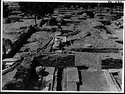
| Well in East Colonnade of Roman House H. Diameter 0.80m, lined with field stones set in mortar. used as a cistern as well.
No useful pottery dates. Capital from colonnade A 3866 and part of shaft found ... 29 July 1970 ... Capital from colonnade A 3866 and part of shaft found at 2.50m-3.00m, indicating destruction of house (late 6th, 580's by Slavs). Three marble heads found at -4.65m to -5.25m suggest change from Pagan to Christian in early 6th c. A.D. (ca. 529 A.D.).
See also Q 21:4 from same house. Marble heads (S 2354-2356) deliberately discarded before house went out of use. |
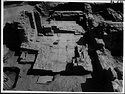
| Well in West Colonnade of Roman House H. Covered by a large handsome marble well-head, apparently reused. Cut through bedrock. Diameter ca. 1.20m, water at -3.60m.
Two distinct POU fills. One at ca. -4.50m ... June-August 1970 ... Well in West Colonnade of Roman House H. Covered by a large handsome marble well-head, apparently reused. ... One at ca. -4.50m to -4.75m dating to the 7th c. A.D.. probably to be associated with the reoccupation of Roman House H by squallers, the other at -6.30m to -6.75m of the 6th c. A.D., reflecting period of use of the house. |
Fillings associated with early houses on the lower north slopes of the Areopagus; various levels and dates.
Both houses were built in the 6th century B.C. and destroyed by the Persians; both also have ... 6rd c. B.C.-3rd c. A.D. |
| Well in Room 7 of Roman House H, partially covered by caldarium of added bath complex (Room 6). Stone well-head; 0.85m in diameter. Stpped because of danger of collapse. Cut through bedrock, water from ... 6th c. A.D. |
|
|