|
|
Middle Stoa Building Fill.
Cf. also H-I-J 14-15, H-K 12-14 (ask SIR) (unsolved)
This deposit is not definitive and must be considered with the above deposits before details are entered into database; ... Before ca. 150 B.C. |
Well at 35/ΛH. In the northern part of the market square, north of the altar of Ares. Stony fill with late Geometric sherds. Not dug ... Late 8th century B.C. |
A deep pit in bedrock over mouth of well. Context archaic, 6th c.
B.C., but with some traces of later disturbance. Found a circle for a well at the bottom, much water, no sherds.
Lay 2.20m south of Well ... 6th c. B.C. |
It seems likely that the well was never used due to poor quality of rock. Uniform fill of collapsed bedrock ... 650-625 B.C. |
| N.A. Doenges Evelyn Lord Smithson ... "Near or in Grave" (width 0.50m)
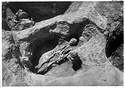
Grave to the east of the southeast corner of the great court of the Gymnasium. Shallow and superimposed on Well N 11:5. It is a simple cist oriented north and south, with ... 750-725 B.C. |
| Eugene Vanderpool ... Grave. Roughly circular pit with scraps of bone and traces of carbonized material. Four similar empty pits nearby with a little Geometric pottery ... Early Geometric |
Well E (diameter 1.10-1.20m) just outside the northwest corner of the southwest Fountain House.
Dug initially as a pit (J 15:2) partially covered by an early Roman wall ... Early 7th c. B.C. |
Located in the NE corner of the early peribolos. Probably originally 1.00-1.50m. deeper, the bedrock above having been cut back in late times. Scanty pottery remains; some evidence for a period of use ... Ca. 600-570 B.C. |
|
|