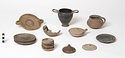
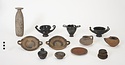
|
|
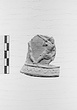
| Two youthful heads with wreaths, joined by some uncertain object between. Heavy ringlets below wreaths.
Broken off at necks; features much worn.
White with traces of pink in flesh.
Pinkish-buff clay. Komos ... May 1947 |
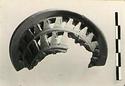
| About half of lower part preserved. Two rows of triangular cut out openings and beginning of a third. Glazed once, as traces of light red glaze show. Fill over stepped retaining wall. 2090 Leica, 87-254 ... 25 April 1953 |
| Miniature bowl with incurving rim; tapering to foot. Single horizontal handle. Handle broken away. Base chipped.
Attic clay. Cloudy glaze laid on knife-finished surface. Well. Leica, 81-267 ... 18 April 1932 |
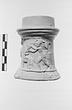
| Three joining fragments preserve part of a hollow stand, probably from a shape such as P 15163 (ΕΕ 196). In relief on wall, lower part of seated figure, right, then a nude figure, left, and a heavy-armed ... 15 May 1939 |
| Nine joining fragments give rather more than half, but in a very fragmentary state; one small piece (of the upper moulding) does not join. Restored in plaster. The profile is complete. Small cylindrical ... May 1939 |
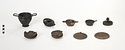
| Pyre in House T, Room 1, Layer 5-6 (RSY=Pyre 3) in the industrial area west of the Areopagus.
First quarter 4th. c. B.C.
Artifacts, bone, and cinders in pit in floor sequence. The pyre was found in digging ... 400-375 B.C.(?) |
| Pyre in Room 1, area west of street (RSY=Pyre 11).
Early in the third quarter of the 4th. c. B.C.
In courtyard. Artifacts, bone, and cinders in irregular pit in floor sequence. The pit had been dug into ... 350-330 B.C. |
| (RSY=Pyre 2). Pyre in the industrial area west of the Areopagus, in House B. In northern corner of room. No pit discerned. A deposit of small stones (a marker/) lay 0.30m above the level of the pyre, ... Third quarter of the 4th. century. |
|
|