|
|
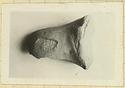
| Shortish and twisted upper part.
Impression in form of losange with eight-pointed star in middle. Incomplete to left and below.
Cf. Dumont (1872), pp. 199, 342 and perhaps p. 287, no. 99, for Euphranon ... 4 March 1933 |
| Typical shape.
Typical clay.
Impression incomplete above and below, espercially to left; left end broken away.
This combination is given in Dumont with trident and several other marine attributes. The ... 16 February 1933 |
| Knidian shape.
Knidian clay (yellowish).
Impression incomplete above and below, and a little broken away left end.
Thrason occurs with trident; cf. Dumont (1872), p. 260, nos. 84-85 and 88. This particular ... 27 February 1933 |
| Broken all round. The outside black glazed, the inside chocolate brown.
To the left, nude standing figure, head and shoulders missing; to the right a woman in long chiton beyond her a long-legged water ... 18 February 1933 |
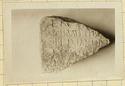
| Inscribed fragment.
Left side rough picked, and back smooth preserved. Other edges broken.
Remains of six lines of the inscription.
Pentelic marble. Found in late Roman to Byzantine context, south of the ... 2nd. century A.D. |
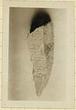
| Part of back surface dressed smooth preserved; edges broken.
Remains of nine lines of the inscription.
Pentelic marble. Found in a late Roman context, just east of the Tholos. Leica ... 3 March 1933 |
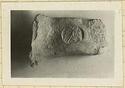
| Shape look Knidian.
Clay look Knidian; russet with gray core; porous and full of bits, and slightly micaceous particularly on the surface which may be a slip.
The impression is circular but the letters ... 11 February 1933 |
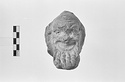
| The edges broken, the plain back preserved; the head complete save for chips. Wrinkled brow; large mask-like mouth, broad flat beard.
Coarse red clay, fired gray at surface. Disturbed area. Leica, 93-61-20 ... 25 February 1933 |
|
|