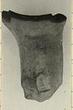
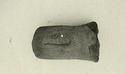
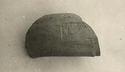
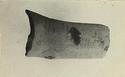
|
|
| Level, broad, start of right angle curve.
Coarse clay; grey at core.
Impression incomplete below; much worn. Publ: a worse ex than TD 6862 (VG)* Lowest red stratum. Ἐπὶ Ξενο[κλ]έ
ο[υς Ἀ]θα[ν]οκ
ρί[του ... 1 March 1932 |
| Slightly rising; broad, ribbed, broken at curve.
Coarse clay; red, grey at core; light slip.
Impression incomplete above an d below; retrograde. Dte: 188--167 BC (VG, v.62)* Lowest stratum. [Ε]ὐ̣κ̣ρ̣ ... 188-167 B.C. |
| Rising; angular.
Buff clay, red at cote; traces of cream slip. Surface including breaks blackened; much damaged.
Doubled impression, flaked off left end. Stp: doubled*Dte: 3/4 3c BC (VG v.62)* Lowest ... Third quarter of 3rd century B.C. |
| Broad, arched.
Rather coarse clay; cream surface, red just beneath; distinct gray core.
Indistinct impression from wear. Dim: W 0.037* Μενιπ( (Ν retr) Leica ... Late Hellenistic |
| Typical, junction with neck not preserved.
Typical clay.
Right end of the impression broken away; worn down middle. Par: bet ex BSA H69(VG)* Ἐπὶ Εὐφράν̣[ορ]
ος Εὐβουλί
δα Κνί al-
διον tar
(Σ lunate) ... 11 March 1932 |
| Small lagynos handle, broad; slightly rising; curves far from body; broken at curve.
Medium fine, light red clay; cream slip, thick on top.
Shallow impression; chipped at left end. Rdg: originally read ... 29 February 1932 |
| Broad, level, ribbed, right angle curve close to neck.
Coarse clay; red with large grey core; traces of light slip.
Impression shallow set, incomplete above and below; high relief letters somewhat chipped ... 1 March 1932 |
| Broad; ribbed, slightly arched, broken at curve.
Coarse clay; red, light slip.
Only top line complete. From Hellenistic deposit. Ἐπινικίδα
Ἀθην[αίου] clus-
Κ̣ν̣[ίδιον] ter r. Leica ... Ca. 300-100 B.C. |
|
|