|
|
| Badly battered, especially the heads. Much of the bottom broken away, but the full height preserved.
Three female figures, three Hekate, in long chitons stand with their backs against a central pillar ... 1st c. A.D. (?) |
| Nozzle broken off.
Wavy lines on rim.
On discus, rows of small gouges radiating from filling hole, very faint.
Handle solid, with two grooves above and below.
A broad deprsession at neck of nozzle.
On ... 8 March 1933 |
| Fragment from rim and body. From a large lamp.
The rim is plain, with a broad panel, on which is an owl, in relief, left, the head facing.
Traces of a thin red wash (?).
Light red clay.
Type XXVIII of ... 9 March 1933 |
| Top part.
All of the lower part of the lamp is missing, save a little near the nozzle.
On rim, debased herringbone, very faint.
On discus, a cross (?), very faint indeed; filling hole between the arms ... 15 March 1933 |
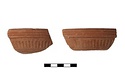
| Two pieces of rim and wall virtually to missing foot, with edge of floor above on fragment a. Very worn.
Form 84, rather small version. One/two lines of coarse rouletting on wall, the normal two grooves ... 23 March 1933 |
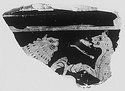
| Fragment from the lip of a large open vase. Rim flat on top and projecting outward. A handle(?) formerly attached to the top of the rim, broken away. On the exterior, below an irregular reserved line, ... 21 July 1933 |
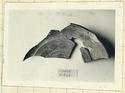
| Part of P 1521. Late Roman A plate fragment mended from five pieces. A bit of the rim and about one-third of the bottom of the plate preserved. Low ring foot; curving sides; downward rim with two grooves ... Card: ca. 440-500 A.D. |
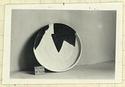
| Late Roman B plate fragment. Mended from six pieces; restored in plaster. Possibly one-third of the plate is preserved. Ring foot edged by grooves; very flat sides; vertical rim with two grooves on outside ... Card: ca. 430-475 A.D. |
|
|