|
|
Well at 112/Ν.
Shallow well with a short period of use. The scattering of fragments in the upper dumped filling is consistently earlier. Lot Τ 12 (all sherds saved) and Lot Τ 13a (Dirt Pile) ... 520-500 B.C. |
Well at ΜΣΤ,ΜΗ/112. Collapsing bedrock prevented us from reaching bottom. Not A. Walker but same scenario ... 7th-Mid 6th c. B.C. |
Just east of Building II near its south end. The tiles were in place.
Upper filling (to 3.00m.) of Hellenistic-Byzantine dump all discarded.
POU fill a gradual accumulation of typical Justinianian ware ... 6th c. A.D. POU-7th c. A.D. |
Well at 115/ΜΘ.
Careful stone curbing around the upper walls, the presence of footholds in the sides, an adequate water supply and the fragments of a terracotta well-head in the filling indicate that the ... 600-550 B.C. |
Well at 123/ΝΑ.
At the bottom a few water jars; above , a dumped filling with a small amount of pottery; at the top supplementary fill with scattered sherds.
POU, ca. 500 B.C.
Dumped filling, of ca. 500 ... 6th c. B.C. |
Outside the market square, near the southeast corner, on the south edge of the east-west road, where it passes to the south of the Mint.
There is no doubt that the pottery from the well is "stratified" ... Early 1st to 6th c. and of 8th c. A.D. |
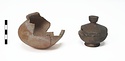
| Disturbed pyre containing only a pyxis and a chytridion.
No notebook account of excavation exists. The pyre may have been located at the edge of an ancient road. There is no record of bone or burning ... 350-325 B.C. (?) |
First trial east Stoa colonnade, N. of S. wall III, layer 12.
Note quantities of cattle bones, the knuckles sawn off and many worked bits. Evidently a bone implement factory near by. [nbp. 2139] Coins: ... Late 3rd c.-earliest 4th c. A.D. |
|
|