|
|
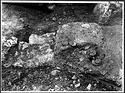
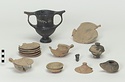
| Pyre 1 in Central House, Room XI, strosis 3. Sacrificial pyre with characteristic small vases amid carbonized twigs and bone.
Near north side of courtyard. This pit was cut slightly into strosis 3 (lot ... 1st quarter 4th c. B.C. |
| Pyre 2 in Central House, Room X, under strosis 9. Signs of burning, carbonized food, animal bone.
In room south of courtyard. concentration of artifacts, bone, and charred material in floor makeup, no ... 290-275 B.C. |
Fillings associated with early houses on the lower north slopes of the Areopagus; various levels and dates.
Both houses were built in the 6th century B.C. and destroyed by the Persians; both also have ... 6rd c. B.C.-3rd c. A.D. |
Rectangular pit at 54/ΛΓ.
The pit's plan is irregular; its measurements approximately 2.00x1.10x1.15m. The wall foundations run a little over a meter deep at 53/ΛΓ-ΛΕ, consist of irregularly shaped and ... Ca. 450-425 B.C. |
Geometric Pit 58/ΛΒ.
It was started as a well, but after 2 meters crumbling bedrock must have discouraged the diggers. It produced only a few sherds, all of which were kept ... Geometric |
Hellenistic construction fill mainly of amphoras used as packing between well tiles and bedrock. Estimated Grid ... 1st c. B.C. |
Estimated Grid ... 2nd c. A.D. |
Tomb at 53-54/ΛΕ-ΛΣΤ-ΛΗ (Late Roman), on the lower north slope of the Areopagus Nb. says ΛΕ-ΛΗ. Deposit list and deposit DB say: ΛΕ-ΛΣΤ ... 350-400 A.D. |
|
|