|
|
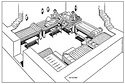
Exploration in the peristyle of the Heliaea (1960); evidence for rebuilding in the third quarter of the 4th c. B.C. with some disturbance as late as 1st-2nd c. A.D. Date of reconstruction ca. 325 B.C ... Ca. 350- 325 B.C. |
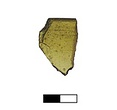
| Two fragments of rim and wall of a deep bowl.
Grooved inside, near rim.
Amber glass. Agora sample no. 310. Central House, room X, cleaning debris over polygonal E.W. wall.
Late 2nd c. B.C. 1152 Leica PD ... 11 March 1957 |
| Rim and wall fragment.
Double groove near rim.
Yellow-brown glass. Central House, room X, cleaning debris over polygonal E.W. wall.
Late 2nd c. B.C. Leica PD 2023-4 ... 11 March 1957 |
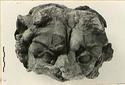
| Two joining fragments preserve a large lion's head spout which has the lower jaw, right ear and much of the nose missing. Traces of color in the eyes; a red pupil, surrounded by yellow; inside of the eyelids ... 4 August 1966 |
| Commercial, Civic Unknown Reused Material, Mudbrick Fair, foundations and walls up to a meter high ... 450-400 B.C. |
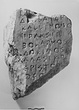
| Inscribed fragment.
Broken on all sides.
Three lines of the inscription preserved and traces of a fourth above; stoichedon.
Pentelic marble.
ADDENDA With EM 10235.
Transferred to the Epigraphical Museum ... 5th. century B.C. |
| Inscribed fragments.
Fragment Ι 405 a), the rough picked back preserved; other edges broken.
Inscribed stoichedon.
One uniscribed fragment may belongs with fragment a).
Fragment Υ 15 b), belongs with ... 5th. century B.C. |
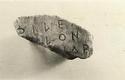
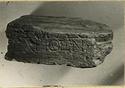
| Inscribed fragment of dedication base.
Inscribed face only preserved.
Two lines of the inscription preserved.
Hymettian marble.
Roman Imperial period. Found in modern context in the house 639/15, south ... 15 February 1947 |
|
|