|
|
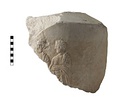
| Part of the shoulder and wall preserved, with part of two draped bearded figures in low relief.
The figure to the left (head and shoulder only) faces forward, the one to the right, preserved to below ... 10 February 1933 |
| Rather small but in other respects resembles Knidian.
Clay russet to gray, with traces of probable slip.
Impression incomplete above and below, and very faint and shallow, but unmistakeably another from ... 10 February 1933 |
| Mended from three pieces. From the lower wall of a small but thick-walled open vase. Above two horizontal reserved lines is the outstretched foot of a seated figure with part of the rock(?) on which he ... 10 February 1933 |
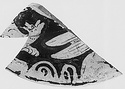
| The larger fragment preserves part of the overhanging rim, with large egg and dot pattern. On the top are, at the left, the forepaws of a seated panther(?), next, a plant conventionalized to a spiral, ... 9 February 1933 |
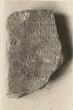
| Fragment of inscribed stele.
Rough picked behind; the edges broken.
Parts of thirteen lines preserved, stoichedon; fifteen letters to 0.20m.
Fragment mentioning trieropoioi.
Pentelic marble.
Transferred ... 5th. century B.C. |
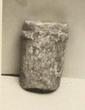
| Columnar grave monument.
The top is missing with the ring, broken off at upper edge of first line of inscription. Part of one side has split away but is preserved and joins.
In the present top surface ... 10 February 1933 |
| Columnar grave monument.
The bottom broken off and the column split in half.
Ring damaged but in part preserved.
Remains of an inscription in three lines.
Hymettian marble. Found in late context, west ... 10 February 1933 |
| Inscribed fragment.
Left edge and part of rough picked back surface preserved. Other edges broken.
The left end of thirteen lines preserved.
Hymettian marble.
ADDENDA Joins with I 3240. Found in a modern ... Late 2nd. or 3rd. centuries A.D. |
|
|