|
|
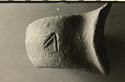
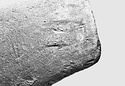
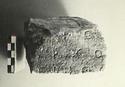
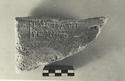
| Inscribed fragment.
Original rough picked back and inscribed surface preserved; broken elsewhere.
The letters follow a curved line.
Below second line of letters the same curve can be followed, below which ... 4th. century B.C. |
| Brown clay, containing much coarse grit. Stored with ἀγνωστα.
Dim: W 0.052*Rdg: prhps %tri?* Propylon, drain cut, disturbed surface. Δ Leica ... 5 April 1935 |
| Dolphin right.
Early Thasian. Dte: prhps Period I(VG 19.xi.52)*
Par: closely resembles type of =DAMASTHS-DEWFANHS=, but is apptly not
the same? (cf =O= before =L=)(VG)* Finished Disturbed area. [Θ]ά̣σι̣ο̣[ν] ... 5 April 1935 |
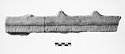
| Inscribed fragments.
Back and both sides broken, under surface worked, though unevenly; apparently the projecting crowning moulding of a stele.
Fragment from monument which apparently represents in miniature ... (Ε 83) 9 February 1932
(Ε 444) 6 April 1935 |
| Wall from hemispherical bowl with out-turned lip.
Slight ridge below lip and on lower side wall.
Thin light blue-green glass. Early Roman (?) A storage mount was made for the piece consisting of a plastic ... 8 April 1935 |
| Inscribed fragment.
Inscribed face and back preserved; elsewhere broken away.
A protuberance from the upper part of the block has been broken away also.
Eleven letters remain.
Hymettian marble. Found in ... 5 April 1935 |
| Inscribed fragment.
Inscribed face and back preserved.
Two lines of the inscription preserved.
Pentelic marble. Found in late Roman context, over the central part of the Odeion. Leica ... 6 April 1935 |
| Inscribed fragment; twice used as Ionic capital.
Originally the crowning block of a small monument or stele, on the front face the projecting moulding is preserved, and below a curved line marking the ... 2nd.-3rd. centuries A.D. |
|
|