|
|
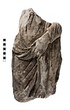
| Back rough-picked, the other sides broken. Figure preserved from below breast to knees, right arm missing. Figure thinly draped and wrapped in himation held at hips with left hand. On the right breast ... 4 April 1932 |
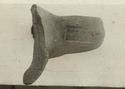
| Broad, widens to neck; start of right angle curve. Part of rim preserved.
Comparatively fine clay; red, grey core; buff surface with thin traces of slip.
Impression with slightly incomplete right end; ... Hellenistic |
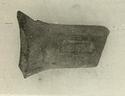
| Large, distinctly twisted; otherwise typical.
Typical clay, baked yellow at surface.
Left end of the impression broken away; incomplete above. Bottom of Hellenistic fill. Σ̣κ̣ι̣ρ̣ boukra- τοῦ
Κνί nion ... Hellenistic |
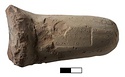
| Large; broken at curve which is close to neck.
Coarse, micaceous buff clay.
Shallow impression; rather careless. Par: SS 00018(VG)* Hellenistic level. Φ horizontal? Leica ... Hellenistic |
| Shape resembles typical Knidian; broken at curve.
Dark reddish-yellow clay; greyish at core; thin slip.
Small impression shallow; letters nearly worn away; trident right. Msc: prob from jar dated in ... 4 April 1932 |
| Knidian type; broken before curve.
Coarse, greyish-red clay, yellow at surface; traces of slip.
Left end of the impression broken away; incomplete below; worn. Retrograde. Ἐπὶ Σωκρά(τευς)
φρουράρχο[υ] ... 4 April 1932 |
| Broad, broken at curve close to neck.
Coarse red clay; traces of light slip.
Impression set violently, so as to be incomplete below and present a marked curve; left end broken away. Msc: prob from jar ... 4 April 1932 |
| Rising, angular.
Fairly fine, reddish-yellow clay; cream slip; surface including breaks speckled with black; traces of burning(?).
Left end of the imp;ression wanting due to surface breaks; shallow and ... 4 April 1932 |
|
|